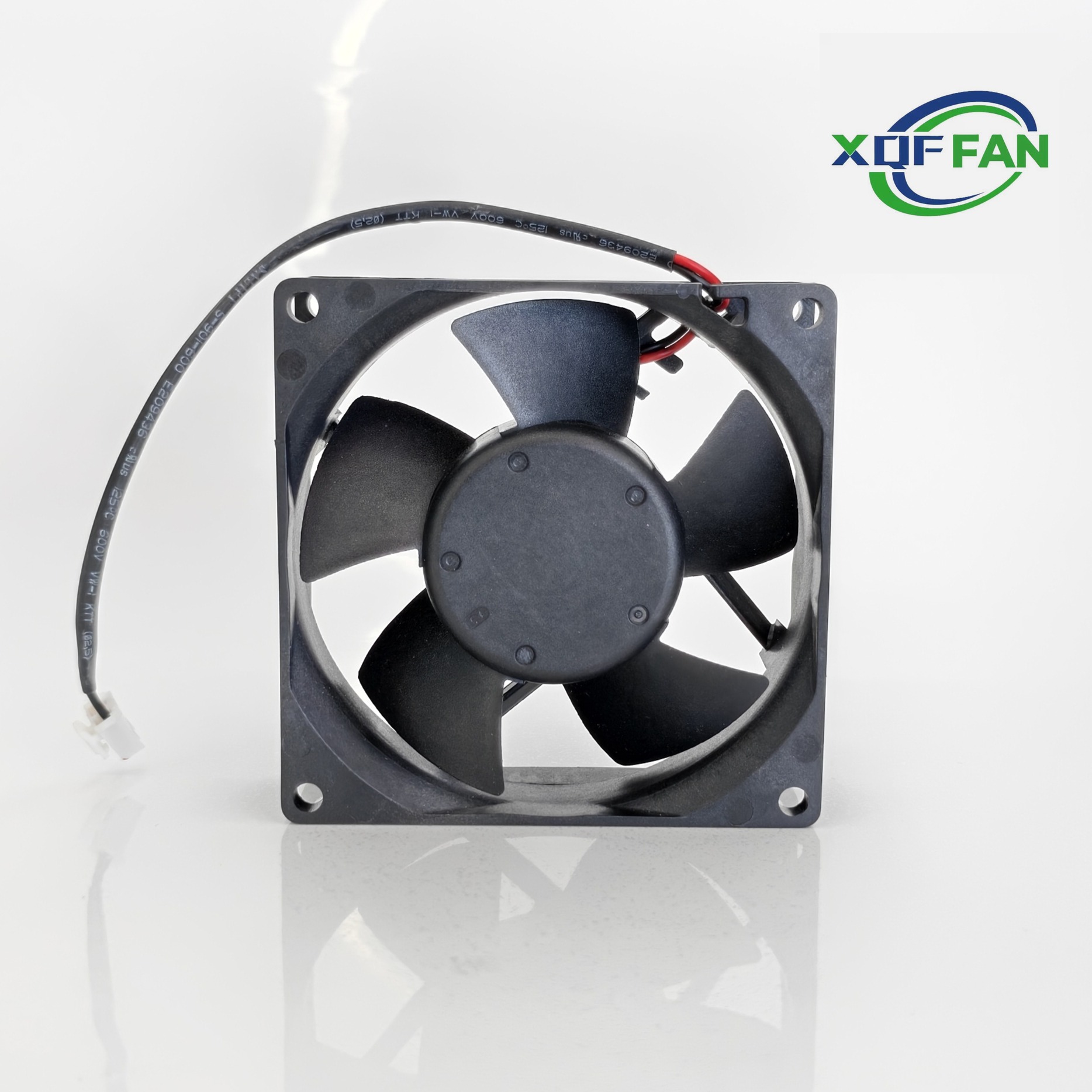

Cooling Fan Bearing Types-Sleeve vs. Ball Bearing
Cooling Fan Bearing Types: Sleeve vs. Ball Bearing
Fan bearings affect lifetime, noise, installation orientation and cost. Selecting the right bearing is important for industrial cabinets, servers, power supplies and outdoor equipment.
Sleeve bearing fans
A sleeve bearing supports the rotating shaft with a lubricated sleeve. It is often economical and can be quiet in clean, moderate-temperature, lower-duty applications. Its life can be more sensitive to heat, lubrication loss and installation orientation.
Ball bearing fans
A ball bearing uses rolling elements and is commonly chosen for continuous operation, higher temperature, vibration or demanding mounting orientations. It may cost more, but can offer better durability in harsh industrial use.
Comparison
| Factor | Sleeve bearing | Ball bearing |
|---|---|---|
| Cost | Often lower | Often higher |
| Heat and continuous duty | Best for moderate conditions | Often better for demanding duty |
| Orientation | May be more sensitive | Usually more tolerant |
| Vibration | Application dependent | Often preferred in harsher equipment |
How to choose
Start with inlet-air temperature, daily operating hours, orientation, vibration, accessibility and the consequence of failure. Compare the stated life rating at its specified temperature; do not compare lifetime figures without checking test conditions. Also consider dust, moisture and IP protection—bearing choice alone does not protect the motor or enclosure.
FAQ
Which bearing lasts longer?
It depends on the exact design and environment. Ball-bearing fans are commonly selected for high-temperature, continuous-duty or vibration-prone applications, but the supplier's stated rating and application test should guide the decision.
Can I replace a sleeve bearing fan with a ball bearing fan?
Usually only after confirming voltage, dimensions, airflow, pressure, connector, control signals and noise.
Conclusion
Choose sleeve bearings for suitable cost-sensitive, moderate-duty applications; choose ball bearings when operating temperature, uptime, orientation or vibration demands greater robustness. Validate the selected fan in the finished equipment.
Cooling Fan Noise Reduction Guide- Quieter Industrial Thermal Design
24V DC Cooling Fan Selection Guide
Related Article