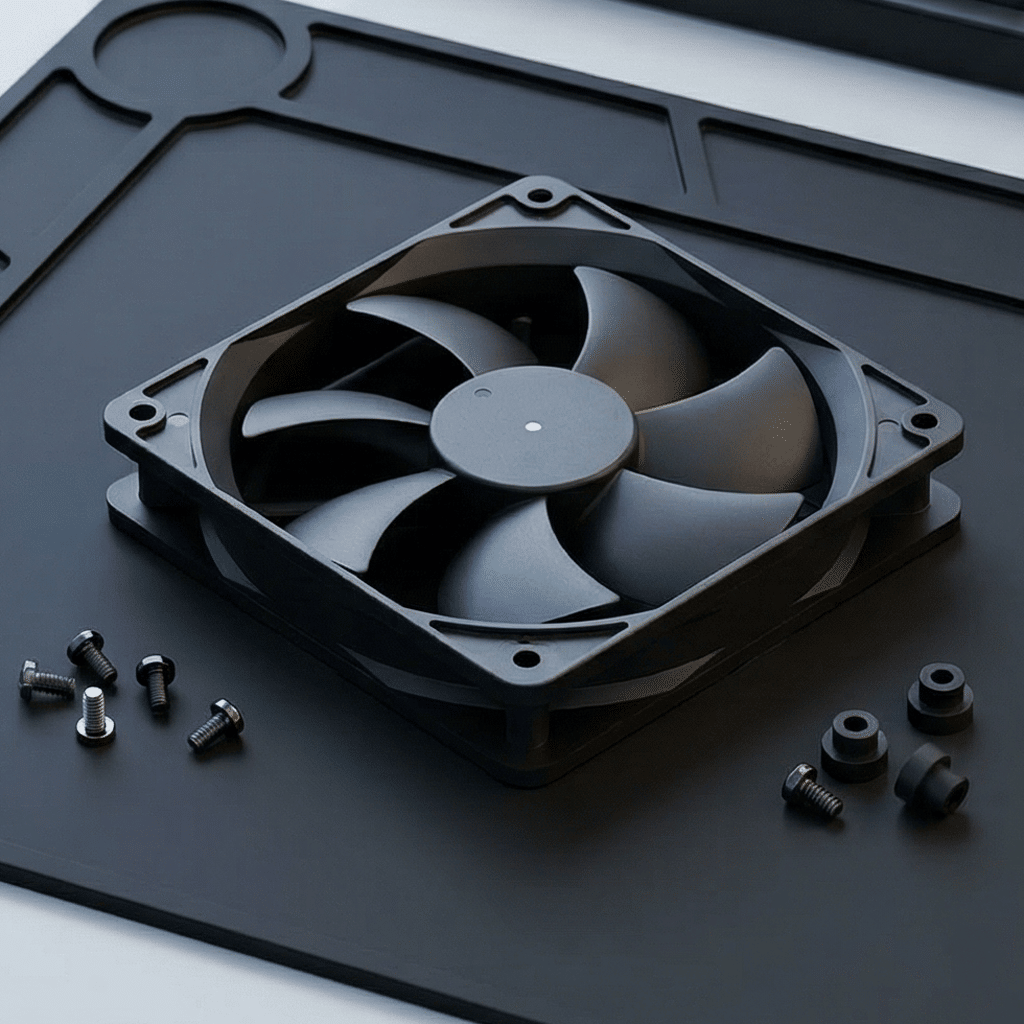
EC Fan vs DC Fan: How Do You Choose the Right Cooling Fan?

EC Fan vs DC Fan: How Do You Choose the Right Cooling Fan?
Choose an EC fan when the application needs wide-range speed control, integrated electronics, advanced monitoring or communications, and energy performance across changing duty points. Choose a compact DC fan when the equipment provides a suitable DC supply, the control requirement is simpler, and the specific fan meets airflow, static-pressure, reliability, acoustic and protection requirements. “EC” and “DC” are not interchangeable labels: EC describes an electronically commutated motor system with electronics, while compact DC fans are commonly brushless DC products powered by a DC supply. The data sheet for the exact part number—not the category name—determines voltage range, control input, alarm outputs and environmental ratings.
Start with the actual operating point: airflow and pressure after filters, grilles, heat sinks and ducts are installed. Then compare electrical input, speed-control range, connector and signal requirements, fault behavior, EMC needs, service access and total installed cost.
What Is the Practical Difference Between an EC Fan and a DC Cooling Fan?
An EC motor is an electronically commutated permanent-magnet motor with integrated control electronics. In industrial applications, EC fans can offer speed command, alarm, tachometer, analog, PWM or bus communications depending on the model. ebm-papst’s technical FAQ lists PWM, analog, 0–10 V, 4–20 mA and Modbus as possible options on EC and DC products, while confirming that options vary by part number.
A compact DC fan normally uses a DC input such as 12 V, 24 V or 48 V and electronic commutation. Many models offer tachometer, PWM input or alarm output, but the allowed control method and speed range must be verified in the data sheet. ebm-papst notes that supply-voltage control on suitable DC fans is generally narrower than a dedicated speed input.
| Selection factor | EC fan | Compact DC fan |
|---|---|---|
| Power arrangement | Integrated electronics with application-specific input | Typically uses available regulated DC supply |
| Speed control | Often wide-range and command-driven | Model-specific PWM, analog or voltage control |
| Monitoring | May include alarms, feedback or communications | Often tachometer or basic alarm on suitable models |
| Critical check | Input, control, EMC and protection requirements | Voltage range, current, control circuit and pinout |
How Should Energy Efficiency Affect the EC vs DC Decision?
Compare energy at the required duty points, not only at full speed. AMCA’s wire-to-air approach treats fan, motor and control as one system because all influence electrical input. Its Fan Energy Index discussion says speed control can provide meaningful part-load savings even though a controller imposes a full-load efficiency penalty.
EC technology is commonly selected for efficient, variable-speed operation. ebm-papst describes its EC motor as electronically commutated permanent-magnet synchronous technology and says continuously variable speed can reduce part-load fan noise. These are manufacturer statements for its EC products, not a substitute for comparing tested input power, airflow and pressure at the same operating point.
Do not raise fan speed simply to hide poor ducting. AMCA reports that a 10% speed increase can produce a 33% increase in energy consumption under the cited fan-law relationship. Improve inlet and outlet geometry and remove avoidable restrictions before increasing speed.
Which Control and Monitoring Features Should You Specify?
Specify the control function rather than assuming it is standard: required speed range, signal type, logic level, startup behavior, minimum safe speed, tachometer scaling, alarm state, connector, cable length and fault response. If the equipment controller expects 0–10 V, Modbus or PWM, the chosen fan’s data sheet must explicitly support it. PWM capability does not automatically mean support for every frequency or interface arrangement.
For EC fans in networked or industrial equipment, communications and closed-loop feedback can decide the selection. ebm-papst explains that some larger EC fans can use integrated PID control with sensor inputs. Confirm the exact model, firmware, parameter access and commissioning process before release.
- Define thermal duty, ambient range and required airflow/static-pressure point.
- List power input, supply variation and inrush-current constraints.
- Specify command signal, feedback, alarm logic and safe-state behavior.
- Confirm protection class, operating temperature, EMC and connector requirements.
- Validate airflow, component temperature, noise and control response in the final assembly.
How Do Airflow Path and Environment Change the Selection?
Motor technology cannot compensate for an inadequate air path. Filters, dense heat sinks, narrow louvres, cable bundles and grilles increase resistance and reduce actual airflow. Select from the published fan curve at the expected installed pressure, then test with the actual enclosure. The same fan can perform differently when inlet clearance, outlet obstruction or supply condition changes.
Also review ingress protection, contamination, vibration, condensation, altitude and service access. ebm-papst states that fan operation above 2,300 m needs individual review in its FAQ. Treat this as a model-specific design-review trigger, not a universal approval threshold.
What Tests Should Approve an EC or DC Fan Selection?
Test a representative unit at maximum thermal load and the least favorable allowed ambient condition. Record supply voltage, current, control input, speed, inlet temperature, hot-spot temperature, outlet temperature and noise where relevant. Repeat at normal and minimum controlled speed and with the filter state that represents the intended service interval.
Test safe fault behavior, including fan-disconnect detection, restart behavior and control-signal loss. For EC products, verify communications and configuration. For DC fans, verify supply tolerance, polarity-protection provisions and controller compatibility. Keep the part number, configuration, enclosure revision and test setup with the approval record.
References: AMCA—EC fan-array technology; ebm-papst FAQ; ebm-papst EC technology; AMCA—Fan Energy Index; AMCA—System effect.
Frequently Asked Questions
Is an EC fan the same as a DC fan?
No. EC refers to electronically commutated motor technology with electronics, while compact DC fans are generally powered from a DC source and can also use electronic commutation. Input power, control interface, size range and features depend on the exact model.
Does an EC fan always use less energy than a DC fan?
No. Energy depends on airflow, static pressure, motor/control efficiency, speed, supply conditions and duty cycle. Compare tested electrical input at the same required operating point. Integrated variable-speed control can be valuable when thermal demand changes.
Can I control any DC fan by changing its supply voltage?
No. Use only the voltage range and method stated in the data sheet. Some DC fans permit limited voltage control, while others require a dedicated PWM or analog input. Exceeding the allowed range can cause improper operation or damage.
What data should I request before buying an EC or DC fan?
Request the performance curve, input-voltage range, current and inrush data, speed-control specification, feedback and alarm definitions, acoustic data, operating-temperature range, protection rating, drawing and connector pinout. Validate the exact part in the final equipment.
How Do You Choose a Cooling Fan by Static Pressure and Airflow
Related Article