How Do You Set Cooling Fan Airflow Direction in Electronic Equipment?
How Do You Set Cooling Fan Airflow Direction in Electronic Equipment?
Set cooling fan airflow so cool supply air reaches the highest-heat components first and hot air exits without returning to the intake. Verify the airflow arrow molded on the fan frame, not the visible blade shape. Then select the fan at the installed pressure–airflow operating point, keep the inlet and outlet clear, and test the finished enclosure for temperature and recirculation. AMCA identifies inlet/outlet obstructions, swirl, and poorly configured ductwork as common causes of system effect that reduce installed fan performance. AMCA system-effect guidance
How can you identify a fan's airflow direction?
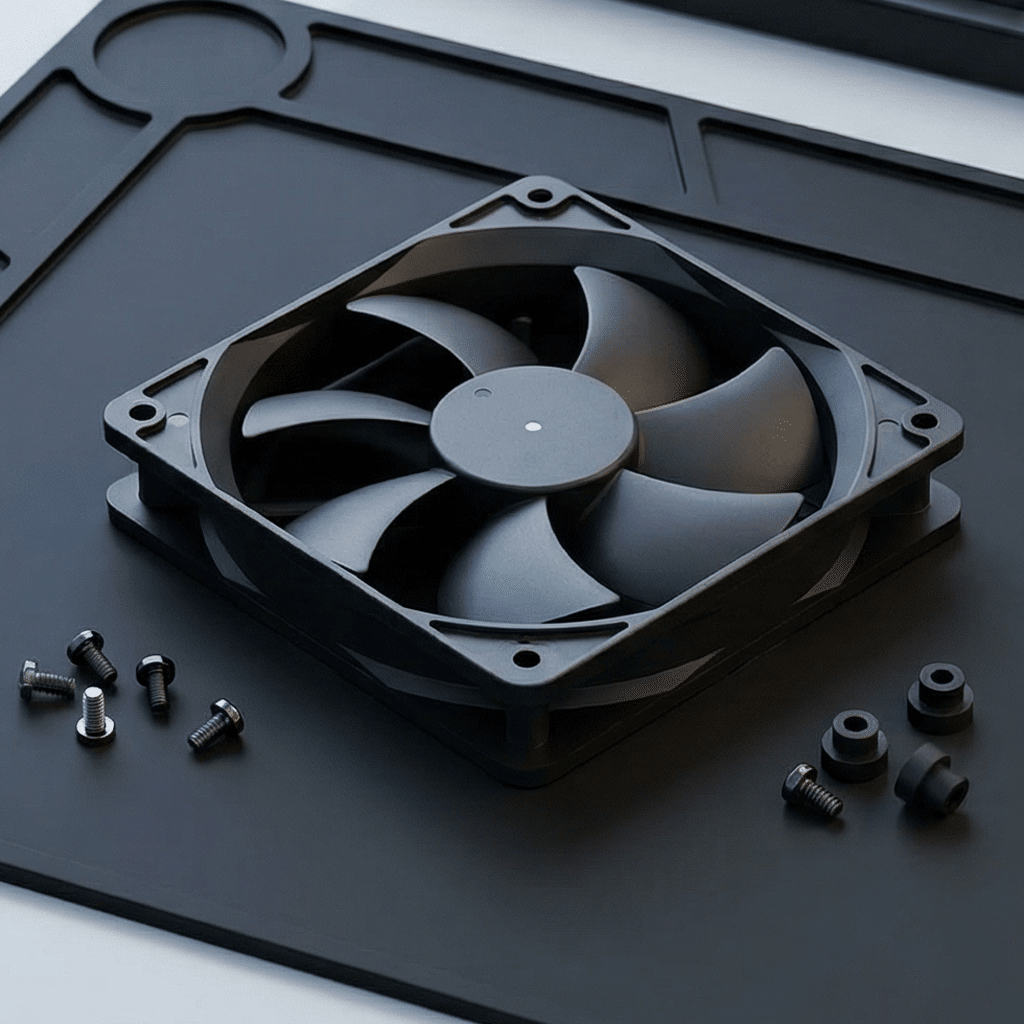
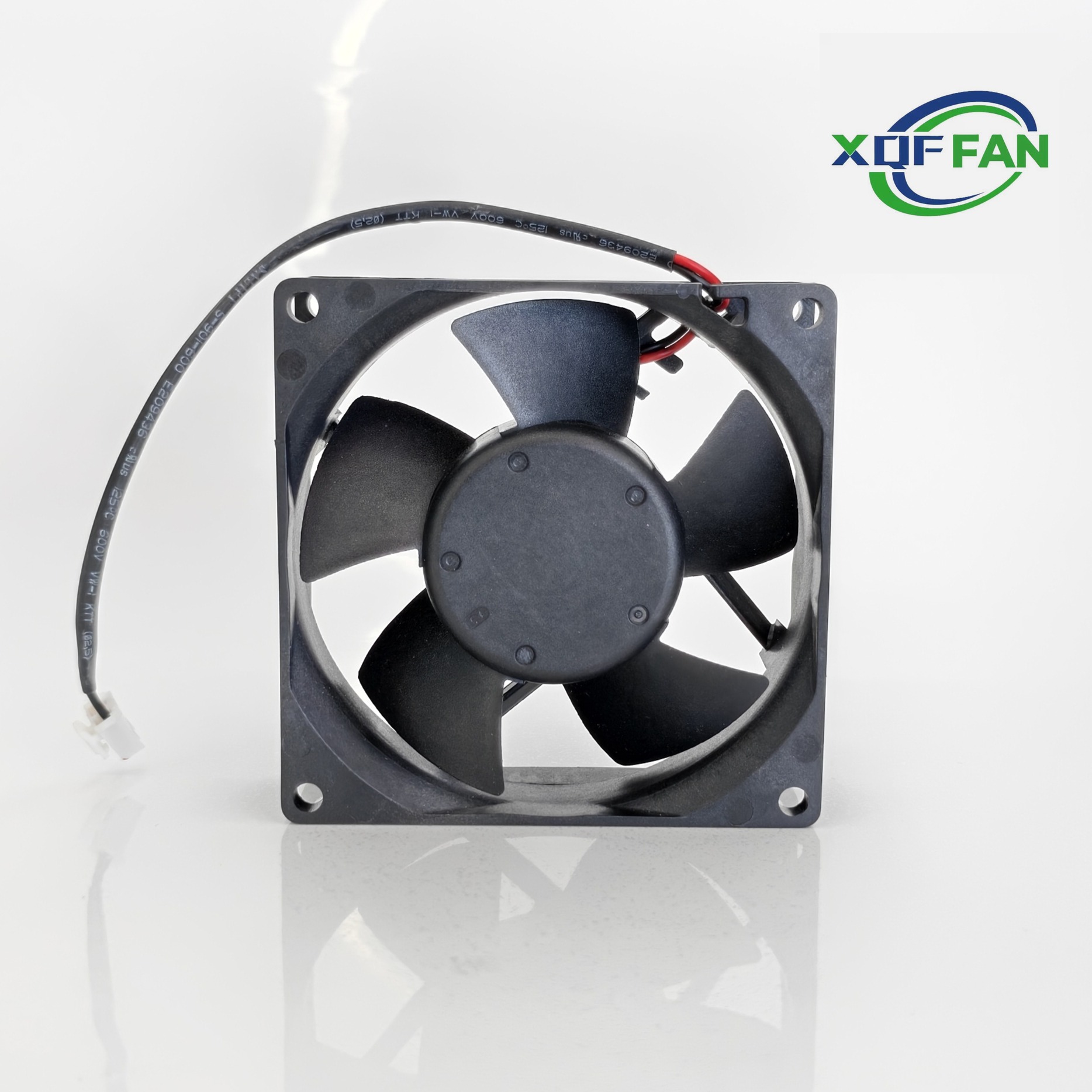
Most axial and centrifugal cooling fans show two molded arrows on the frame: one identifies blade rotation and the other identifies airflow direction. Follow the airflow arrow. Do not infer direction from the apparent curve of the blades, because frame orientation and fan construction can be misleading. The fan datasheet, mechanical drawing, or manufacturer marking is the final authority. An ebm-papst operating drawing, for example, labels the airflow direction explicitly. Example manufacturer drawing
For a typical axial fan, air enters from one face and exits from the opposite face parallel to the motor axis. A blower generally takes air in near the impeller center and discharges it through a side outlet. Before final assembly, run the fan briefly with a safe low-voltage test setup or use a paper strip at the opening to confirm the intended flow path.
Should a cooling fan be installed as intake or exhaust?
Neither position is universally better. The correct arrangement creates one intentional path from a cool inlet through heat-generating components to a hot outlet. Intake fans can deliver cooler air directly to a critical heat sink or battery module. Exhaust fans can pull air across a full enclosure and may simplify dust-filter placement. The choice should be made after mapping hotspots, openings, cable paths, filters, and service access.
| Arrangement | Useful when | Design check |
|---|---|---|
| Intake fan | Cool air must reach a localized hotspot first. | Filter the inlet and avoid nearby exhaust recirculation. |
| Exhaust fan | Air should be pulled through an enclosure from a controlled inlet. | Confirm the inlet area does not restrict flow. |
| Push-pull path | Long, dense, or high-resistance equipment needs controlled through-flow. | Match fans and prevent bypass around the load. |
For data-center racks, ASHRAE recommends using blanking or filler panels in unused openings to avoid bypass and recirculation. The same principle applies to compact industrial enclosures: unplanned gaps can let air avoid the components it needs to cool. ASHRAE data-center airflow guidance
Why does airflow recirculation cause overheating?
Recirculation occurs when hot exhaust air returns to a fan inlet instead of leaving the equipment. The fan continues to turn, but inlet temperature rises and the available temperature difference for cooling falls. Common causes include adjacent inlet and exhaust openings, weak cabinet separation, missing baffles, roof-level wind effects, and exhaust outlets aimed toward intakes.
Separate intake and exhaust zones physically whenever possible. Direct exhaust away from the inlet, seal large bypass gaps, and use baffles or ducts where the cabinet geometry cannot be changed. For outdoor or rooftop systems, ASHRAE notes that exhaust reentry can occur in wind-recirculation regions; placement must consider both airflow and surroundings. ASHRAE airflow guidance
How do obstructions change fan performance?
Filters, stamped grilles, finger guards, sharp duct bends, cable bundles, and heat sinks increase system resistance. A fan operates where its pressure–airflow curve intersects the system curve; its maximum free-air CFM is not its installed airflow. AMCA explains that airflow is plotted against pressure loss on a fan curve, and the system curve intersection defines the duty point. AMCA fan-curve explanation
Do not compensate for an avoidable obstruction only by selecting a faster fan. AMCA reports that a 10% fan-speed increase can require roughly 33% more energy in the system-effect example it describes, while also raising stress and often noise. Improve inlet area, smooth transitions, remove unnecessary restriction, and account for dirty-filter pressure drop before increasing RPM. AMCA installation analysis
How should airflow direction be validated in the finished product?
- Confirm the molded airflow arrow and installed orientation of every fan.
- Map the intended route from inlet to the hottest components and out through exhaust openings.
- Measure component temperatures at peak heat load and maximum design ambient temperature.
- Repeat with representative filter loading or restricted louvers where applicable.
- Check for hot-air recirculation using temperature probes, smoke visualization where safe, or airflow testing.
- Test failed-fan response when the equipment uses multiple fans or requires high uptime.
Practical conclusion: Correct fan direction is necessary but not sufficient. The final enclosure must prove that air moves through the thermal load at the required flow and pressure, without recirculating hot exhaust back to the intake.
Frequently asked questions
Which side of an axial cooling fan is the intake?
Use the airflow arrow molded into the fan frame or the product drawing. On many axial fans, the open side is the intake and the support-strut side is the exhaust, but this visual rule is not universal enough for specification work. The manufacturer’s marking should always determine final installation direction.
Can intake and exhaust fans face each other?
They can in a designed push-pull system, but only when the enclosure creates a controlled path through the heat load. Fans placed across an open space can create short-circuit airflow, turbulence, or bypass instead of cooling the components. Validate temperatures and airflow in the assembled product.
Why is my fan running but the enclosure still hot?
The fan may have the wrong direction, insufficient static-pressure capability, a blocked inlet, a dirty filter, recirculated exhaust air, or an increased heat load. Check actual RPM, supply voltage, the pressure–airflow operating point, and temperatures at the hottest components.
Should filters be fitted on intake or exhaust openings?
Filters are normally placed on the air intake to keep contamination out of the enclosure and fan path. Their pressure drop must be included in fan selection, and their condition must be monitored or serviced. An unmaintained filter can reduce installed airflow substantially.
How Do You Choose a Cooling Fan by Static Pressure and Airflow
Axial Fan vs Centrifugal Blower- Which Is Better for Electronics Cooling
Related Article