
Why Can Cooling Fans Lower Temperatures - An Explanation Based on Aerodynamics Principles
author: Rainie
2025-06-11


Rainie YU
Cooling Fan Expert | XQF FAN Overseas Mgr
Specialize in DC FAN/AC FAN/EC FAN/Industrial Equipment Cooling Solutions Services.
I. Heat Conduction: The “Basic Rule” of Heat Transfer
To understand how cooling fans work, we first need to understand heat conduction. Imagine holding a freshly brewed cup of hot tea. Soon, you’ll feel the outer wall of the cup getting hot. This is because heat is transferred from the high - temperature tea to your lower - temperature hand through the cup. The rule of heat conduction is simple: heat always transfers from a place with a higher temperature to a place with a lower temperature, just as water naturally flows downhill.
In electronic devices, core components like the CPU and graphics card generate a lot of heat during operation. They are like “little stoves.” This heat is first transferred to the heat sinks in close contact with them through heat conduction. Heat sinks are usually made of metals with good thermal conductivity, such as copper and aluminum, which can quickly absorb and dissipate heat. It’s just like when you stir hot water with an iron spoon, the spoon will quickly get hot.
II. Aerodynamics: The “Secret Weapon” for Fans to Generate Airflow
Aerodynamics studies the laws of air flow, and cooling fans use this principle to generate airflow and achieve cooling.
2.1 The Special Design of Fan Blades
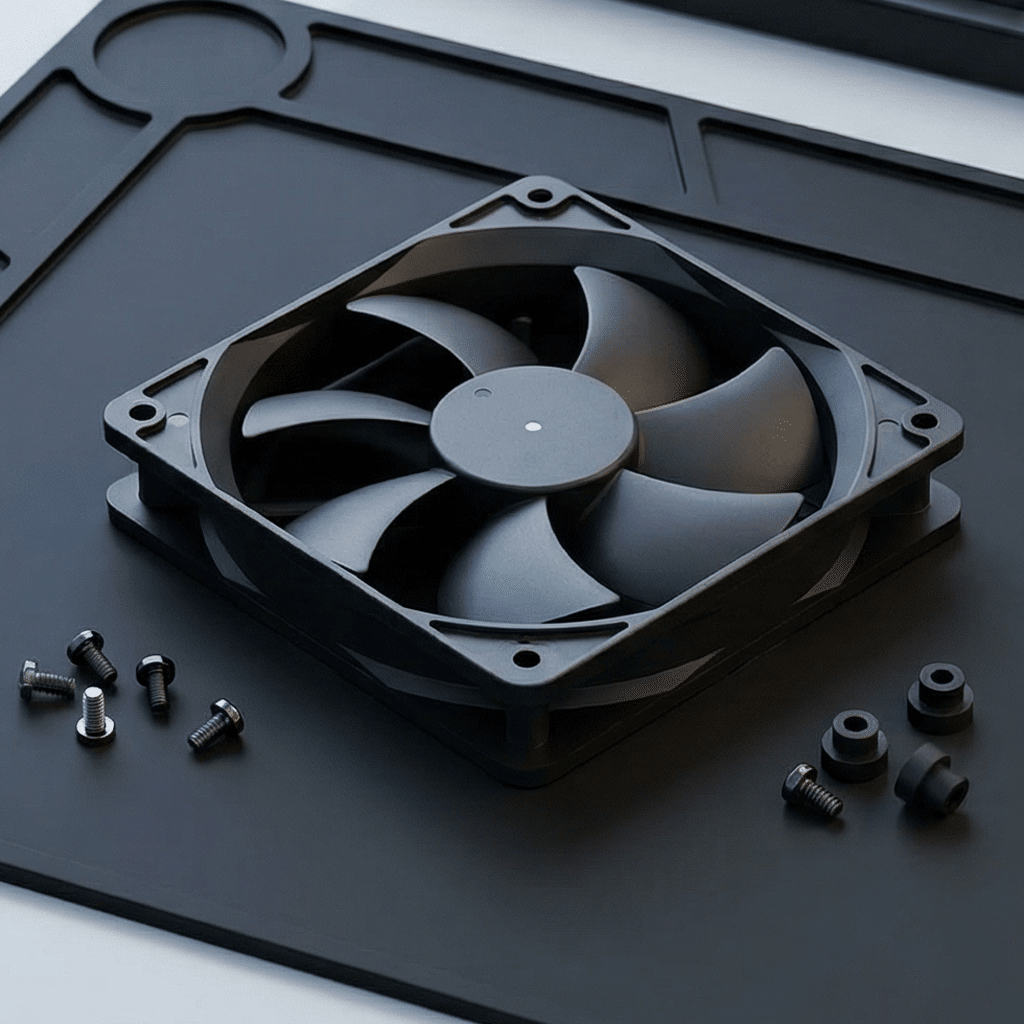
Take a close look at the blades of a cooling fan, and you’ll find that they are not flat but have a certain curvature. This design is very particular. When the fan motor drives the blades to rotate, the shape of the blades pushes the air, just like the propeller of a ship pushes water forward. The air flow speed on one side of the blade is fast, while that on the other side is slow. According to Bernoulli's principle, the pressure is low where the flow speed is fast and high where the flow speed is slow. Thus, a pressure difference is generated, which pushes the air to flow in one direction, forming an air current.
2.2 The Process of Airflow Taking Away Heat
When the airflow generated by the fan blows over the heated heat sink, the air acts like a group of diligent “porters,” carrying away the heat from the heat sink. Here comes an important concept: convective heat transfer. The airflow comes into contact with the surface of the heat sink, absorbs heat, and then the temperature of the air rises. The hot air rises, and the surrounding cold air comes in to continue absorbing heat. This cycle repeats, continuously carrying away the heat from the heat sink. It’s similar to fanning yourself when your skin feels hot; you can feel cooler.
We can compare this process to “air - conditioning for devices.” An air conditioner blows out cold air through a refrigeration system to take away the heat indoors, while a cooling fan takes away the heat of devices by generating airflow. The only difference is that an air conditioner actively cools, while a cooling fan accelerates heat dissipation through air flow.
III. Working Modes of Cooling Fans in Different Scenarios
3.1 Cooling Fans in Computer Cases
Inside a computer case, multiple cooling fans are usually installed. The fans at the front of the case are responsible for “sucking” cold air into the case, while the fans at the back and top “blow” out the hot air, forming a complete air duct. In this way, the air continuously flows inside the case, just like opening windows and doors for ventilation in a room. It quickly takes away the heat generated by components such as the CPU, graphics card, and power supply, preventing the device from performance degradation or even damage due to overheating.
3.2 Cooling Fans for Mobile Phones
For mobile phones, due to limited space, small - sized cooling fans are usually used, or they are used with cooling clips. When the phone runs large - scale games or charges for a long time, the airflow generated by the cooling fan accelerates the heat dissipation on the back of the phone, keeping the phone at a suitable operating temperature and avoiding lag.
IV. The Impact of Fan Performance on Cooling Effect
Fan performance parameters, such as air volume and static pressure, directly affect the cooling effect. The larger the air volume, the more heat can be carried away per unit of time. The higher the static pressure, the stronger the fan’s ability to push air against resistance, making it more suitable for passing through dense heat fins. It’s just like the stronger the wind, the faster it can blow away the heat; and the stronger the wind, the better it can penetrate obstacles. Therefore, when choosing a cooling fan, you should reasonably select the fan specifications according to the heat - generating situation of the device and the usage environment to achieve the best cooling effect.
Cooling fans may seem simple, but they contain rich scientific principles. Through processes such as heat conduction, aerodynamics, and convective heat transfer, they act like professional “cooling engineers,” silently ensuring the stable operation of electronic devices and making our device - using experience smoother and more worry - free.

Environmental Protection and Energy Efficiency-How Cooling Fans Contribute to Carbon Neutrality
The Heart of Cooling Fans - A Comprehensive Guide to Bearing Types - How to Choose Among Sleeve-Ball-Hydraulic and Ceramic Bearings
Related Article
hoose a cooling fan at the operating point where its published performance curve meets the resistance of the finished equipment—not at the fan’s maximum free-air CFM.
How Do You Choose a Cooling Fan by Static Pressure and Airflow

Set cooling fan airflow so cool supply air reaches the highest-heat components first and hot air exits without returning to the intake. Verify the airflow arrow molded on the fan frame, not the visible blade shape.
How Do You Set Cooling Fan Airflow Direction in Electronic Equipment?

An axial fan is usually better for moving a large volume of air through a low-resistance enclosure, while a centrifugal blower is usually better when air must pass through dense heat sinks, filters, narrow ducts or other high-resistance components.
Axial Fan vs Centrifugal Blower- Which Is Better for Electronics Cooling