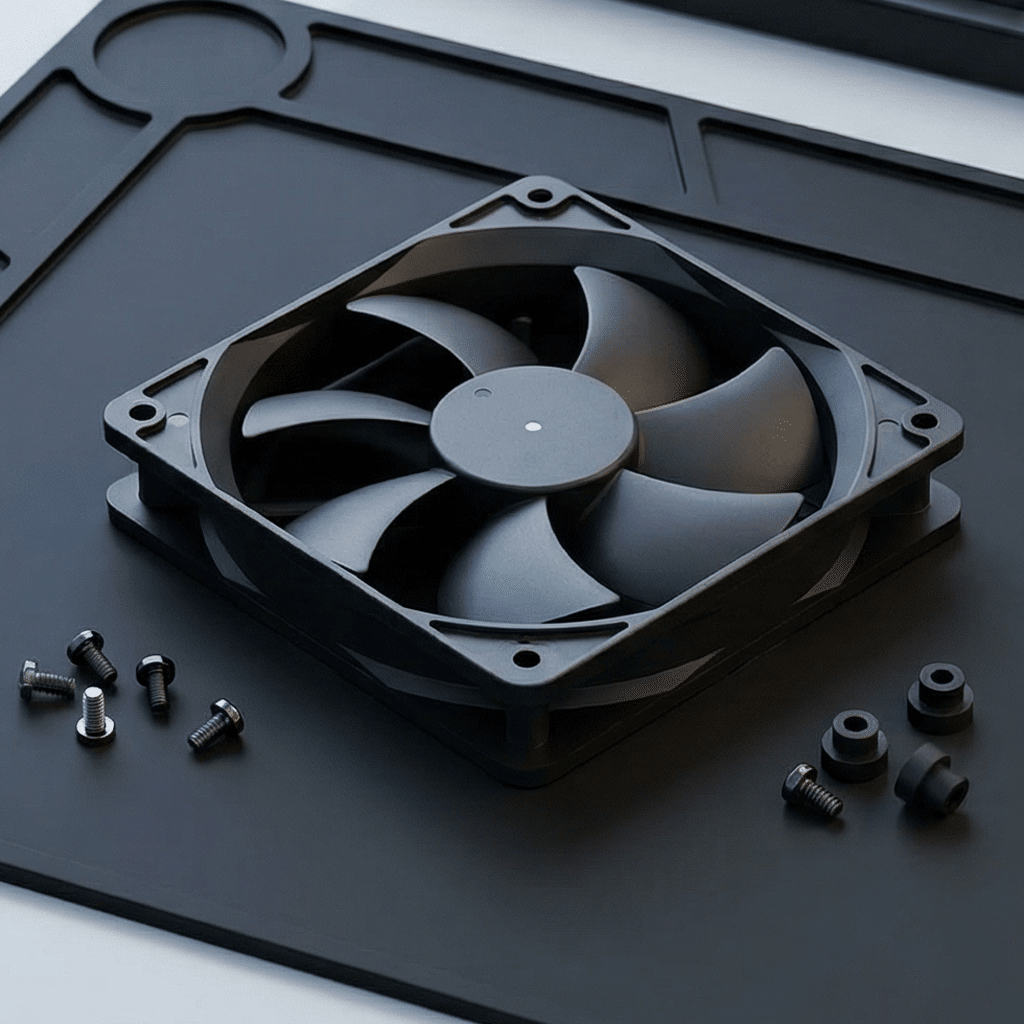
IP68 Cooling Fan Guide- How to Choose a Waterproof Fan
IP68 Cooling Fan Guide: How to Choose a Waterproof Fan
Cooling equipment in the real world often faces far more than heat. Outdoor cabinets, charging stations, telecom enclosures, marine equipment, factory machinery, and energy-storage systems may encounter dust, rain, washdown, humidity, vibration, and corrosive contaminants. An IP68 cooling fan can be part of a robust thermal solution—but only when its protection level and airflow performance match the whole application.
What does IP68 mean?
IP stands for Ingress Protection. The two digits describe protection against solid objects and water under defined test conditions. For an IP68 fan:
- 6: Dust-tight. The enclosure prevents dust ingress at a level that could interfere with satisfactory operation.
- 8: Protected against continuous immersion in water under conditions specified by the manufacturer.
The “8” is not one universal water test. The manufacturer must state the relevant immersion conditions, such as depth, duration, and any other details. Therefore, “IP68” is a starting point for specification review—not a substitute for reading the datasheet and qualification report.
Why use an IP68 cooling fan?
Standard cooling fans may perform well in clean, controlled environments, but moisture and contamination can damage bearings, motor electronics, windings, and connections. A properly designed IP68 fan helps protect critical fan components from dust and water exposure. This can improve service life and reduce unplanned maintenance in demanding equipment.
Common applications include:
- Outdoor telecom and network cabinets
- EV charging stations and power-conversion equipment
- Energy-storage systems and battery enclosures
- Industrial automation, process equipment, and washdown areas
- Agricultural machinery and construction equipment
- Marine, coastal, and transportation applications
- Outdoor LED, security, and communications equipment
IP ratings compared: IP54, IP55, IP65, IP67, and IP68
| IP rating | Solid-particle protection | Water protection | Typical use consideration |
|---|---|---|---|
| IP54 | Limited dust ingress protection | Water splashes | Basic industrial environments with limited moisture exposure. |
| IP55 | Limited dust ingress protection | Water jets | Equipment needing protection from routine spray or cleaning. |
| IP65 | Dust-tight | Water jets | Outdoor or industrial equipment exposed to dust and directed water. |
| IP67 | Dust-tight | Temporary immersion | Equipment at risk of short-duration water immersion. |
| IP68 | Dust-tight | Continuous immersion under specified conditions | Demanding wet environments; exact limits must be confirmed. |
Do not choose a higher IP number simply as a safety margin without considering the cooling architecture. Higher sealing may change fan cost, weight, dimensions, airflow, pressure capability, and the way heat is removed from the enclosure.
How an IP68 fan is protected
Designs vary by supplier and product type. A waterproof cooling fan may use sealed motor construction, protected electronics, potting or coating, water-resistant bearing arrangements, gaskets, and sealed cable exits. The effectiveness depends on the complete design and test method—not one material or component alone.
When comparing products, ask for details on the tested configuration. For example, a fan may be rated with a particular cable length or connector arrangement. Substituting a connector, modifying a lead, or changing the mounting surface can affect real-world ingress protection.
Waterproof does not mean corrosion-proof
IP testing focuses on ingress. It does not automatically guarantee resistance to salt mist, chemicals, UV, oil, fertilizer, or industrial gases. In coastal, marine, agricultural, and chemical environments, corrosion can be a major failure mechanism even when water cannot enter the motor.
For these applications, review additional requirements such as corrosion-resistant materials, protective coating, salt-spray testing, chemical compatibility, and connector plating. The air-moving system may also carry contaminants into other areas of the equipment, so the enclosure's airflow route matters as much as the fan itself.
Choose airflow and static pressure for the real enclosure
Ingress protection is only one part of fan selection. The fan must still remove enough heat. Start with the system heat load, maximum ambient temperature, and permitted component temperatures. Then evaluate the air path, including vents, louvers, filters, ducts, grilles, heat sinks, and cable congestion.
A fan's free-air airflow rating is measured with minimal resistance. In a weather-protected enclosure, louvers and filters often create significant pressure drop. Select from the pressure–airflow curve at the actual system resistance. High static pressure is especially important for compact cabinets, dense electronics, filtered inlets, and long duct paths.
Electrical and control requirements
Most IP68 DC cooling fans are available in common low-voltage versions such as 12 VDC, 24 VDC, and 48 VDC. Verify nominal voltage, voltage tolerance, startup current, locked-rotor current, and reverse-polarity protection. For smart thermal management, choose a model with the control and monitoring features your system can use.
- 2-wire: Fixed-speed operation.
- 3-wire: Usually adds a tachometer signal for speed monitoring.
- 4-wire PWM: Adds precise speed control while maintaining a stable supply voltage.
- Alarm or locked-rotor output: Enables fault reporting in critical systems.
The connector and cable assembly deserve the same attention as the fan. A water-resistant fan connected through an unsealed cable gland or connector does not provide a water-resistant system.
Reliability factors beyond IP rating
| Factor | Why it matters | What to verify |
|---|---|---|
| Operating temperature | Heat affects electronics, bearings, and expected fan life. | Minimum/maximum operating range and life rating at stated temperature. |
| Bearing system | Influences life, noise, orientation tolerance, and continuous-duty performance. | Bearing type, L10 or stated life, and installation orientation guidance. |
| Vibration and shock | Can affect impeller balance, connector retention, and bearing wear. | Test standards and performance in the actual mounting location. |
| UV and corrosion | Outdoor exposure can degrade plastics, metals, and cable jackets. | Material data, coatings, salt-mist or environmental qualification. |
| Maintenance access | Filters and grilles may collect debris and reduce airflow over time. | Service interval, filter design, and safe replacement procedure. |
IP68 cooling fan selection checklist
- Define the environmental exposure: dust, rain, immersion, washdown, salt mist, chemicals, UV, and vibration.
- Confirm the exact IP68 test conditions stated by the manufacturer.
- Calculate heat load and determine required airflow at the worst-case ambient temperature.
- Estimate enclosure resistance from filters, louvers, grilles, and internal obstructions.
- Select airflow and static pressure from the fan curve at the expected operating point.
- Verify voltage, current, PWM/tachometer interface, cable, and sealed connector requirements.
- Review temperature range, bearing life, corrosion resistance, and application-specific tests.
- Validate the finished enclosure—not only the individual fan—with representative water, dust, and thermal tests.
Frequently asked questions
Can I wash an IP68 cooling fan?
Do not assume so. IP68 describes protection under specified immersion conditions; it does not necessarily cover high-pressure washdown, detergents, hot water, or chemical cleaners. Follow the fan manufacturer's cleaning and test guidance.
Will an IP68 fan run underwater?
The rating indicates protection against continuous immersion under stated conditions, but it does not automatically define operational performance while submerged. Confirm whether the supplier approves powered operation during immersion and under what conditions.
Do I need an IP68 fan for an outdoor cabinet?
Not always. The right rating depends on the enclosure design and exposure level. A protected cabinet may only require a lower rating, while a unit exposed to flooding or heavy washdown may need greater protection. Consider the complete equipment specification.
Conclusion
An IP68 cooling fan can improve reliability in wet and dusty environments, but protection rating alone is not a complete selection method. Confirm the specific immersion conditions, then match airflow, static pressure, electrical control, temperature capability, cable sealing, and corrosion resistance to the finished equipment. The most reliable result comes from validating the full thermal and environmental system under real operating conditions.
Industrial Blower Fan Applications-Selection Guide for Reliable Airflow
How to Choose a Server Cooling Fan-A Practical Selection Guide
Related Article