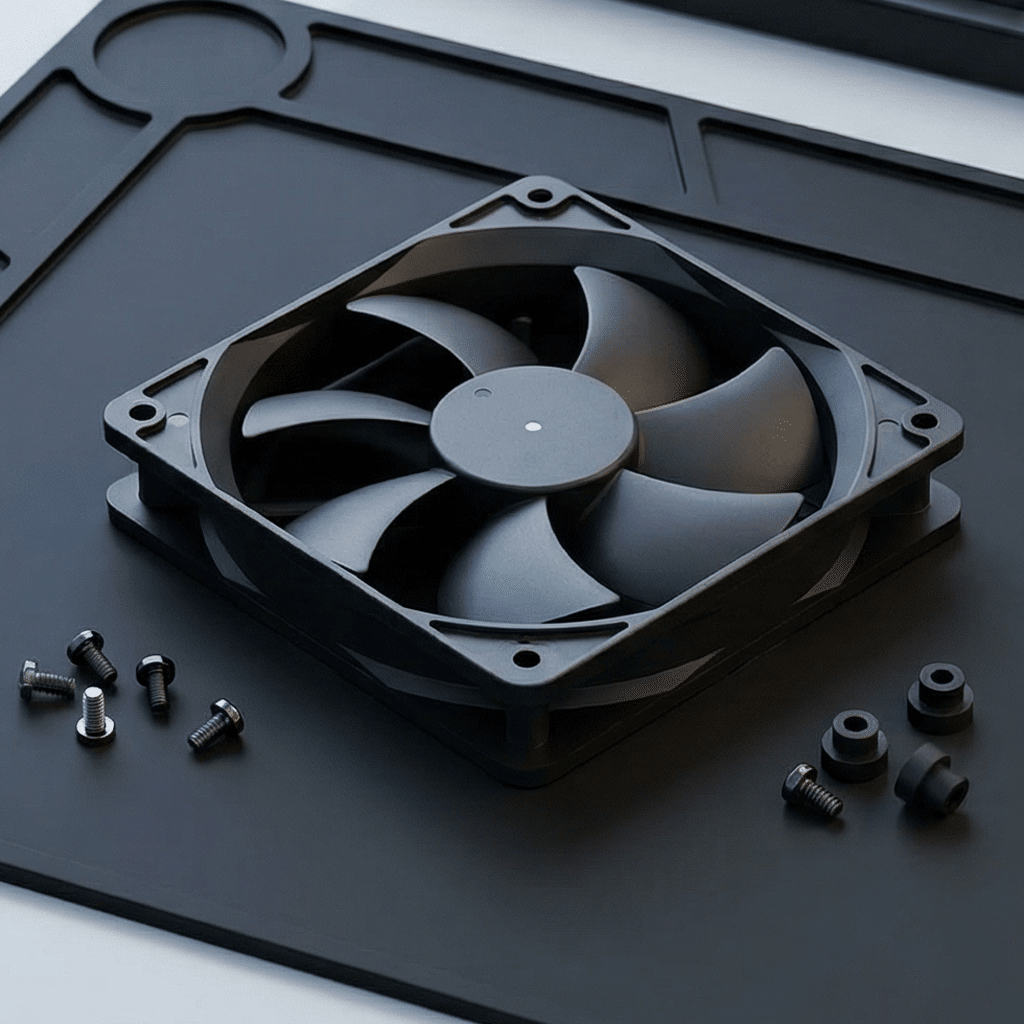
Industrial Blower Fan Applications-Selection Guide for Reliable Airflow
Industrial Blower Fan Applications: Selection Guide for Reliable Airflow
Industrial blower fans are used whenever air must travel through resistance. From electronic enclosures and laser equipment to drying lines, HVAC systems, and dust-control machines, a blower delivers focused airflow and useful pressure. Selecting the right model requires more than choosing a voltage and frame size: the blower must match the complete air path, environment, and duty cycle.
What is an industrial blower fan?
An industrial blower fan, often called a centrifugal blower, uses an impeller to draw air into its inlet and discharge it at roughly a right angle to the inlet flow. This arrangement can generate higher static pressure than many axial-fan designs, making blowers well suited for ducts, filters, heat exchangers, narrow channels, and compact equipment with restricted airflow paths.
Industrial blowers are available in AC, EC, and DC versions. They may be designed for continuous operation, variable speed, high temperature, low noise, or harsh environments. The best design depends on the application and system resistance.
Industrial blower fan applications
Electronics and electrical enclosures
Power supplies, inverters, battery systems, telecom cabinets, EV chargers, servers, and industrial control panels can contain dense components and heat sinks. A compact DC blower can force air through these restrictions and direct cooling toward a specific hotspot. PWM speed control allows the system to increase airflow as temperature rises.
HVAC and air-handling equipment
Blowers are central to air handlers, fan-coil units, heat pumps, ventilation modules, and air-purification equipment. They move air through evaporator or condenser coils, filters, ducts, and diffusers. Efficient variable-speed EC blowers are commonly selected where long operating hours and part-load energy use matter.
Industrial drying and process equipment
Drying ovens, printing lines, packaging equipment, coating systems, and food-processing machines may use blowers to circulate heated air, remove moisture, or create a controlled process atmosphere. Temperature capability, material compatibility, and airflow uniformity are often key selection factors.
Dust collection and fume extraction
Blowers can move contaminated air toward a collection or filtration system. In these applications, the fan must overcome filter pressure drop and may require abrasion resistance, spark-control measures, or special materials. The complete dust-collection system must be designed with applicable safety requirements in mind.
Medical and laboratory equipment
Analyzers, diagnostic instruments, patient-support systems, and laboratory devices can use compact blowers for cooling, air sampling, pressure control, or controlled ventilation. Low vibration, predictable performance, low noise, and reliability are especially important in these applications.
Transportation and outdoor equipment
Rail systems, commercial vehicles, battery packs, communication stations, and outdoor cabinets may need forced-air cooling in environments with vibration, moisture, temperature extremes, and contamination. Select protection features, bearings, cables, and materials for actual field conditions.
Blower vs. axial fan: which one should you choose?
| Factor | Centrifugal blower | Axial fan |
|---|---|---|
| Airflow direction | Air enters axially and exits radially or through a housing outlet. | Air moves parallel to the fan shaft. |
| Static-pressure capability | Often better for ducts, filters, heat sinks, and restrictive paths. | Often efficient for open or lower-resistance ventilation paths. |
| Airflow targeting | Housing and outlet can direct air to a specific area or channel. | Usually provides broad through-flow across an opening. |
| Common uses | Electronics cooling, HVAC modules, ducts, dryers, air sampling. | Cabinet ventilation, open-frame cooling, general air movement. |
| Selection basis | Pressure–airflow curve, outlet integration, and duct resistance. | Airflow requirement, pressure curve, and open-area installation. |
Neither option is universally better. If the air path is open and the goal is general ventilation, an axial fan may be simple and efficient. If air must move through a tight, long, filtered, or ducted path, a blower often provides the pressure required to maintain flow.
Understand airflow and static pressure
Airflow is the volume of air moved, commonly stated in CFM or m³/h. Static pressure is the blower's ability to overcome resistance, stated in Pa, mmH₂O, or inH₂O. The blower's published pressure–airflow curve shows how these values change together.
At the curve's free-air end, airflow is high but static pressure is low. At the blocked end, pressure is high but airflow is zero. Your machine operates at the intersection of the blower curve and the system-resistance curve. Any filter, grille, duct bend, heat exchanger, or narrow channel changes that resistance.
Key specifications for industrial blower selection
Power and motor type
AC blowers may suit fixed-speed mains-powered equipment. DC blowers are common in compact electronics using 12 VDC, 24 VDC, or 48 VDC rails. EC blowers are a strong option for efficient, controllable industrial and HVAC applications. Confirm voltage tolerance, rated current, startup current, and electrical protection requirements.
Speed control and monitoring
Variable speed can reduce noise and energy use during low demand. Available control methods can include PWM, analog voltage, voltage control, digital communication, or a dedicated controller. For critical systems, consider tachometer feedback, locked-rotor detection, and alarm outputs.
Operating temperature
Air temperature at the blower inlet may be far higher than room temperature. Verify the operating range of the motor electronics, bearings, housing, and impeller. For hot-air circulation, consult the supplier about temperature derating and material suitability.
Noise and vibration
Noise comes from motor operation, impeller turbulence, and the installed air path. Sharp duct transitions, restrictive grilles, and unbalanced mounting can increase noise. Use flexible mounting or isolation where appropriate, and test the blower in the final assembly rather than relying only on catalog dB(A) values.
Materials and environmental protection
Consider humidity, dust, oil mist, corrosive gases, salt exposure, UV, and vibration. Select appropriate ingress protection, coatings, materials, bearings, connectors, and cable construction. For potentially flammable or explosive atmospheres, follow applicable safety standards and obtain qualified engineering guidance.
Common blower selection mistakes
- Ignoring system resistance. Ducts, filters, and heat exchangers can reduce delivered airflow substantially.
- Using an oversized blower without control. Excess pressure can waste energy, increase noise, and create unnecessary turbulence.
- Forgetting air recirculation. Hot exhaust air can return to the inlet if enclosure layout is not controlled.
- Underestimating filter loading. Filters become more restrictive as they collect debris.
- Choosing a fan for room conditions only. Inlet air, vibration, contaminants, and duty cycle may be much harsher in real operation.
- Skipping prototype tests. CFD, calculations, and catalog curves are valuable, but final thermal and acoustic validation remains essential.
Industrial blower fan selection checklist
- Required airflow at the intended operating point
- Total static pressure from ducts, filters, heat sinks, and grilles
- Air temperature, ambient temperature, altitude, and duty cycle
- Available power supply and maximum current
- Required speed-control, feedback, and alarm interface
- Available installation space, inlet/outlet orientation, and mounting method
- Noise, vibration, and service requirements
- Ingress protection, corrosion resistance, and environmental qualification
- Final validation in the completed product at worst-case conditions
Frequently asked questions
Can a blower fan be used for cooling electronics?
Yes. Compact DC blowers are widely used for electronics because they can direct airflow through narrow channels and heat sinks. Select the blower based on the equipment's heat load and pressure drop, then validate component temperatures in the final enclosure.
How do I reduce blower noise?
Start by selecting a blower that meets the required operating point without excessive speed. Use smooth inlet and outlet transitions, avoid restrictive grilles, reduce air leaks and abrupt turns, add vibration isolation if appropriate, and use variable-speed control rather than continuous maximum RPM.
What information should I provide to a blower manufacturer?
Provide airflow and pressure requirements, supply voltage, available space, inlet/outlet geometry, temperature range, environment, target noise level, control method, operating hours, and required certifications. Photos or drawings of the air path can improve the recommendation.
Conclusion
Industrial blower fans are essential wherever reliable airflow must overcome resistance. Their value comes from matching pressure, airflow, motor technology, control, and environmental durability to the complete machine. Define the real operating point, account for restriction and aging, and test the integrated system to choose a blower that delivers reliable performance over its service life.
Battery Energy Storage System Cooling- Fan Selection and Design Guide
IP68 Cooling Fan Guide- How to Choose a Waterproof Fan
Related Article