
Environmental Protection and Energy Efficiency-How Cooling Fans Contribute to Carbon Neutrality
author: Rainie
2025-06-14


Rainie YU
Cooling Fan Expert | XQF FAN Overseas Mgr
Specialize in DC FAN/AC FAN/EC FAN/Industrial Equipment Cooling Solutions Services.
Driven by the global goal of "carbon neutrality", all industries are actively exploring paths to reduce energy consumption and emissions. As an indispensable cooling tool in the fields of electronic devices and industrial machinery, cooling fans are also becoming a crucial part of the effort to achieve carbon neutrality through technological innovation. From the design principles of energy - saving fans to the differences in energy consumption, cooling fans are contributing to carbon emissions reduction with high - efficiency and low - energy - consumption performance.
I. The Transformation of Cooling Requirements under the Global Emission Reduction Trend
With the rapid development of industries such as data centers, 5G base stations, and new energy vehicles, the usage of cooling fans has experienced explosive growth. According to statistics from the International Energy Agency (IEA), the energy consumption of cooling systems in data centers alone accounts for 1% - 1.5% of the global electricity consumption, and cooling fans are a major part of this energy consumption. Under the goal of carbon neutrality, traditional high - energy - consumption and low - efficiency cooling fans can no longer meet the requirements, and the research and development of energy - saving cooling fans has become an industry consensus. Many countries around the world have successively introduced policies. For example, the EU's "Ecodesign Directive" sets strict requirements for the energy efficiency of cooling components in electronic devices, forcing enterprises to accelerate technological upgrades.
II. The Core Design Principles of Energy - Saving Cooling Fans
2.1 PWM Speed Regulation Technology: Intelligent Speed Control for Demand - Based Energy Supply
PWM (Pulse - Width Modulation) speed regulation technology is one of the core technologies of energy - saving cooling fans. Traditional fans usually operate at a fixed speed, consuming the same amount of power regardless of the device load. In contrast, PWM - regulated fans are equipped with built - in temperature sensors that can monitor the device temperature in real - time. When the device is under low load, such as when a computer is only used for document editing, and the sensor detects a low temperature, the fan automatically reduces its speed to save energy. When the device is under high load, such as running large - scale games or video rendering and the temperature rises, the fan quickly increases its speed to ensure effective heat dissipation. Through this "demand - based energy supply" approach, PWM - regulated fans can reduce energy consumption by 30% - 50% compared to traditional fans.
2.2 Low - Power Motors: Structure Optimization to Reduce Losses
Energy - saving fans adopt new low - power motors, which are optimized in terms of materials and structure. In terms of materials, silicon steel sheets with high magnetic permeability are used to make the motor core, reducing hysteresis and eddy current losses. Copper wires with low resistance are used to wind the coils, reducing heat losses during current flow. In terms of structural design, the layout of the motor windings is optimized to improve the efficiency of converting electrical energy into mechanical energy. For example, some cooling fans using brushless DC motors (BLDC) can increase energy efficiency by 20% - 30% compared to traditional brushed motor fans. They also have a longer service life and lower maintenance costs.
2.3 High - Efficiency Aerodynamic Design: Performance Enhancement to Cut Energy Consumption
Energy - saving cooling fans enhance their aerodynamic performance by optimizing the shape, angle, and number of blades. For example, blades designed with bionics, mimicking the streamlined structures of bird wings or fish fins, can reduce air resistance. Adjusting the blade angle enables the fan to achieve the desired air volume and static pressure even at low speeds. This design not only improves heat dissipation efficiency but also reduces mechanical losses during fan operation, indirectly reducing energy consumption.
III. Comparison of Energy Consumption between Traditional and Energy - Saving Fans
Take a server cooling fan that runs 24 hours a day as an example. A traditional fixed - speed fan with a power of 20W consumes 0.48 kWh of electricity per day, 175.2 kWh per year. Calculated based on 0.785 kilograms of carbon dioxide emissions per kWh of electricity, it generates approximately 137.6 kilograms of carbon dioxide emissions per year. In contrast, an energy - saving fan with PWM speed regulation and a low - power motor has an average power reduced to 12W, consuming 0.288 kWh of electricity per day, 105.12 kWh per year, with an annual carbon emission of about 82.5 kilograms. The comparison shows that energy - saving fans can reduce carbon emissions by about 40% per year. If this data is scaled up to millions of servers globally, the energy - saving and emission - reduction effects will be extremely significant.
IV. Industry Practices of Cooling Fans Contributing to Carbon Neutrality
In the field of data centers, companies such as Google and Amazon have deployed a large number of energy - saving cooling fans. Combined with intelligent temperature control systems, they have significantly reduced the Power Usage Effectiveness (PUE) of data centers, with an annual carbon emission reduction equivalent to planting millions of trees. In the new energy vehicle industry, brands like BYD and Tesla use high - efficiency cooling fans to cool batteries and motors, reducing vehicle energy consumption and extending the driving range, thus indirectly reducing carbon emissions. In addition, some fan manufacturers have introduced a "full - life - cycle environmental protection" strategy, practicing low - carbon concepts throughout the entire process, from raw material procurement and production to product recycling, further promoting the industry's progress towards the goal of carbon neutrality.
From design principles to practical applications, energy - saving cooling fans are becoming an important support for achieving the goal of carbon neutrality driven by technological innovation. With continuous technological progress and the improvement of industry standards, cooling fans will play an even greater role in energy conservation and emission reduction in the future, contributing to the protection of the global environment and the promotion of sustainable development.
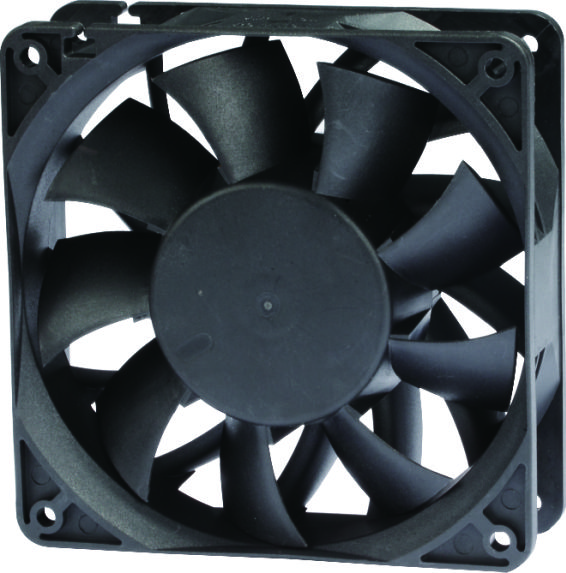

How Do Industrial Equipment Combat High Temperatures— The Hardcore Applications of Cooling Fans in Manufacturing
Why Can Cooling Fans Lower Temperatures - An Explanation Based on Aerodynamics Principles
Related Article
hoose a cooling fan at the operating point where its published performance curve meets the resistance of the finished equipment—not at the fan’s maximum free-air CFM.
How Do You Choose a Cooling Fan by Static Pressure and Airflow

Set cooling fan airflow so cool supply air reaches the highest-heat components first and hot air exits without returning to the intake. Verify the airflow arrow molded on the fan frame, not the visible blade shape.
How Do You Set Cooling Fan Airflow Direction in Electronic Equipment?

An axial fan is usually better for moving a large volume of air through a low-resistance enclosure, while a centrifugal blower is usually better when air must pass through dense heat sinks, filters, narrow ducts or other high-resistance components.
Axial Fan vs Centrifugal Blower- Which Is Better for Electronics Cooling