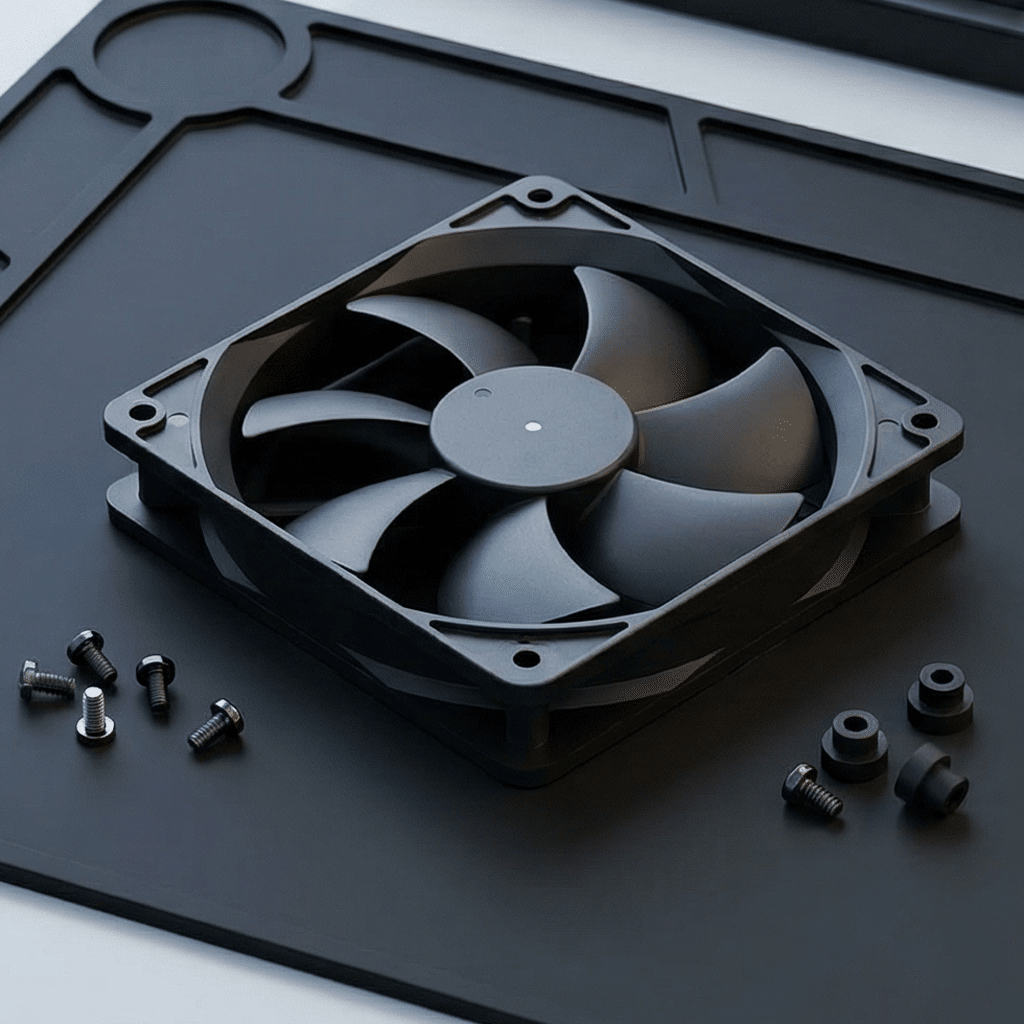
EC Fan vs. DC Fan-Key Differences and How to Choose
EC Fan vs. DC Fan: Key Differences and How to Choose
EC fans and DC fans both play an important role in modern thermal management. Although their names are sometimes used loosely, they are not simply interchangeable labels. The right choice depends on your available power source, system size, control requirements, energy target, operating environment, and total cost of ownership.
Quick answer: EC fan vs. DC fan
An EC fan uses an electronically commutated motor. In many commercial and industrial products, it accepts AC mains power and contains integrated electronics that convert and control the power for a brushless motor. A DC fan is generally designed to run from a low-voltage DC source, such as 5 VDC, 12 VDC, 24 VDC, or 48 VDC. Most modern DC cooling fans are also brushless and use internal electronics for commutation.
In short, EC fans are often selected for larger, AC-powered ventilation and HVAC-style applications where efficient variable-speed operation is valuable. DC fans are widely used in electronic equipment and compact industrial systems where a DC power rail and board-level fan control are already available.
What is an EC fan?
“EC” means electronically commutated. An EC motor uses electronic switching rather than mechanical brushes to energize the motor windings. In a typical EC axial fan or blower, the motor electronics are integrated into the assembly. This enables efficient speed control and eliminates the wear associated with brushed motors.
EC fans are common in ventilation units, refrigeration equipment, heat pumps, air-handling systems, electrical enclosures, and industrial machinery. They may accept AC input directly, depending on the model, while providing a brushless motor's controllability and efficiency.
What is a DC fan?
A DC cooling fan operates from a direct-current supply. The most common industrial DC fan voltages are 12 VDC and 24 VDC, with 48 VDC increasingly common in telecom, energy storage, and data-center equipment. Brushless DC (BLDC) fans use a compact driver circuit to commutate the motor electronically.
DC fans are available in many frame sizes, including miniature fans, axial fans, blowers, and high-pressure server fans. They can use two-wire fixed-speed operation, three-wire tachometer feedback, or four-wire PWM speed control.
EC fan vs. DC fan: comparison table
| Factor | EC fan | DC fan |
|---|---|---|
| Typical power source | Often AC mains input, with integrated conversion and motor control; designs vary by model. | Low-voltage DC supply, commonly 5 V, 12 V, 24 V, or 48 V. |
| Common product scale | Medium to large ventilation fans, blowers, and AC-powered equipment. | Small to medium cooling fans and high-density electronics; also available in large formats. |
| Speed control | Often supports 0–10 V, PWM, analog input, Modbus, or other integrated control options. | Usually voltage control, PWM, or dedicated fan-controller input. |
| Integration | Can simplify an AC-powered system by integrating motor electronics and control functions. | Integrates easily with existing DC rails, embedded controllers, and PCB fan headers. |
| Typical applications | HVAC, refrigeration, ventilation, heat pumps, large cabinets, industrial machinery. | Servers, telecom, power supplies, battery systems, medical devices, EV chargers, control cabinets. |
| Selection focus | Input power, control protocol, energy use across the duty cycle, approvals, and airflow system design. | Voltage, current, PWM/tachometer compatibility, frame size, static pressure, and thermal control. |
Efficiency: compare the complete operating point
It is tempting to say that one category is always more efficient. In practice, the answer is more nuanced. A well-designed EC fan can deliver excellent part-load efficiency because it combines an efficient brushless motor with integrated variable-speed control. That makes EC technology particularly attractive where the fan runs many hours per year and rarely needs maximum output.
Modern brushless DC fans can also be very efficient, especially when matched to a DC-powered electronic system and controlled with PWM. The useful comparison is not a label on the fan. Compare airflow, static pressure, input power, and noise at the actual operating point of the equipment.
Speed control and monitoring
Variable speed is valuable because thermal load changes over time. Running a fan only as fast as necessary can reduce power use and acoustic output while extending component life.
EC fan control
EC fans frequently offer several interface options, which may include analog voltage, PWM, digital communications, alarm relay outputs, or speed feedback. The exact interface is model-specific. For a building or industrial-control system, this flexibility can make EC fans easier to connect to higher-level automation.
DC fan control
Four-wire PWM DC fans are a standard solution in electronics. The fan receives constant DC power, while a PWM signal commands speed. A tachometer output can report actual rotation to the host controller. Two-wire and three-wire DC fans remain useful for simpler fixed-speed or voltage-controlled designs.
Airflow and static pressure still matter most
Whether you select EC or DC technology, aerodynamic performance must fit the cooling path. Airflow describes volume of air moved. Static pressure describes the fan's ability to overcome resistance. An open enclosure usually needs airflow capacity; a restricted path with a filter, heat sink, dense board layout, or ducting needs stronger pressure capability.
Ask the supplier for a pressure–airflow (P–Q) curve. Your product's resistance curve intersects the fan curve at the real operating point. This is the point to use for thermal calculations and product comparisons—not the fan's zero-pressure airflow rating.
Cost: look beyond purchase price
DC fans are often economical and easy to integrate when a DC power supply and PWM-capable controller are already part of the design. EC fans may have a higher initial cost because of their integrated electronics and input capability. However, in long-running AC-powered systems, lower energy use at part load and simplified control integration can improve lifetime economics.
When evaluating cost, include installation, controller hardware, energy consumption, maintenance, expected operating hours, replacement access, and downtime risk. For critical infrastructure, a lower-cost fan that cannot meet reliability or monitoring requirements may be the more expensive decision over the product's life.
Reliability and environment
Both EC and BLDC fan designs eliminate mechanical brushes, which is beneficial for reliability. But lifetime depends on more than commutation technology. Bearing type, operating temperature, ingress protection, moisture, salt exposure, vibration, electrical quality, and duty cycle all matter.
- Specify an operating-temperature range that covers worst-case ambient conditions.
- Choose an appropriate bearing system for the installation orientation and expected running hours.
- For harsh locations, review IP ratings, coating, corrosion resistance, and vibration requirements.
- Confirm the life rating at its stated temperature; higher temperature generally reduces fan life.
- For monitored systems, use tachometer, alarm, or locked-rotor signals where available.
When to choose an EC fan
An EC fan is often the right choice when:
- The equipment uses AC mains power and you want integrated, efficient speed control.
- The fan is large or runs for long periods, so part-load energy use is important.
- The system needs an industrial or building-automation control interface.
- You are replacing an AC fan and need a solution with better speed control or monitoring.
- The application is HVAC, ventilation, refrigeration, heat-pump, or industrial air movement.
When to choose a DC fan
A DC fan is often the right choice when:
- The product already has a suitable low-voltage DC supply.
- Space is limited and the fan must fit a compact electronics enclosure.
- The embedded controller can provide PWM speed control and read tachometer feedback.
- The application needs high static pressure in a small frame, such as a server or telecom chassis.
- The product is powered by batteries, rectified DC, or a DC distribution bus.
Selection checklist
- Define the heat load, ambient temperature, and allowed component temperature.
- Map the airflow path and identify filters, grilles, heat sinks, and other restrictions.
- Determine whether the system provides AC mains, low-voltage DC, or both.
- Select airflow and static-pressure performance at the expected operating point.
- Verify control input, speed feedback, alarms, connector, and cable requirements.
- Check current draw, startup current, and protection requirements.
- Review mounting dimensions, airflow direction, service access, and noise target.
- Validate samples in the finished equipment under worst-case temperature and restriction.
Frequently asked questions
Is an EC fan a DC fan?
An EC motor is electronically commutated and typically brushless, so it has similarities to a BLDC motor. In product selection, however, “EC fan” commonly refers to an AC-input fan with integrated electronics, while “DC fan” commonly refers to a low-voltage DC cooling fan. Always review the specific product's input and control specifications.
Can I use a DC fan on an AC supply?
Not directly. A DC fan requires a correctly rated DC power supply. Supplying AC voltage to a DC fan can damage the fan and create a safety risk. Use an approved AC-to-DC supply if the system starts from AC mains.
What information should I send a fan supplier?
Provide your available voltage, installation space, required airflow or heat load, static-pressure estimate, operating temperature, control method, noise target, environmental conditions, annual volume, and required approvals. This gives the supplier enough context to recommend a suitable fan rather than a generic replacement.
Conclusion
EC fans and DC fans are both capable cooling solutions. EC technology is especially compelling for efficient, controllable air movement in AC-powered industrial and ventilation systems. DC fans are an excellent fit for low-voltage electronic equipment that needs compact packaging, PWM control, and straightforward integration. Select based on the entire thermal system—power source, airflow resistance, operating profile, control interface, and environmental demands—not on the technology name alone.
How to Choose a Server Cooling Fan-A Practical Selection Guide
120mm PWM Fan Buying Guide-How to Choose the Right Cooling Fan
Related Article