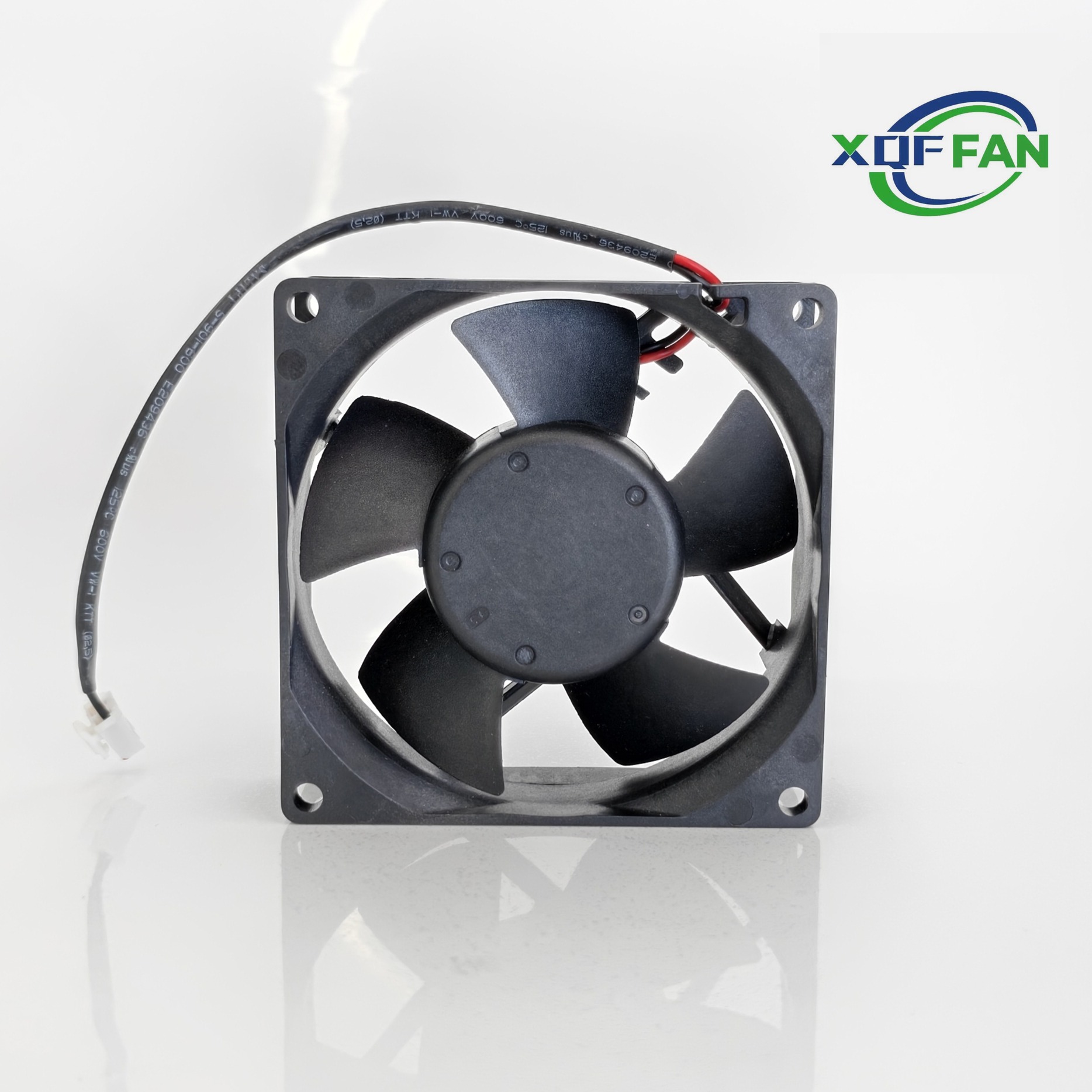
Battery Energy Storage System Cooling- Fan Selection and Design Guide
Battery Energy Storage System Cooling: Fan Selection and Design Guide
Battery energy storage systems (BESS) depend on careful thermal management. Cells, inverters, power-conversion systems, busbars, and control electronics all produce heat, while outdoor installations can also face intense ambient temperatures, dust, humidity, and solar load. Effective cooling helps support performance, reliability, service life, and consistent operation across the system.
Why thermal management matters in BESS
Battery cells perform best within a controlled temperature range defined by the battery manufacturer and system designer. Excessive temperature can accelerate aging and reduce available performance. Large temperature differences between modules can also create uneven aging and operating behavior across a pack.
Cooling design must consider more than battery cells. Power conversion equipment, contactors, transformers, control boards, and cable connections create their own heat sources. The result is a system-level problem involving heat generation, heat paths, airflow, ambient conditions, and control logic.
Common BESS cooling approaches
| Approach | How it works | Typical strengths | Key design considerations |
|---|---|---|---|
| Natural convection | Heat leaves through enclosure surfaces and passive airflow paths. | Simple, quiet, low maintenance. | Limited cooling capacity; depends heavily on ambient temperature and enclosure design. |
| Forced-air cooling | Fans move air across cells, heat sinks, and power electronics. | Flexible, cost-effective, responsive to load. | Airflow distribution, dust, filter loading, noise, fan reliability, and environmental sealing. |
| Liquid cooling | Coolant transfers heat through plates, loops, and heat exchangers. | High heat-removal capability and temperature uniformity. | Complexity, leak management, pumps, coolant service, and system integration. |
| Hybrid cooling | Combines air and liquid or other thermal methods. | Can address different zones efficiently. | Requires coordinated controls and more detailed validation. |
Forced-air cooling is common in applications where cost, serviceability, and system simplicity are important. Its success depends on delivering air where heat is generated rather than merely moving air somewhere inside the cabinet.
How fans support BESS air cooling
Fans can bring cool air into a cabinet, exhaust warm air, circulate air through battery modules, or force airflow across power-electronic heat sinks. Axial fans are often used for cabinet ventilation and broad airflow, while centrifugal blowers may be preferred where ducts, filters, narrow channels, or dense components create high pressure drop.
The fan's job is to maintain enough airflow at the real operating pressure. Louvers, filters, finger guards, ducts, cable pathways, and module gaps all add restriction. For this reason, a maximum free-air CFM value is not enough for design selection.
Start with the BESS heat load and air path
A useful design process begins by identifying where heat comes from and where it must go. Include battery charge/discharge losses, inverter and converter losses, auxiliary power consumption, and environmental heat gain. Then map the air path from inlet to outlet.
- Where is the hottest battery module or electronic component?
- Does air pass evenly across all battery modules, or bypass some areas?
- Can warm outlet air recirculate to the inlet?
- What pressure drop is created by filters, louvers, ducts, and heat sinks?
- How will dust accumulation change airflow over time?
- What happens when one fan fails or an inlet becomes partially blocked?
Computational modeling and bench testing can reveal dead zones, bypass paths, and hotspots. In the final stage, validate with temperature sensors at representative cells, power devices, and inlet/outlet locations during realistic charge/discharge and ambient-temperature conditions.
Airflow and static pressure: the essential fan comparison
Airflow is the volume of air a fan moves, commonly expressed in CFM or m³/h. Static pressure indicates the fan's ability to overcome resistance. In a BESS cabinet with filters and protective louvers, static pressure can be just as important as airflow.
Review the fan's pressure–airflow curve. The actual operating point is where the fan curve intersects the cabinet's system-resistance curve. As filters become dirty, resistance increases and delivered airflow falls. Allow margin for this change and define a maintenance or monitoring plan for filters.
Key fan specifications for energy-storage equipment
Voltage, current, and power
Common DC fan options include 12 VDC, 24 VDC, and 48 VDC. Choose the supply that matches the BESS auxiliary power architecture. Confirm voltage tolerance, startup current, locked-rotor current, and required circuit protection. In multi-fan systems, design for simultaneous startup and fault conditions.
PWM control and speed feedback
Four-wire PWM fans enable the battery-management or thermal-control system to adjust fan speed based on temperature, load, and ambient conditions. Tachometer feedback helps verify actual fan rotation. Alarm or locked-rotor outputs can provide earlier warning of a cooling problem.
Reliability and redundancy
BESS installations may operate continuously and may be difficult to access. Use a fan with an appropriate bearing system, service-life rating, and operating-temperature range. For critical systems, design redundancy so that remaining fans can maintain acceptable temperature after a fan failure. Test this fault condition in the completed cabinet.
Ingress protection and corrosion resistance
Outdoor or industrial BESS equipment may require protection against dust, rain, washdown, humidity, and corrosion. Match the fan's IP rating, cable exit, connector, materials, and coating options to the actual enclosure and exposure. An IP-rated fan alone does not make the final cabinet IP-rated; every opening and cable entry matters.
Noise
Noise can be important in commercial, residential, or urban installations. A temperature-based speed-control curve can lower fan noise during mild conditions. Also review grille design, filter restriction, duct transitions, and vibration isolation because installed airflow noise may exceed catalog measurements.
Recommended fan-control strategy
A robust control system does not wait until a component is already too hot. It uses temperature data, smooth speed changes, and safety fallbacks. A typical strategy may include:
- Run fans at a defined minimum speed to prevent local heat buildup.
- Increase speed gradually as the hottest monitored zone approaches its control threshold.
- Use hysteresis or filtering to prevent constant speed oscillation.
- Run at a safe high speed if a critical temperature sensor or fan feedback signal fails.
- Escalate alarms, reduce power, or shut down according to the system's validated safety logic.
Control thresholds and safety actions must be set by qualified system engineers using battery and equipment requirements. They should be verified across the full expected range of temperature, load, and failure conditions.
Common BESS cooling design mistakes
- Selecting fans by free-air airflow only. Filters, louvers, and modules can reduce delivered airflow significantly.
- Cooling the cabinet but missing the hotspot. Air must reach the components with the highest thermal load.
- Ignoring filter maintenance. A dirty filter increases pressure drop and reduces cooling capacity.
- Not testing high ambient conditions. Outdoor systems must perform at the actual maximum design ambient temperature.
- Skipping failed-fan validation. Redundancy should be measured under load, not assumed from the fan count.
- Treating fan protection as enclosure protection. The complete product needs an integrated ingress and condensation strategy.
BESS fan selection checklist
- Total heat load at normal and peak charge/discharge operation
- Maximum ambient temperature, solar load, altitude, and installation location
- Required airflow and system static-pressure curve
- Battery-module and power-electronics temperature limits
- Available voltage, maximum current, PWM, tachometer, and alarm interfaces
- Required service life, bearing type, and continuous-duty capability
- IP rating, corrosion resistance, cable sealing, and environmental exposure
- Noise target, filter strategy, maintenance access, and monitoring plan
- Thermal, acoustic, and fault-mode validation in the finished system
Frequently asked questions
Are axial fans or blowers better for BESS cooling?
It depends on the airflow path. Axial fans often work well for lower-resistance cabinet ventilation. Blowers are often better where air must pass through filters, ducts, narrow module channels, or dense heat sinks. Select using the actual pressure–airflow requirement.
How can I improve temperature uniformity in a battery cabinet?
Use a designed air path that directs airflow evenly across modules, reduce bypass gaps, separate hot exhaust from the inlet, and monitor temperatures at multiple locations. Testing and iterative baffle or duct design are often needed to eliminate local hotspots.
Should BESS fans run continuously?
That depends on the thermal design, environmental conditions, and control requirements. PWM control can reduce speed during low thermal demand, but some systems use a minimum operating speed for airflow consistency. The strategy should be validated against battery and equipment temperature limits.
Conclusion
Battery energy storage system cooling is a system-design task. The right fan must deliver the required airflow through real restrictions, operate reliably in the actual environment, and integrate with controls and fault monitoring. By starting with heat load and airflow distribution, then validating performance at worst-case conditions, BESS designers can build a more reliable and maintainable thermal-management solution.
AC Axial Fan vs. DC Axial Fan-How to Choose the Right Cooling Fan
Industrial Blower Fan Applications-Selection Guide for Reliable Airflow
Related Article