
Axial Fan vs Centrifugal Fan:Which Has Better Cooling Effect?Different Application Scenarios
author: Rainie
2025-07-09


Rainie YU
Cooling Fan Expert | XQF FAN Overseas Mgr
Specialize in DC FAN/AC FAN/EC FAN/Industrial Equipment Cooling Solutions Services.
In the field of cooling equipment, axial fans and centrifugal fans are two common types, with obvious differences in their cooling principles, performance characteristics, and applicable scenarios. Many users will struggle when choosing: which one has a better cooling effect? In fact, the "cooling effect" of the two cannot be generalized, but should be judged in combination with specific usage scenarios. The following is a detailed comparison from multiple dimensions to help you find the most suitable choice.
1. Cooling Principle: Airflow Direction Determines Core Differences
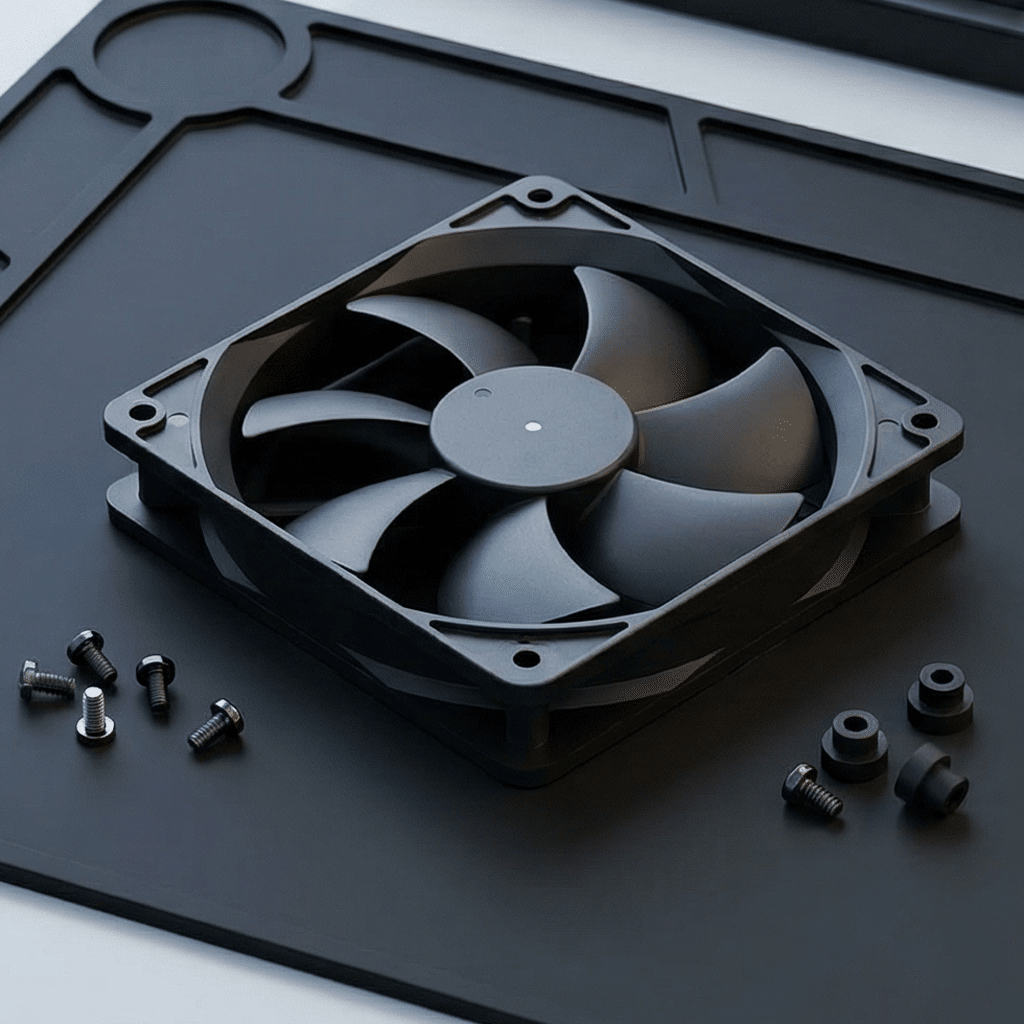
The working principle of an axial fan is similar to that of a household fan. When the blades rotate, they push air to flow axially, that is, the direction of the airflow is parallel to the fan axis. This design allows air to pass directly through the fan, forming a linear airflow, which is suitable for scenarios where heat needs to be "discharged" quickly.
Centrifugal fans are different. Their blades are arranged radially. Air enters from the center of the fan and is thrown out radially under the action of centrifugal force, and the direction of the airflow is perpendicular to the fan axis. This structure can "compress" the air, allowing the airflow to obtain higher pressure.
2. Comparison of Cooling Effects: The "Game" Between Air Volume and Air Pressure
2.1 Axial Fan: Large Air Volume, Low Air Pressure
The advantage of axial fans is that they have large air volume, which can drive more air flow per unit time, making them suitable for environments with concentrated heat and open spaces. For example, inside a computer case, axial fans can quickly "blow away" the heat generated by the CPU and graphics card and discharge it through the case's air duct. However, its air pressure is low. When the airflow encounters obstacles (such as dense heat sink fins, complex pipelines), the wind force is easily attenuated, and the cooling efficiency will decrease significantly.
2.2 Centrifugal Fan: High Air Pressure, Small Air Volume
The core advantage of centrifugal fans is high air pressure, which can push airflow through narrow channels or spaces with high resistance. For example, in air conditioners, projectors and other equipment, the heat sink fins are arranged closely, and centrifugal fans can "press" cold air into the fin gaps by virtue of high air pressure to take away heat. However, its air volume is relatively small, and in open spaces, the cooling coverage is not as wide as that of axial fans.
3. Summary of Advantages and Disadvantages: Key Judgment Basis for Applicable Scenarios
|
Type
|
Advantages
|
Disadvantages
|
|
Axial Fan
|
Sufficient air volume, fast cooling speed; simple structure, low cost; relatively low noise (under the same power)
|
Low air pressure, weak resistance to resistance; fixed airflow direction, poor flexibility
|
|
Centrifugal Fan
|
High air pressure, suitable for complex air ducts or closed spaces; airflow direction can be guided through pipelines, strong flexibility
|
Small air volume, narrow cooling coverage; complex structure, high cost; relatively high noise
|
4. Applicable Scenarios: Choose the Right Fan According to the Environment
4.1 Best Scenarios for Axial Fans
- Open space cooling: such as computer cases, server racks (non-closed), industrial motor surfaces, etc., which need to quickly "dissipate" heat to the surrounding environment.
- Low-resistance cooling systems: such as power supplies with sparse heat sink fins, small household appliances (microwaves, set-top boxes), where the airflow does not need to overcome too much resistance.
- Scenarios sensitive to cost and noise: household equipment, office equipment, etc. Axial fans have more advantages in economy and quietness.
4.2 Best Scenarios for Centrifugal Fans
- Closed or complex air ducts: such as air conditioners, heat pump units, automobile engine compartments (pipeline cooling), which require air pressure to overcome pipeline resistance.
- High-resistance cooling components: such as dense heat sink fins (LED street lights, medical equipment chips), small closed instruments (projectors, laser printers), which need to "penetrate" obstacles for cooling.
- Scenarios requiring directional air guidance: such as ovens and industrial ovens, where hot/cold air can be guided to designated areas through pipelines. The controllability of centrifugal fan airflow is more applicable.
5. Conclusion: There Is No "Absolutely Better", Only "More Suitable"
The cooling effect of axial fans and centrifugal fans is essentially a balance between "air volume" and "air pressure". If your equipment needs to dissipate heat quickly in an open space and there are no obvious obstacles in the heat dissipation path, axial fans are a cost-effective choice; if the internal structure of the equipment is complex, the air duct is narrow, or directional air guidance is required, the high air pressure of centrifugal fans can better ensure cooling efficiency.
When choosing, you might as well clarify two questions first: Is the heat dissipation space of the equipment open? Does the airflow need to pass through obstacles? The answers will help you quickly lock in the most suitable fan type.
Ultimate Guide to Waterproof & Dustproof AC/DC Fans
2025 AC/DC Cooling Fan Technology Trends-Development Directions of Quietness, Energy Efficiency, and Intelligence
Related Article
hoose a cooling fan at the operating point where its published performance curve meets the resistance of the finished equipment—not at the fan’s maximum free-air CFM.
How Do You Choose a Cooling Fan by Static Pressure and Airflow

Set cooling fan airflow so cool supply air reaches the highest-heat components first and hot air exits without returning to the intake. Verify the airflow arrow molded on the fan frame, not the visible blade shape.
How Do You Set Cooling Fan Airflow Direction in Electronic Equipment?

An axial fan is usually better for moving a large volume of air through a low-resistance enclosure, while a centrifugal blower is usually better when air must pass through dense heat sinks, filters, narrow ducts or other high-resistance components.
Axial Fan vs Centrifugal Blower- Which Is Better for Electronics Cooling