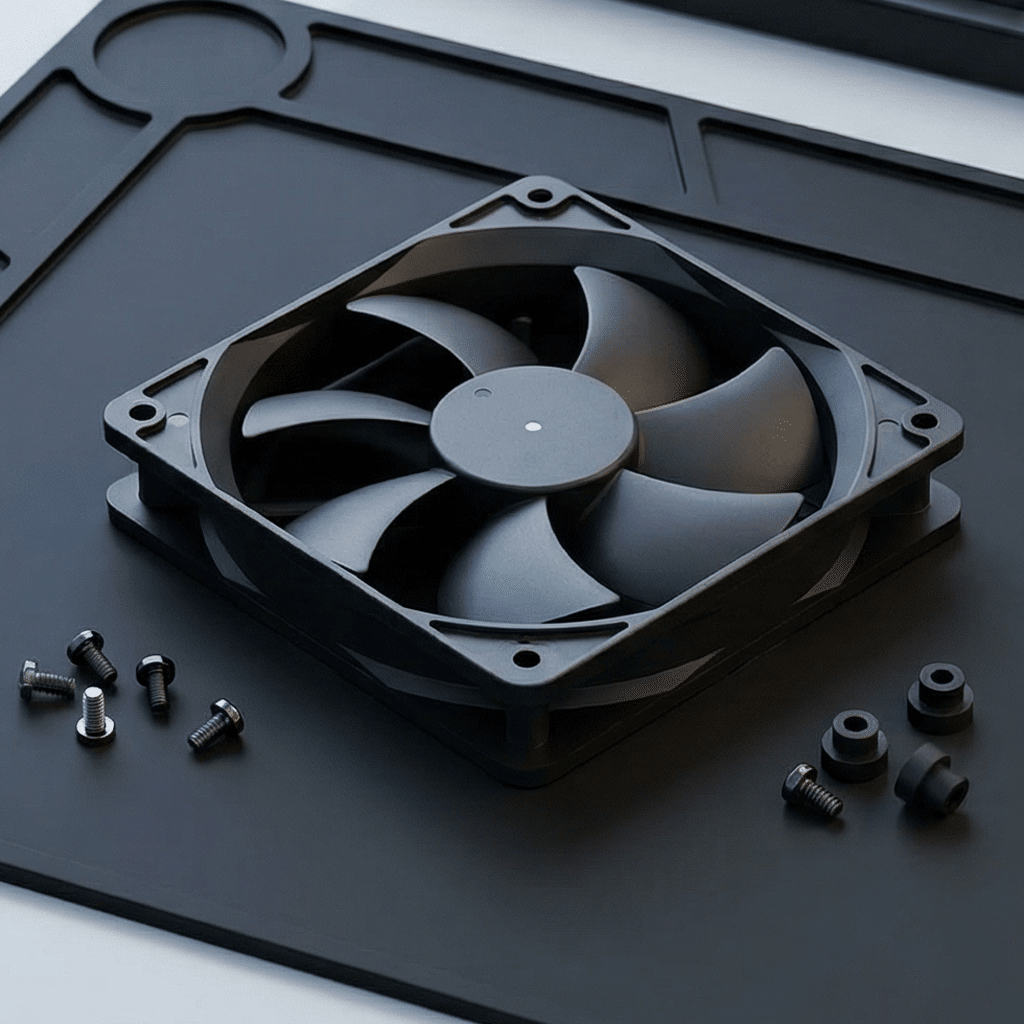
Why Do Laboratory Precision Instruments Depend on High-Quality DC Cooling Fans?
Why Do Laboratory Precision Instruments Depend on High-Quality DC Cooling Fans?
From spectrometers detecting parts-per-billion traces to centrifuges spinning at 15,000 RPM, laboratory instruments demand thermal stability measured in hundredths of a degree. The humble DC cooling fan — engineered for low vibration, low noise, and high reliability — is the unsung hero keeping modern science accurate.
The Precision Cooling Paradox in Modern Laboratories
Walk into any modern analytical laboratory and you'll find instruments that would have been unimaginable two decades ago. Inductively coupled plasma mass spectrometers (ICP-MS) detect trace elements at parts-per-trillion. Next-generation DNA sequencers process billions of base pairs in a single run. High-performance liquid chromatography (HPLC) systems separate compounds with sub-nanometer precision. Confocal microscopes image living cells at 200-nanometer resolution for hours on end.
What do all these instruments have in common? They generate substantial heat — and they cannot tolerate temperature fluctuations of even a tenth of a degree without compromising measurement accuracy. This creates a paradox: the instruments need active cooling to function, but the cooling solution itself must not introduce vibration, electromagnetic interference, or acoustic noise that could degrade the very measurements the instrument is designed to make. 实验仪器散热 (laboratory instrument heat dissipation) is thus a discipline unto itself, occupying the intersection of thermal engineering, mechanical vibration control, and acoustic design.
📊 The Scale of the Problem
A typical mid-sized research laboratory operates 15–30 precision instruments simultaneously, drawing 5–25 kW of total electrical power — nearly all of which converts to heat. The cooling fans inside these instruments must run 24/7 for months at a time without maintenance, often in environments where a single fan failure can invalidate weeks of experimental data. The global market for laboratory precision cooling fans exceeds $480 million annually and is growing at 7.2% CAGR, driven by the proliferation of thermally sensitive analytical instruments in pharmaceuticals, genomics, and materials science research.
The solution — increasingly adopted by every major laboratory instrument manufacturer — is the high-precision DC brushless cooling fan. Not just any DC fan, but one specifically engineered for low vibration, low noise, and long-term reliability. In this guide, we examine the specific thermal challenges of laboratory instruments, the three non-negotiable cooling requirements, and how 科研设备风扇 (research equipment fans) are designed to meet them.
1. Where the Heat Comes From in Lab Instruments
Laboratory instruments are thermally dense by nature. Unlike consumer electronics, where thermal design has the luxury of a large chassis and moderate power density, lab instruments pack high-power optical, electronic, and mechanical subsystems into compact, often sealed enclosures — because the enclosure itself must provide optical isolation, electromagnetic shielding, or contamination control. The result is extreme heat density in a space-constrained package.
| Heat Source Category | Typical Instruments | Heat Output Range | Temperature Sensitivity | Cooling Criticality |
|---|---|---|---|---|
| Light sources (laser, xenon lamp, LED) | Spectrometers, fluorimeters, confocal microscopes | 5–150 W | ±0.05°C for wavelength stability | Critical — thermal drift shifts spectral peaks |
| RF / plasma generators | ICP-MS, ICP-OES, MRI scanners | 200–1,500 W | ±0.5°C for plasma stability | Critical — plasma temperature affects ionization efficiency |
| Peltier / thermoelectric modules | PCR thermal cyclers, CCD detectors, sample chillers | 20–200 W (heat rejection side) | ±0.1°C for thermal cycling accuracy | Critical — hot-side cooling determines cold-side performance |
| High-speed motors & spindles | Ultracentrifuges, microtomes, stirrer drives | 50–500 W | ±1°C for bearing life & sample integrity | High — overheating triggers safety shutdown |
| Power electronics (SMPS, motor drivers) | All instruments with internal power supplies | 10–300 W (losses) | ±2°C for component reliability | Moderate — affects long-term MTBF |
| Compute & data acquisition electronics | Sequencers, imagers, real-time analysis systems | 15–200 W | ±1°C for clock stability & ADC precision | High — thermal drift introduces measurement noise |
🧪 The ICP-MS Thermal Cascade
Consider an ICP-MS as a thermal case study. The plasma torch operates at 6,000–8,000°K, generating ~1,200W of waste heat that must be removed from the interface region. The RF generator adds another 300W. The detector (electron multiplier) must be maintained below 35°C for stable gain. The vacuum pumps' drive electronics add 150W. All of this heat must be managed by DC fans in a chassis typically the size of a filing cabinet — and the plasma interface temperature must remain stable within ±0.5°C for the instrument to maintain its calibrated sensitivity. A single fan failure in the interface cooling path causes plasma instability within 90 seconds, invalidating any ongoing analysis.
2. The Three Non-Negotiables: Vibration, Noise, Reliability
What separates a precision instrument fan from a standard DC fan? It's not just airflow or static pressure specifications. Laboratory instruments impose three constraints that are rarely encountered in other cooling applications — and failure to meet any one of them can render a multi-hundred-thousand-dollar instrument unusable.
Vibration is the single most destructive side effect of active cooling in precision instruments. Many laboratory measurements rely on optical paths, mechanical positioning, or fluid dynamics that are exquisitely sensitive to mechanical disturbance. A fan vibrating at even a modest amplitude can introduce measurement noise that masquerades as signal — or worse, systematically biases results in a way that's difficult to detect.
| Instrument Type | Vibration-Sensitive Component | Max Allowable Vibration | Failure Mode If Exceeded |
|---|---|---|---|
| Atomic Force Microscope (AFM) | Cantilever tip (<1nm resolution) | <0.005g (0.05 m/s²) | Surface image blurring, false topographic features |
| Confocal / fluorescence microscope | Objective lens & stage | <0.02g | Focus drift, Z-axis image stack misalignment |
| FTIR / Raman spectrometer | Interferometer mirror / sample stage | <0.01g | Spectral line broadening, ghost peaks |
| Ultracentrifuge (100k+ RPM) | Rotor & drive bearing | <0.05g (structural) | Rotor imbalance, catastrophic bearing failure |
| HPLC system | Detector flow cell & pump | <0.03g | Baseline noise, peak shape distortion |
| Mass spectrometer (quadrupole) | Quadrupole rod assembly | <0.02g | Mass accuracy drift, resolution degradation |
High-quality 低振动风扇 (low-vibration fans) for laboratory use incorporate several design features that distinguish them from commodity fans:
Dynamically balanced impellers: Every impeller is individually balanced to G2.5 or better per ISO 1940-1, compared to G6.3 typical for commercial fans. This reduces residual imbalance forces by 60–80%.
Precision ball bearings with pre-loaded assemblies: Dual ball bearing configurations with controlled radial preload eliminate bearing play that causes vibration at specific RPM bands. Ceramic hybrid bearings (steel rings with Si₃N₄ balls) further reduce vibration by 30–40% due to lower mass and higher stiffness.
Reinforced frame construction: Thicker die-cast aluminum or stainless steel frames (1.5–2.5mm wall thickness vs. 0.8–1.2mm for commercial fans) increase structural stiffness, raising the frame's natural resonance frequency above the fan's operating speed range.
Anti-vibration mounting options: Precision lab fans are supplied with silicone or elastomer isolation grommets rated for specific frequency ranges, breaking the vibration transmission path between the fan frame and the instrument chassis.
📏 Vibration Measurement Protocol
Reputable precision fan manufacturers provide vibration test data measured per ISO 10816, typically expressed as RMS vibration velocity (mm/s) at the fan mounting points across the full operating speed range. A fan suitable for laboratory use should exhibit <0.5 mm/s RMS at the rated speed, measured at three axes (X, Y, Z). For ultra-sensitive instruments (AFM, interferometers), fans with <0.2 mm/s RMS — achieved through active magnetic balancing or fluid dynamic bearings with herringbone grooves — may be required.
Laboratories are acoustic environments where measurement sensitivity and human concentration both demand quiet operation. Many analytical techniques — particularly those involving acoustic detection, ultrasonic measurement, or audio-frequency signal analysis — are directly corrupted by fan noise. Additionally, researchers spending 8–12 hours in proximity to instruments report fatigue, headache, and reduced cognitive performance when ambient noise exceeds 45 dBA. OSHA and ISO guidelines recommend maintaining laboratory ambient noise below 55 dBA, and the quietest research environments target 35–40 dBA.
| Lab Environment | Target Ambient Noise | Fan Noise Budget | Typical Strategy |
|---|---|---|---|
| Genomics / sequencing core | <45 dBA | <28 dBA per fan | Multi-speed PWM, insulated ducts |
| Analytical chemistry lab | <50 dBA | <32 dBA per fan | Low-RPM oversized fans |
| Microscopy / imaging suite | <35 dBA | <20 dBA per fan | FDB fans, acoustic enclosure, remote mounting |
| Electrophysiology / patch-clamp | <30 dBA | <15 dBA per fan | Thermoelectric cooling, fanless option, or vibration-isolated external blower |
| Acoustic / ultrasonic measurement lab | <25 dBA (anechoic) | Near-zero | Fanless design or remote cooling via ducted external airflow |
The noise reduction techniques employed in laboratory-grade DC fans go well beyond simply reducing fan speed:
Hydrodynamic bearing (FDB) technology: Fluid dynamic bearings eliminate the metal-to-metal contact of ball bearings, reducing mechanical noise by 8–12 dBA compared to ball bearing fans of equivalent airflow. The oil film also provides inherent damping of impeller micro-vibrations. FDB fans are the preferred choice for microscopy and electrophysiology applications.
Asymmetric blade spacing: Conventional fans with evenly spaced blades produce a tonal whine at the blade-pass frequency. Asymmetric blade spacing distributes acoustic energy across a broader spectrum, converting an annoying pure tone into a less noticeable broadband hiss. The perceived loudness reduction is typically 3–6 dBA.
Aerodynamic blade optimization: CFD-optimized blade profiles with variable chord length, sweep, and camber reduce turbulent airflow separation at the blade tips — the primary source of broadband fan noise. Leading-edge serrations (bionic owl-feather design) further reduce trailing-edge noise by 2–4 dBA in the 1–4 kHz range where human hearing is most sensitive.
Variable-speed PWM control with thermal mapping: Rather than running at a fixed speed, laboratory fans use instrument-mapped PWM profiles that match fan speed to actual thermal demand at each operating mode. An ICP-MS in "standby" mode may need only 25% fan speed (18 dBA), ramping to 60% (28 dBA) only during active analysis — a profile that keeps average noise levels well below the continuous full-speed value.
Laboratory instruments are expected to run continuously — some for months at a time between scheduled maintenance windows. A DNA sequencer may run 72-hour protocols back-to-back for weeks. An HPLC system in a clinical lab runs 16+ hours daily with zero downtime tolerance. An ICP-MS in an environmental testing lab processes hundreds of samples per day, and every hour of unplanned downtime costs $200–800 in lost throughput.
| Reliability Metric | Commercial Fan | Laboratory-Grade Fan | Why It Matters |
|---|---|---|---|
| MTBF (mean time between failures) | 30,000–50,000 hrs | 80,000–120,000 hrs | 9–14 years continuous operation |
| L10 bearing life at 40°C | 40,000–60,000 hrs | 70,000–100,000 hrs | Survives multi-year 24/7 duty cycles |
| Operating temperature range | -10°C to +70°C | -20°C to +85°C | Cold-room labs, incubator-adjacent installations |
| Conformal coating on PCB | None or optional | Standard (acrylic or silicone) | Resists chemical fumes, humidity, condensation |
| Bearing seal rating | IP20–IP40 | IP54–IP68 | Dust, bio-aerosol, and liquid splash resistance |
| Locked-rotor protection | None | Auto-restart + thermal cutoff | Prevents fire risk and allows recovery without intervention |
| Tachometer (FG) signal output | Optional | Standard | Instrument firmware monitors fan health in real time |
| Life prediction / end-of-life signal | None | Available (rotation deviation alarm) | Enables predictive maintenance before failure |
📉 The Cost of Fan Failure in a Laboratory
When a cooling fan fails in a consumer device, the device shuts down and the user replaces it. When a fan fails in a laboratory instrument, the consequences cascade: (1) The instrument's thermal protection triggers an emergency shutdown mid-run, invalidating all data collected since the last calibration point. (2) Samples may be destroyed — a 96-well plate of amplified DNA worth $2,000–10,000 in reagents and technician time, or a tissue sample that cannot be re-collected. (3) The instrument may require recalibration before returning to service (4–24 hours of downtime). (4) In some cases, thermal damage to detectors or optical components requires factory service ($5,000–50,000). The total cost of a single fan failure in a high-end instrument can exceed $20,000 — making the price difference between a $3 commercial fan and a $15 laboratory-grade fan irrelevant.
3. How Precision DC Fans Meet Laboratory Standards
Given the three non-negotiable requirements, why are DC brushless fans the preferred cooling solution for laboratory instruments — rather than alternative technologies like thermoelectric coolers, heat pipes, or liquid cooling? The answer lies in a combination of practical advantages that no single alternative can match.
DC brushless fans deliver the highest airflow per unit of vibration of any active cooling technology. A 40mm laboratory-grade DC fan can deliver 12–18 CFM with vibration below 0.3 mm/s RMS — a ratio unmatched by AC fans (which vibrate 3–5x more due to 50/60 Hz electromagnetic pulsation), piezoelectric fans (which deliver 10x less airflow at equivalent vibration), or liquid pumps (which transmit pump-motor vibration through the coolant lines).
| Cooling Technology | Airflow (CFM) | Vibration (mm/s RMS) | Noise (dBA) | MTBF (hrs) | Cost Index |
|---|---|---|---|---|---|
| DC brushless fan (precision-grade) | 5–80 | 0.2–0.5 | 15–32 | 80k–120k | 1.0x |
| AC axial fan | 10–100 | 1.5–3.0 | 30–45 | 30k–50k | 0.6x |
| Piezoelectric fan | 0.5–3 | 0.1–0.3 | 10–18 | 50k–80k | 3.5x |
| Liquid cooling (pump + radiator fan) | N/A (liquid) | 0.5–1.5 | 25–35 | 40k–60k | 5.0x |
| Thermoelectric cooler (TEC) | N/A (conduction) | 0.0 | 0 (fanless) | 100k+ | 8.0x |
| Heat pipe (passive) | N/A (conduction) | 0.0 | 0 | 100k+ | 2.0x |
🔍 Why Not TEC or Heat Pipes Everywhere?
Thermoelectric coolers and heat pipes offer zero vibration and zero noise — so why aren't they used exclusively? Because they have critical limitations: TECs have low coefficient of performance (COP 0.3–0.7), meaning they consume 2–3x more electrical power than the heat they remove — and that heat must still be dissipated from the hot side, usually by a fan. Heat pipes can only move heat, not remove it; they require an external heat rejection surface (fin array + airflow). In practice, most precision instruments use a hybrid approach: heat pipes or TECs for spot cooling of vibration-critical components (detectors, lasers), paired with DC fans for bulk heat removal from the chassis. The DC fan remains indispensable for overall laboratory equipment cooling because it provides the volumetric airflow that no conduction-based solution can deliver.
The ±0.01°C temperature stability required by many instruments is achieved not by brute-force overcooling, but by precise matching of cooling capacity to instantaneous heat load. DC brushless fans with PWM control offer the finest speed resolution of any fan technology:
| Speed Control Method | Speed Range | Resolution | Thermal Stability | Appropriate For |
|---|---|---|---|---|
| Fixed-speed (on/off only) | 0% or 100% | Binary | ±2–5°C | Low-precision equipment, power supplies |
| Voltage control (linear) | 40–100% | ±5% | ±1–2°C | General lab equipment, incubators |
| PWM control (25 kHz) | 10–100% | ±1% | ±0.3–0.5°C | Spectrometers, HPLC, PCR cyclers |
| Closed-loop PWM + RTD feedback | 5–100% | ±0.1% | ±0.02–0.1°C | ICP-MS, AFM, interferometers, reference standards |
In the most demanding instruments, the DC fan's PWM signal is driven by a PID control loop that reads temperature from RTD sensors placed at critical thermal zones. The fan speed is updated every 50–100ms, achieving thermal stability of ±0.02°C — a level impossible with any passive cooling or fixed-speed fan approach. This closed-loop architecture is the standard for precision instrument fan integration in modern analytical equipment.
Laboratory instruments contain extremely sensitive analog electronics — photomultiplier tubes, charge-coupled devices (CCDs), electrometers, and preamplifiers that operate at picoampere signal levels. Any electromagnetic interference (EMI) from a cooling fan can couple into these circuits and corrupt measurements. DC brushless fans with internal commutation electronics generate some EMI, but laboratory-grade fans are designed to minimize it:
Shielded motor construction: The motor windings and Hall-effect sensor PCB are enclosed in a grounded metallic housing, containing radiated EMI to levels below CISPR 11 Class B (suitable for residential and light industrial environments).
Filtered lead wires: Ferrite beads and bypass capacitors on the power and signal leads suppress conducted EMI on the cable, preventing it from coupling into the instrument's internal wiring harness.
Low-EMI commutation design: Sinusoidal commutation (rather than trapezoidal) reduces current ripple and associated EMI by 10–15 dB compared to standard BLDC fans, at a modest cost premium.
| EMC Parameter | Commercial Fan | Laboratory-Grade Fan | Relevant Standard |
|---|---|---|---|
| Radiated emissions (30–230 MHz) | 40 dBµV/m @ 3m | 30 dBµV/m @ 3m | CISPR 11 Class A / B |
| Conducted emissions (150kHz–30MHz) | 66 dBµV (quasi-peak) | 56 dBµV (quasi-peak) | CISPR 11 Class A / B |
| Magnetic field at 10mm distance | 2–5 µT | <0.5 µT | Internal instrument spec |
| Current ripple at PWM frequency | ±15% of nominal | ±3% of nominal | Internal instrument spec |
Laboratories are not benign environments. Chemical fumes (acids, solvents, ammonia), biological aerosols, humidity fluctuations, and occasional spills all challenge fan longevity. A commercial fan in a chemistry lab may corrode within 6–12 months; a laboratory-grade fan is engineered to survive for years:
Conformal coating: Acrylic (AR) or silicone (SR) conformal coating on the fan's PCB and motor windings provides a moisture and chemical barrier. Silicone coating is preferred for chemistry labs (better acid resistance); acrylic for biology labs (easier rework). Coating thickness of 25–75 µm provides IP54-equivalent protection without sealed enclosures.
Stainless steel shafts and hardware: 300-series stainless steel resists corrosion from acidic and alkaline fumes that would pit and seize carbon steel shafts within months. Essential for fume hood installations and chemical storage areas.
Polymer impeller options: For extreme chemical environments, PBT or PPS (polyphenylene sulfide) impellers replace standard glass-filled nylon, offering resistance to strong acids, bases, and organic solvents. PPS impellers survive continuous exposure to hydrochloric acid, sulfuric acid, and toluene vapors.
Sealed bearing options: Fans with IP68-rated bearing seals prevent ingress of bio-aerosols and liquid splashes, critical for BSL-2/3 biological safety cabinets and medical diagnostic instruments.
4. Application Case Studies by Instrument Type
The requirements for 科研设备风扇 (research equipment fans) vary significantly across instrument categories. Here's how precision DC fans are deployed in six major laboratory instrument types:
Spectrometers (UV-Vis, FTIR, ICP-OES)
The optical bench of a spectrometer must maintain thermal uniformity within ±0.1°C to prevent wavelength drift and baseline shift. Light sources (deuterium lamps, tungsten-halogen lamps, xenon arc lamps) generate 50–150W of heat that must be removed without introducing vibration to the monochromator or interferometer. Precision DC fans (40–60mm, FDB bearing) are typically deployed in a push-pull configuration across the lamp housing, with the spectrometer optical bench thermally isolated by a baffle. PWM speed control is linked to lamp current, ramping fan speed proportionally to lamp power output. Vibration isolation grommets are mandatory to prevent coupling into the interferometer.
Fan: 40–60mm FDB | 12V DC | PWM closed-loopUltracentrifuges & High-Speed Centrifuges
Centrifuges spinning at 15,000–150,000 RPM generate enormous heat from air friction and motor losses — 100–800W depending on rotor speed and vacuum level. The drive motor and bearing assembly must be cooled to maintain rotor stability and prevent lubricant breakdown. Precision DC fans (60–120mm, dual ball bearing for high-temperature operation) provide forced-air cooling of the motor housing and drive electronics. Vibration is less critical here (the rotor itself dominates the vibration spectrum) but reliability is paramount: a fan failure during a 24-hour ultracentrifuge run can destroy both the sample and the rotor ($3,000–25,000). Dual-fan redundant configurations with automatic switchover are standard.
Fan: 80–120mm dual BB | 24V DC | Redundant pairIncubators & Environmental Chambers
CO₂ incubators, refrigerated incubators, and stability chambers must maintain internal temperature within ±0.1–0.5°C for cell culture, pharmaceutical stability testing, and materials aging studies. The internal air circulation fan must run 24/7 for years without failure, at low speed (to avoid drying out cultures or disturbing samples), and with zero vibration transfer to sample shelves. Large-diameter (120–172mm), low-RPM DC fans with FDB bearings provide gentle, uniform air circulation at 15–22 dBA. Chemical-resistant construction (stainless shaft, PBT impeller) is essential for CO₂ incubators where high humidity and biological contamination are constant factors.
Fan: 120–172mm FDB | 12V/24V DC | Fixed low-speedPCR Thermal Cyclers
PCR thermal cyclers rely on Peltier (thermoelectric) modules to rapidly cycle sample blocks between 4°C and 98°C — sometimes completing 40 cycles in under 60 minutes. The Peltier modules' hot side must be actively cooled to achieve fast ramp-down rates (2–6°C/second). High-static-pressure DC blower fans (centrifugal type, 50–80mm) push air through dense fin arrays attached to the Peltier hot side. The fan's speed directly impacts the instrument's throughput: faster cooling = shorter cycle time = more samples per day. Fan noise is secondary to airflow performance in this application, but reliability remains critical — a fan failure mid-run destroys the PCR reaction.
Fan: 50–80mm blower | 12V/24V DC | High static pressureHPLC & Liquid Chromatography Systems
HPLC systems house UV-Vis photodiode array detectors, column ovens (30–80°C), autosampler cooling (4–8°C), and solvent degassers — each with distinct thermal requirements. The detector's photodiode array must be thermostatized to ±0.1°C for baseline stability; the column oven must maintain ±0.2°C for retention time reproducibility. Multiple small DC fans (25–40mm, FDB) provide zoned cooling: one for the detector, one for the column oven exhaust, one for the pump motor drive. Vibration is critical — pump pulsation is already the dominant noise source in HPLC, and any additional vibration from fans degrades baseline noise performance.
Fan: 25–40mm FDB | 5V/12V DC | PWM per zoneMass Spectrometers (LC-MS, ICP-MS, MALDI-TOF)
Mass spectrometers combine the most extreme thermal management challenges in the laboratory: RF generators (300–1,500W), plasma or ion sources (600–1,200W), vacuum pump drive electronics (150–400W), and temperature-sensitive detectors (electron multipliers, <35°C). A single ICP-MS may contain 8–14 DC fans of varying sizes, each serving a specific thermal zone with its own speed control profile. The plasma interface cooling fans (80–120mm, high-airflow) are the most critical — their failure invalidates the instrument within 90 seconds. Redundant fan pairs with independent speed monitoring are standard in the interface zone. Lower-criticality zones (power supply, vacuum pump drive) use single fans with tachometer feedback.
Fan: 40–120mm mixed | 12V/24V DC | Multi-zone PWM5. Integration & Design Considerations
Integrating DC fans into laboratory instruments requires more than selecting a fan with the right CFM and noise specifications. The following engineering rules separate instruments that perform to specification for years from those that develop thermal drift, vibration noise, or premature fan failures:
Rule 1 — Thermal zoning with dedicated airflow paths. Never cool multiple thermally incompatible zones with a single airflow stream. The lamp housing of a spectrometer (80°C exhaust) should not feed air into the detector compartment (25°C target). Design dedicated airflow paths with physical baffles separating zones, each with its own fan sized for that zone's heat load and temperature target.
Rule 2 — Vibration isolation hierarchy. The vibration sensitivity of instrument components follows a clear hierarchy: interferometers > AFM cantilevers > optical stages > detectors > electronics. Mount fans as far as possible from the most vibration-sensitive components, and install at least one vibration isolation layer (silicone grommets, elastomer pad, or flexible duct section) between every fan and the chassis.
Rule 3 — Redundancy for single-point-of-failure cooling paths. Any fan whose failure would cause instrument shutdown, data loss, or sample destruction within 5 minutes must have a redundant backup. Dual fans in push-pull or side-by-side configurations, each sized to handle 60–70% of the thermal load alone, ensure continued operation even if one fan fails. The instrument firmware must detect the failure via tachometer signal and issue a maintenance alert.
Rule 4 — Filtered intake for long-term reliability. Laboratory air contains dust, paper fibers, chemical crystals, and biological aerosols that accumulate on fan blades and heat sink fins over months of operation. Install removable, cleanable intake filters (mesh or porous foam) upstream of every fan. The filter should be accessible without disassembling the instrument and should be specified for cleaning at routine maintenance intervals (3–6 months).
Rule 5 — Acoustic design from the concept stage. Fan noise is additive — two 28 dBA fans in the same chassis produce 31 dBA combined. An instrument with 6 fans (not uncommon in mass spectrometers) can easily exceed 40 dBA if each fan contributes 30 dBA. Design the acoustic budget at the concept stage: allocate noise budgets per zone, select fans that meet their budget, and use acoustic foam lining, duct silencers, and speed management to stay within the total instrument noise target.
📐 Airflow Simulation for Laboratory Instruments
CFD (computational fluid dynamics) simulation is even more valuable in laboratory instrument design than in consumer electronics, because the thermal targets are tighter and the cost of physical iteration is higher. A 3D CFD model of the instrument chassis — including all heat-generating components, airflow paths, and fan operating curves — can predict temperature distributions within 5–10% accuracy and identify hot spots, airflow short circuits, and stagnation zones before the first prototype is built. For instruments targeting ±0.1°C thermal stability, CFD simulation is not optional — it is a prerequisite for achieving the thermal targets within a reasonable number of design iterations.
Selection Guide: Fan Specs by Instrument Category
Use the following table as a starting point for sourcing laboratory equipment cooling fans. All specifications assume 25°C ambient, sea-level altitude. Derate airflow by 10% per 1,000m altitude and by 5% per 5°C above 25°C ambient.
| Instrument Category | Fan Size | Bearing Type | Voltage | Airflow | Noise Target | Vibration Target | Control |
|---|---|---|---|---|---|---|---|
| Spectrometer (lamp housing) | 40–60mm axial | FDB | 12V DC | 10–25 CFM | <28 dBA | <0.3 mm/s | PWM (lamp-current linked) |
| Ultracentrifuge (motor cooling) | 80–120mm axial | Dual ball (ceramic hybrid) | 24V DC | 40–80 CFM | <40 dBA | <0.8 mm/s | Fixed speed + redundant |
| CO₂ incubator (air circulation) | 120–172mm axial | FDB | 12V/24V DC | 30–60 CFM | <22 dBA | <0.2 mm/s | Fixed low-speed |
| PCR thermal cycler (Peltier hot side) | 50–80mm blower | Dual ball | 12V/24V DC | 15–30 CFM (high SP) | <35 dBA | <0.5 mm/s | PWM (ramp-rate linked) |
| HPLC detector / column oven | 25–40mm axial | FDB | 5V/12V DC | 4–12 CFM | <22 dBA | <0.15 mm/s | PWM per zone |
| Mass spectrometer (plasma interface) | 80–120mm axial (redundant) | Dual ball | 24V DC | 50–100 CFM | <42 dBA | <0.6 mm/s | PWM + tach monitor |
| Confocal microscope (lamp + detector) | 40–60mm axial | FDB (low-vibe) | 12V DC | 8–18 CFM | <20 dBA | <0.1 mm/s | Closed-loop PWM |
| BSL-2/3 safety cabinet | 120–172mm axial (sealed) | FDB (IP68 seal) | 24V DC | 40–80 CFM | <35 dBA | <0.3 mm/s | Fixed speed + tach alarm |
🎯 OEM Specification Checklist for Laboratory-Grade Fans
✅ Vibration test data: Request ISO 10816 vibration velocity data (mm/s RMS) at rated speed, measured at three axes
✅ Acoustic spectrum: Request 1/3 octave band noise data (not just overall dBA) to identify tonal components
✅ Bearing life data: Request L10 life curves at multiple temperatures (25°C, 40°C, 60°C)
✅ Conformal coating spec: Confirm coating type (acrylic/silicone), thickness, and coverage area
✅ Shaft material: Confirm stainless steel (300-series) for chemistry/biology lab applications
✅ Impeller material: Confirm PBT or PPS for chemically aggressive environments; nylon acceptable for clean labs
✅ EMC compliance: Request CISPR 11 test report (Class A minimum, Class B preferred)
✅ Tachometer signal: Confirm open-collector FG output with pull-up resistor spec
✅ Locked-rotor protection: Confirm auto-restart function and thermal cutoff temperature
✅ PWM frequency: Confirm 25 kHz standard to avoid audible PWM tones in quiet lab environments
✅ MTBF calculation: Request MIL-HDBK-217 or similar MTBF calculation at laboratory ambient (25°C, 50% RH)
✅ Chemical resistance data: For fume hood or BSL installations, request compatibility data for common lab chemicals
🔬 Designing a Laboratory Instrument? Let's Engineer Your Cooling Solution.
We supply precision DC cooling fans engineered for laboratory instruments — low vibration (<0.2 mm/s), low noise (<18 dBA), high reliability (70k+ hrs MTBF), with conformal coating, stainless steel shafts, and closed-loop PWM control. Vibration test data, acoustic spectra, and CFD support available. Contact our engineering team for samples and consultation.
❓ FAQs on DC Fans for Laboratory Precision Instruments
Q: Can I use a standard commercial DC fan in my lab instrument if I add a vibration isolator?
A: Vibration isolators help, but they cannot fully compensate for a fan with poor dynamic balance. A commercial fan balanced to G6.3 generates residual imbalance forces that produce vibration across a broad frequency range — much of which passes through elastomer isolators (which are only effective near their tuned resonance frequency). For instruments requiring <0.1g vibration at the measurement point, a precision-balanced fan (G2.5 or better) is the starting point; isolators then reduce the remaining vibration by an additional 40–60%. The two approaches are complementary, not substitutive.
Q: How do I know if my instrument's fan is approaching end-of-life before it fails?
A: The most reliable indicator is rotational speed deviation at a fixed PWM duty cycle. As bearings wear, friction increases and the fan's speed at a given PWM input gradually decreases. A precision fan with tachometer (FG) output allows the instrument firmware to track RPM over time. When the RPM drops more than 15–20% below the baseline value at a given PWM duty and temperature, the fan should be scheduled for replacement. Some laboratory-grade fans also provide a dedicated "end-of-life" signal output that triggers when rotation deviation exceeds a threshold — a feature increasingly requested by instrument OEMs for predictive maintenance.
Q: My instrument runs in a cold room at 4°C. Do I need a special fan?
A: Standard commercial fans are rated for -10°C minimum, but their bearing lubricant viscosity increases dramatically at low temperatures, causing slow startup, high initial current draw, and accelerated bearing wear. Laboratory-grade fans specified for cold-room use use low-temperature lubricants (synthetic ester or PAO-based) rated to -20°C or below, with bearing seals that remain flexible at low temperatures. Also verify that the fan's start voltage is achievable at low temperatures — cold lubricant can increase startup torque by 30–50%, potentially preventing the fan from starting at minimum PWM duty. A thermostatic pre-heat function (running the fan at full speed for 10 seconds at startup) is a practical workaround.
Q: Can DC fans be used in explosion-proof laboratory environments?
A: Yes, but only with specific certifications. Standard DC fans are not explosion-proof — the motor commutation sparks and the PCB electronics can serve as ignition sources in environments with flammable gases or vapors. Explosion-proof DC fans are available with: (1) encapsulated motor windings (Ex d flameproof enclosure); (2) intrinsically safe circuit design (Ex i) limiting electrical energy below ignition thresholds; (3) anti-static impeller material (carbon-filled polymer to prevent static discharge). These fans carry ATEX or IECEx certifications for specific gas groups (IIA, IIB, IIC) and temperature classes (T1–T6). Always confirm the fan's certification matches your laboratory's hazardous area classification.
Q: How do I minimize fan noise in a microscopy suite where the instrument is 1 meter from the operator's ear?
A: Three strategies, applied in combination, bring even multi-fan instruments to near-inaudible levels in microscopy suites: (1) Select FDB fans rated 15–22 dBA at the required airflow — FDB eliminates ball-bearing mechanical noise, which is the dominant noise source in small fans. (2) Mount fans externally in a remote enclosure connected via flexible insulated ducts, moving the noise source 50–100cm from the operator. (3) Use acoustic foam lining (melamine or polyurethane, 15–25mm thick) on all internal surfaces of the fan enclosure and duct paths, absorbing 5–10 dBA of broadband fan noise. With all three strategies, a 6-fan instrument can be brought below 25 dBA at the operator position — quieter than a typical laboratory HVAC system.
Q: What's the difference between FDB and dual ball bearings for laboratory use — which should I choose?
A: For laboratory instruments, the choice depends on the primary constraint. FDB (fluid dynamic bearing) is preferred when noise and vibration are the top priorities: it's 8–12 dBA quieter than ball bearings, vibrates less, and is ideal for microscopy, spectroscopy, and any instrument near the operator. Its weakness is orientation sensitivity (some FDB designs cannot operate reliably in horizontal shaft orientation) and shorter life at high temperatures (above 60°C). Dual ball bearing is preferred when reliability and temperature resistance are paramount: it operates at any orientation, survives temperatures to 85°C+, and has more predictable life degradation. It's the standard choice for centrifuges, PCR cyclers, and mass spectrometer plasma zones. Ceramic hybrid ball bearings (Si₃N₄ balls) offer a premium middle ground: ball-bearing robustness with 30–40% less vibration and 2–3 dBA less noise than steel ball bearings.
DC Cooling Fan Manufacturer: How to Choose the Right Partner for Reliable Cooling Solutions
Home Appliances Getting Thinner, But What About Cooling? Ultra-Thin DC Fans Offer a Solution
Related Article