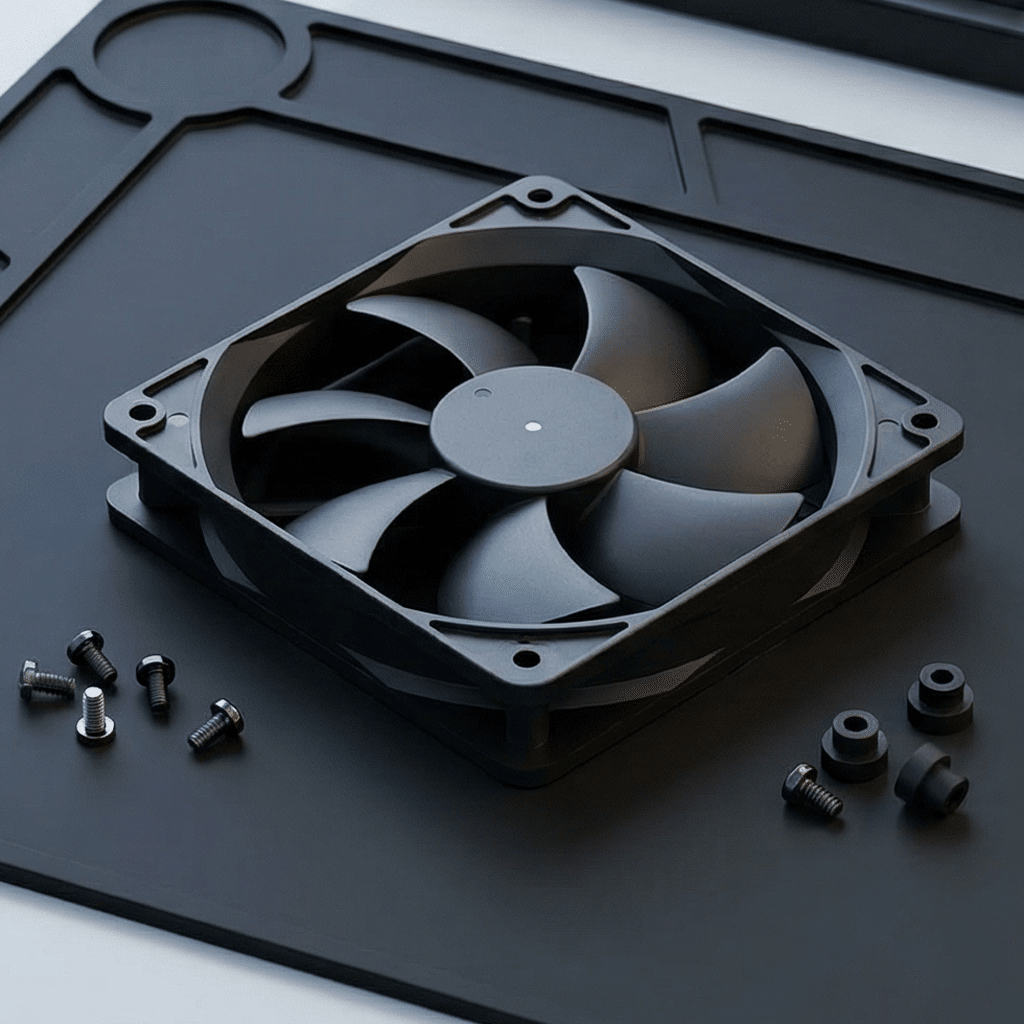
Home Appliances Getting Thinner, But What About Cooling? Ultra-Thin DC Fans Offer a Solution
Home Appliances Getting Thinner, But What About Cooling? Ultra-Thin DC Fans Offer a Solution
Modern TVs are now under 6mm thick, laser projectors sit flat on a shelf, and air purifiers double as furniture. As internal space shrinks and processing power grows, embedded cooling with ultra-thin DC fans has become the hidden engineering breakthrough making slim home appliances possible.
The Slim Paradox: Thinner Design, Hotter Internals
Consumer home appliances are in a race to the bottom — in the best possible way. Flat-panel TVs that once measured 10–15cm deep have been trimmed to under 15mm. Laser UST (ultra-short-throw) projectors that used to need ceiling mounts now sit on coffee tables at just 8cm tall. Smart air purifiers have evolved from boxy towers into wall-art panels under 4cm thick. Portable speakers, smart home hubs, wireless chargers, and even refrigerators are all trending in the same direction: thinner, lighter, more beautiful.
But there's a physics problem that no amount of industrial design talent can design away: the electronics inside these devices are not getting less powerful — they're getting more powerful. A modern QLED TV's processor handles 4K AI upscaling, HDR tone mapping, Dolby Atmos audio processing, and smart OS multitasking simultaneously. A laser projector's light engine and color wheel driver generate substantial heat in a package half the size of the previous generation. More processing power + less internal volume = a serious 家电散热 (home appliance heat dissipation) challenge.
📊 The Numbers Behind the Trend
Global flat-panel TV shipments have seen average panel thickness decrease by over 60% in the past decade, while SoC processing power (measured in TOPS for AI tasks) has increased by more than 10x in the same period. This means the heat density — watts per cubic centimeter inside the chassis — has increased dramatically, even as chassis volume has shrunk. The result: thermal management has gone from an afterthought to one of the top three engineering constraints in slim home appliance design, alongside display quality and power efficiency.
The solution lies in a component that's easy to overlook: the ultra-thin DC fan. Available in profiles as slim as 5–10mm, these miniature brushless fans make active 嵌入式散热 (embedded cooling) possible even inside the most space-constrained device enclosures. In this guide, we examine the specific cooling challenges of popular slim appliance categories and show how ultra-thin DC fans address each one.
1. Where the Heat Comes From in Slim Appliances
Unlike a desktop PC — which has a spacious chassis, dedicated CPU cooler, and multiple case fans — a slim home appliance must fit all its heat-generating components into a shallow volume measured in millimeters. Every component category has its own thermal signature:
| Component | Typical Heat Output | Risk at Excess Temp | Trend |
|---|---|---|---|
| Smart TV / display SoC | 3–8 W | Thermal throttle, image artifacts, reboot | ↑ Increasing (AI processing) |
| Backlight / LED driver board | 5–20 W | Brightness drop, uneven backlighting, LED aging | Stable |
| Laser projector light source | 20–60 W | Laser output drop, phosphor degradation | ↑ Increasing (brightness wars) |
| Power supply / SMPS | 5–25 W (losses only) | Capacitor aging, efficiency drop, MOSFET failure | Stable |
| Air purifier motor + HEPA fan | 8–50 W | Motor insulation degradation, reduced airflow | ↑ Increasing (slim + high CADR) |
| Wireless charging coil (fast charge) | 3–12 W (losses) | Derating, automatic power reduction | ↑ Increasing (100W+ fast charge) |
🧪 The Slim Device Thermal Trap
In a conventional appliance chassis, heat from any single component rises naturally and dissipates across a large internal air volume before reaching other components. In a slim chassis only 15–20mm deep, all components are packed into a flat plane within millimeters of each other. Heat from the power supply immediately raises the ambient temperature around the SoC, which in turn accelerates aging of the capacitors next to it. This thermal coupling effect means that poor cooling of one component cascades into accelerated aging across the entire board — a critical concern for 家电散热 (home appliance cooling) in thin-profile designs.
2. Case Studies: Where Ultra-Thin Cooling Is Needed Most
The slim fan home appliance challenge manifests differently across product categories. Here's a closer look at the four most demanding applications:
Ultra-Thin Flat Panel TVs
Modern OLED and QLED TVs under 15mm depth face the harshest thermal density challenge. The SoC, TCON board, power supply, and backlight driver are all crammed into a chassis shallower than a fingertip. Without active airflow, the area behind the screen can reach 70–80°C in sustained use, causing visible brightness reduction (thermal derate), picture processing artifacts, and premature OLED pixel degradation. A single ultra-thin axial fan (8–10mm profile) mounted horizontally along the bottom chassis creates a chimney effect, drawing cool air in from the bottom vent and exhausting heated air from the top.
Fan: 60–80mm × 8–10mm | 12V DC | PWMLaser UST Projectors
Ultra-short-throw laser projectors generate the most intense heat load among slim home appliances — a 3,000-lumen laser engine can dissipate 40–80W of thermal energy inside a cabinet just 8–12cm tall. The laser phosphor wheel must stay below 60°C or luminous flux drops rapidly and the blue laser diodes age prematurely. Most UST projectors use two ultra-thin fans in a push-pull configuration across a copper heat pipe array — one drawing cool air in from the side vents, one pushing heated air out through the rear. Noise management is critical here, as projectors are used in quiet home cinema environments.
Fan: 80–120mm × 10–15mm | 12V DC | PWM (dual)Slim Tower Air Purifiers
The new generation of "art panel" air purifiers — thin enough to hang on a wall or stand flat against a surface — presents a unique paradox: the main air-moving fan is the product's primary function, yet the electronics driving it (BLDC motor controller, PM2.5 sensor, Wi-Fi/BT module, display driver) all generate heat in a sealed electronics compartment at the unit's base. An ultra-thin DC blower fan (centrifugal type, 10–15mm profile) circulates air within this sealed electronics bay, keeping the motor driver IC and sensor electronics below 65°C without adding bulk to the product's slim silhouette.
Fan: 50–70mm blower × 10–15mm | 5V/12V DCSmart Speakers & Home Hubs
Always-on smart home devices — including smart speakers with displays, home security hubs, and multi-room audio controllers — run their AI voice processing and network communication chips 24/7. In compact cylindrical or flat-panel form factors under 30mm thick, there is virtually no natural convection. A single ultra-slim 25–40mm DC fan (5–7mm profile) mounted inside the base or back panel provides sufficient airflow (3–8 CFM) to keep always-on SoC temperatures below safe thresholds, with noise below ambient room levels at reduced PWM speed during quiet-mode operation.
Fan: 25–40mm × 5–7mm | 5V DC | PWMInduction Cooktop Control Boards
Slim induction cooktops — flush-mount models that sit within a countertop — house their IGBT inverter, resonant capacitor bank, and MCU in a chassis under 25mm tall. The IGBT alone dissipates 15–30W during high-power cooking cycles. An ultra-thin axial or centrifugal DC fan (15mm profile) mounted beneath the glass surface provides the critical airflow needed to keep IGBT junction temperatures within safe operating range, preventing the nuisance shutdowns ("E1" thermal errors) that frustrate users and damage brand reputation.
Fan: 60–80mm × 15mm | 12V/24V DC | ThermostaticWireless & Desktop Fast Chargers
100W+ GaN fast chargers and wireless charging pads are the newest slim-device cooling challenge. A 100W charger operating at 94% efficiency still dissipates 6W — in a unit barely 10mm thick. Without airflow, surface temperatures exceed 55°C, triggering derating and slower charging speeds. An ultra-slim 30mm DC fan (5mm profile) embedded in the charger base maintains component temperatures in the safe zone, enabling sustained full-speed charging without thermal throttling — a key differentiator in a competitive market where charging speed is a primary purchase driver.
Fan: 30mm × 5mm | 5V DC | Thermostatic3. Why Passive Cooling Fails in Thin Profiles
Natural convection — the process by which warm air rises and draws in cooler air from below — requires a sufficient vertical height differential and air velocity to be effective. In a device chassis only 10–20mm thick, there simply isn't enough vertical space for a meaningful convective airflow column to develop. Heat accumulates in a flat, stagnant layer against the PCB and housing surfaces.
Engineers have tried several passive alternatives to compensate, with limited success:
| Passive Cooling Strategy | Thermal Benefit | Design Trade-off | Effectiveness in <20mm Chassis |
|---|---|---|---|
| Aluminum heat spreader plate | Distributes heat across larger surface | Adds 1–3mm thickness, weight, cost | ⚠️ Moderate (limited without airflow) |
| Graphite thermal pad | High in-plane conductivity (700–1,500 W/mK) | Expensive, brittle, complex integration | ⚠️ Good for spreading, not for removal |
| Vapor chamber | Excellent heat spreading + phase change | Cost ($5–25 each), thickness (1.5–3mm) | ⚠️ Good spreading; still needs airflow to dissipate |
| Chassis as heat sink (perforated design) | Moderate passive convection | Compromises IP rating, aesthetics, structural integrity | ⚠️ Poor in warm ambient environments |
| Ultra-thin DC fan (active) | Forced convection, 5–10x improvement over passive | Adds 5–10mm height, minimal power (0.5–2W) | ✅ Excellent — the only reliable solution |
📐 Why "Better Materials" Aren't Enough
Premium thermal interface materials (TIMs), graphene pads, and vapor chambers all improve heat spreading — moving heat from a hot chip to a larger surface area. But they cannot improve heat removal from that surface without airflow. In a sealed slim chassis where the only path for heat to leave is through the plastic or aluminum housing into still room air, adding a more exotic spreader simply distributes the same amount of heat more evenly across a surface that still can't get rid of it fast enough. This is why every thin appliance category — from smartphones to TVs — eventually adds a small fan once power levels exceed 5–8W in a space-constrained enclosure.
4. Ultra-Thin DC Fans: The Embedded Cooling Answer
The engineering advancement that makes slim-appliance cooling viable is the ultra-thin DC brushless fan — a category that has seen dramatic improvements in airflow-per-millimeter performance over the past decade. Today's ultra-thin fans offer performance that would have been impossible even five years ago in a 10mm profile.
Ultra-thin cooling fans for home appliances come in two primary configurations, each suited to different thermal architectures:
Ultra-thin axial fans move air parallel to their rotation axis — air enters one face and exits the other. They are ideal for open-chassis or lightly ducted applications where a large volume of air needs to move across PCBs, heat sinks, or along the chassis floor. Available from 25mm to 120mm diameter in 5–15mm profiles, they excel in TVs, projectors, and speaker systems where air can flow freely through the chassis.
Ultra-thin centrifugal blowers (radial fans) draw air in axially and exhaust it radially from the side. Though slightly thicker (12–20mm), they generate significantly higher static pressure — ideal for pushing air through narrow ducts, HEPA filters, or tightly packed component clusters. The preferred choice for air purifiers, induction cooktops, and sealed electronics bays where airflow path resistance is high.
| Fan Type | Min Profile | Airflow Strength | Static Pressure | Best Use Case |
|---|---|---|---|---|
| Ultra-thin axial (open frame) | 5–8 mm | High (free-air) | Low | TV, speaker, projector (open chassis) |
| Ultra-thin axial (with frame) | 8–12 mm | Medium-high | Medium | General slim appliance, laptop-style cooling |
| Centrifugal blower (slim) | 10–15 mm | Medium | High | Air purifier, induction cooktop, tight duct |
| Dual-inlet centrifugal (ultra-slim) | 12–18 mm | High | Very High | High-resistance duct paths, projector light engine |
Unlike industrial equipment or outdoor cameras, home appliances live in bedrooms, living rooms, and kitchens — noise-sensitive environments where audible fan sound is a serious quality complaint. This is where the acoustics engineering of a thin cooling fan becomes as important as its thermal performance.
Ultra-thin DC brushless fans for home appliances are designed to the following noise standards:
| Application | Acceptable Noise Level | Fan Speed Strategy | Acoustic Design Features |
|---|---|---|---|
| Bedroom TV (quiet viewing) | <22 dBA | PWM 20–40% (quiet mode) | Uneven blade spacing, rubber anti-vibe mount |
| Living room smart speaker | <18 dBA | PWM 15–30% | 9-blade asymmetric design, foam vibration damper |
| Home cinema projector | <25 dBA | PWM 30–60% (thermal dependent) | Duct-isolated fan chamber, low-turbulence blade profile |
| Kitchen induction cooktop | <35 dBA (ambient louder) | Thermostatic on/off or PWM | Vibration isolation from glass-ceramic surface |
| Air purifier electronics bay | <20 dBA | PWM 15–40% | Decoupled from main airflow path; sealed bay |
🎵 The Acoustic Design Secret: Uneven Blade Spacing
Conventional fans with evenly-spaced blades produce a tonal "whine" at the blade-pass frequency (BPF = RPM/60 × number of blades). In a quiet room, this tonal noise is far more annoying than broadband noise at the same overall dBA level. Premium ultra-thin fans for home appliances use asymmetric (non-uniform) blade spacing — distributing the acoustic energy across a broader frequency spectrum instead of concentrating it at a single tone. The audible result is a softer, more natural "breeze" sound rather than a discernible whine — a difference that shows up in user reviews as "whisper-quiet" versus "distractingly loud."
In home appliances, the thermal load is rarely constant. A TV switches between a low-power menu screen (SoC at 20% load) and a demanding 4K HDR gaming session (SoC at 95% load). A projector runs cooler during dark scenes and harder during bright full-white frames. Smart PWM fan control allows the appliance's main processor to match fan speed precisely to real-time thermal demand — keeping the fan near-silent during light use and ramping up only when genuinely needed.
The result is a significant improvement in the user experience: the fan is almost always below the audible threshold during typical viewing, and only briefly spins up during thermal peaks — exactly the behavior users expect from a premium home appliance. This intelligent approach to 嵌入式散热 (embedded cooling) also reduces bearing wear by avoiding unnecessary high-speed operation, extending the fan's service life toward the 60,000-hour L10 rating.
5. Integration Guide: Fitting a Fan Inside a Slim Device
Integrating an ultra-thin fan into a slim home appliance is not simply a matter of finding a fan that physically fits. The thermal architecture, airflow path, mounting method, and electrical integration all affect whether the fan delivers its rated performance in the actual product. Here are the key engineering rules:
Rule 1 — Match impedance to fan type. Axial fans need a low-resistance airflow path (large vents, minimal bends). If your chassis duct has high resistance (narrow slots, 90° turns, dense filter media), choose a centrifugal blower instead of an axial fan — forcing an axial fan against high backpressure reduces its airflow by 60–80% and dramatically shortens bearing life.
Rule 2 — Minimum clearance for inlet and outlet. An ultra-thin fan needs at least 50–80% of its diameter in clear airflow space on both the intake and exhaust side. Blocking the inlet with a PCB or the outlet with a dense component cluster negates most of the fan's airflow. Leave at least 5mm of clearance on the inlet face and 8mm on the exhaust face as a starting rule, then verify with thermal simulation.
Rule 3 — Isolate vibration from acoustic surfaces. In TVs and speakers, fan vibration coupling into the chassis can create buzzing or rattling sounds at specific fan speeds. Mount the fan on rubber grommets or a silicone gasket frame to break the vibration transmission path. Even a simple 1mm silicone pad between the fan frame and chassis bracket reduces vibration-induced noise by 10–15 dBA in resonance-prone frequency bands.
Rule 4 — Use tachometer feedback for quality control and field monitoring. A fan with tachometer (FG) output allows the product firmware to verify that the fan is spinning at the correct speed during factory test and in the field. If the fan fails silently (a stuck blade or a seized bearing), the firmware can log a fault, trigger a user warning, and apply protective SoC thermal throttling before the product fails visibly. This is particularly valuable for appliances with long replacement cycles where a quiet thermal failure can cause permanent damage.
Rule 5 — Plan the airflow path at the concept stage. The most common slim-appliance thermal design mistake is adding a fan as an afterthought — after the PCB layout and chassis design are finalized. At that point, there's rarely a clean airflow path, and the fan ends up recirculating warm air inside a poorly vented cavity. Effective 家电散热 (home appliance heat dissipation) starts with the chassis airflow path design in the concept sketch phase, not the production validation phase.
📐 Thermal Simulation: Worth the Investment
Before committing to a fan model and mounting location, a basic 3D CFD (computational fluid dynamics) simulation of the chassis airflow can save months of rework. Modern simulation tools (ANSYS Icepak, Flotherm, or even open-source OpenFOAM with simplified models) can predict hot-spot temperatures and airflow velocity maps within 10–15% accuracy at a small fraction of the cost of a physical re-spin. For slim appliances where there are very few degrees of freedom in the thermal design, this upfront investment consistently pays for itself.
Selection Guide: Fan Specs by Appliance Type
Use the table below as a starting point for sourcing an ultra-thin slim fan home appliance cooling solution. All specifications assume standard 25°C ambient operation; derate airflow by 10–15% for environments above 35°C.
| Appliance Type | Fan Size | Profile (Thickness) | Voltage | Airflow | Noise Target | Control |
|---|---|---|---|---|---|---|
| OLED / QLED TV (<50") | 60×60 mm axial | 8–10 mm | 12V DC | 10–18 CFM | <22 dBA | PWM |
| OLED / QLED TV (50–75") | 80×80 mm axial | 10 mm | 12V DC | 18–30 CFM | <24 dBA | PWM |
| Laser UST projector | 80–120 mm axial (dual) | 10–15 mm | 12V DC | 25–50 CFM | <28 dBA | PWM (dual zone) |
| Smart speaker / home hub | 25–40 mm axial | 5–7 mm | 5V DC | 3–8 CFM | <18 dBA | PWM |
| Slim air purifier (electronics bay) | 50–70 mm blower | 12–15 mm | 5V / 12V DC | 8–15 CFM | <22 dBA | PWM |
| Induction cooktop (flush-mount) | 60–80 mm axial | 15 mm | 12V / 24V DC | 15–30 CFM | <35 dBA | Thermostatic / PWM |
| GaN fast charger (100W+) | 30 mm axial | 5–7 mm | 5V DC | 3–6 CFM | <20 dBA | Thermostatic |
| Wireless charging pad (desktop) | 30–40 mm axial | 5–8 mm | 5V DC | 4–8 CFM | <18 dBA | PWM |
🎯 OEM Specification Checklist for Ultra-Thin Home Appliance Fans
✅ Profile thickness: Confirm exact maximum installed height including mounting hardware and connector
✅ Bearing type: Dual ball bearing for vertical/angled mounting; fluid dynamic bearing (FDB) for near-silent horizontal mounting
✅ PWM frequency: 25 kHz standard (avoids audible PWM tone); verify compatibility with appliance SoC GPIO
✅ Tachometer output: Open-collector FG signal for RPM monitoring
✅ Operating temperature: 0°C to +70°C minimum; verify actual enclosure temperature at worst-case ambient
✅ Start voltage: Verify fan starts reliably at minimum PWM duty cycle (10–15%) in cold ambient (<5°C for appliances used in cold climates)
✅ EMI compliance: Verify conducted and radiated EMI meets CE / FCC limits with the fan installed in the appliance PCB environment
✅ Acoustic certification: Request 1/3 octave noise spectrum data (not just overall dBA) to identify tonal components that may be annoying even at low overall levels
✅ Anti-vibration mounting: Confirm silicone grommet or rubber mount option is available from supplier
📺 Designing a Slim Home Appliance? Let's Solve Your Cooling Challenge.
We supply ultra-thin DC axial fans and centrifugal blowers from 5mm profile, optimized for home appliance embedded cooling applications. Low noise, PWM-controlled, wide temperature range, with acoustic data and thermal simulation support available. Contact our engineering team for samples and consultation.
❓ FAQs on Ultra-Thin Fans for Home Appliances
Q: How thin can a DC fan actually be while still moving useful airflow?
A: The current practical lower limit for an axial DC fan with meaningful airflow is around 5–6mm profile. At this thickness, a 30mm diameter fan can deliver approximately 3–5 CFM — sufficient for spot-cooling a single SoC heatsink or maintaining airflow in a small sealed electronics bay. Below 5mm, blade chord length becomes too short to generate meaningful pressure differential, and motor magnet volume is insufficient for reliable starting torque. For higher airflow in extremely constrained spaces, a 10–12mm centrifugal blower with a dual-inlet design often outperforms a thinner axial fan.
Q: My TV design uses a passive heat-pipe system. Do I still need a fan?
A: Heat pipes dramatically improve heat spreading from the SoC to a larger surface area (typically the chassis back panel or a fin array). However, they still require airflow to remove heat from the fin array side. In a fully sealed, slim TV chassis, the fin array can only reject heat to the surrounding still air — which is limited by natural convection. If your SoC TDP exceeds approximately 5–6W in a chassis under 15mm deep, adding a small fan to move air across the heat-pipe condenser end is typically required to prevent thermal throttling in warm ambient conditions (35°C+ room temperature).
Q: Can I use the same fan model across a product line (different screen sizes)?
A: With caution. A fan's CFM rating assumes a specific system impedance (backpressure). A larger chassis (bigger TV) typically has lower airflow resistance, so the same fan will deliver more airflow. A smaller, more tightly packed chassis has higher resistance, reducing airflow. The safest approach is to measure system curve (airflow vs. backpressure) for each chassis size and verify that the fan's operating point on that curve delivers adequate cooling with a 15–20% safety margin. We can provide fan curve data and assist with operating point analysis.
Q: How do I prevent fan noise from coupling into the TV speakers?
A: Three isolation strategies work together: (1) Vibration isolation — mount the fan on rubber grommets (Shore A 30–40) to break the structural vibration path to the chassis and speaker enclosure. (2) Acoustic separation — ensure the fan's airflow path does not connect to the speaker's acoustic chamber. (3) Speed management — keep the fan below 40% PWM duty during audio playback (the SoC should reduce fan speed during low-thermal-load movie audio), since fan noise couples into speakers primarily at mid-range frequencies prominent in speech and music. A good fan design should be completely inaudible in a room when the TV audio is playing at normal volume.
Q: What is the expected lifespan of an ultra-thin fan in a TV that runs 6–8 hours per day?
A: A quality dual ball-bearing ultra-thin fan rated for 60,000 hours L10 at 40°C internal temperature will last approximately 25–30 years at 6–8 hours/day usage — far exceeding the TV's intended service life of 7–10 years. Fluid dynamic bearing (FDB) fans, rated at 40,000–50,000 hours, provide 17–23 years at the same usage pattern. Even at 12 hours/day, both bearing types comfortably outlast the appliance. The limiting factor in real-world deployments is rarely bearing wear; it's more commonly dust accumulation on the fan blades (reducing airflow) or electrolytic capacitor aging on the fan's driver PCB — both of which are addressed by sourcing fans with conformal-coated PCBs and long-life capacitors rated to 105°C.
Q: Does adding a fan affect the product's energy efficiency certification (e.g., Energy Star)?
A: A 5mm ultra-thin fan typically consumes 0.3–1.5W. For a TV with a 150W rated power, this is a 0.2–1% increase in total power draw — negligible for energy efficiency certification purposes. More importantly, effective thermal management via an ultra-thin fan actually improves energy efficiency in practice: a thermally throttled SoC running at 80% clock speed to stay cool still draws nearly full power while delivering less processing performance. A properly cooled SoC running at full speed for shorter periods consumes less total energy for the same workload. This is an often-overlooked efficiency argument for active cooling in slim home appliances.
Why Do Laboratory Precision Instruments Depend on High-Quality DC Cooling Fans?
Server Room Cooling: How to Build an Efficient Airflow System with DC Fans
Related Article