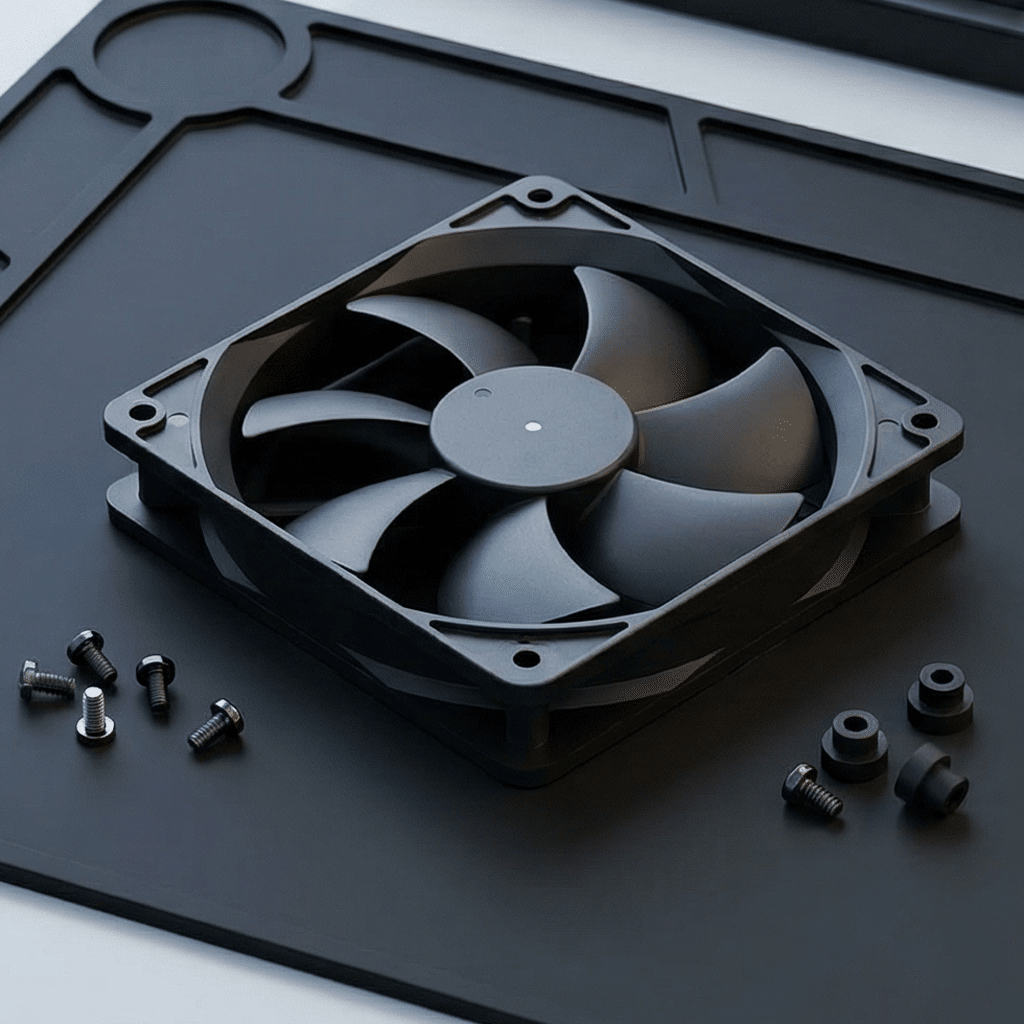
Medical Devices Demand Quieter Cooling, DC Fans Become Preferred Solution
Medical Devices Demand Quieter Cooling, DC Fans Become Preferred Solution
In a CT scanner, 0.1°C can be the margin between a clear diagnosis and an unreadable image. Inside every medical device that saves lives, a DC fan is working — and its noise, vibration, and reliability are non-negotiable.
1. Why Medical Cooling Is a Different Category Entirely
A cooling fan in a desktop computer can be noisy, vibrate slightly, and fail after three years without catastrophic consequences. A cooling fan in an MRI gradient coil or a ventilator cannot do any of those things. The stakes are different — not just equipment uptime, but patient safety and diagnostic accuracy.
CT scanner X-ray tubes reach 200°C+ during operation. MRI gradient coils draw instantaneous power peaks above 40 kW. Ultrasound transducers generate heat that must be dissipated without adding audible noise that distracts the clinician. In every one of these scenarios, a DC brushless fan — often no larger than a coffee cup — is the critical line of defense between normal operation and thermal shutdown.
The global market for DC fans in medical applications reached $19.5 billion in 2025 and is projected to reach $34.2 billion by 2035 at a 6.7% CAGR. Medical equipment cooling alone accounts for 42.8% of that market — making it the single largest vertical.
"We switched from AC to BLDC fans across our diagnostic imaging product line. The noise reduction alone was worth it — our ultrasound technicians reported noticeably less fatigue during long scanning sessions. The energy savings were a bonus."
2. DC vs AC: The Comparison That Ends the Debate
For decades, AC shaded-pole fans were the default choice for medical equipment — they were simple, robust, and ran directly from mains power. But the requirements of modern medical devices have shifted the balance decisively toward DC brushless fans.
| Dimension | DC Brushless Fan | AC Shaded-Pole Fan | Why It Matters in a Medical Context |
|---|---|---|---|
| Speed Control Precision | ±5% via PWM | Fixed or stepped | Imaging equipment requires stable temperature within ±1°C; PWM enables continuous modulation |
| Noise Level | As low as 20 dBA | Typically 35+ dBA | Operating rooms and ICUs have strict noise limits; 15 dBA difference is enormous perceptually |
| Energy Efficiency | 75–93% | 15–50% | Portable and battery-powered medical devices depend on every watt |
| Starting Characteristics | Soft-start, programmable ramp | High inrush current | Inrush can cause voltage sag on sensitive medical electronics sharing the same circuit |
| Expected Lifetime | 50,000–100,000+ hours | 20,000–40,000 hours | Life-support equipment requires MTBF > 100,000 hours; AC cannot meet this without replacement cycles |
| Form Factor Flexibility | Down to 3mm thickness | Limited by iron core and windings | Handheld ultrasound and portable monitors need ultra-slim fans |
| Vibration | Low — electronically balanced | Higher — 50/60 Hz line frequency ripple | Vibration introduces micro-jitter in imaging; MRI and CT are especially sensitive |
3. Three Medical Scenarios That Define the Fan Specification
🔷 Scenario 1: Diagnostic Imaging — Precision Thermal Control
CT and MRI systems are exquisitely sensitive to temperature gradients. A CT detector array that shifts by even 0.5°C can produce ring artifacts that degrade image quality. MRI gradient coils must maintain temperature stability within ±1°C to preserve magnetic field homogeneity.
This demands DC fans with PWM-based closed-loop control: a thermistor on the heat source feeds temperature data to a microcontroller, which modulates fan speed continuously to hold the target temperature — rather than the on/off cycling that causes thermal oscillations. Fan MTBF must exceed 70,000 hours, and the fan must operate reliably at 40°C+ internal ambient for the life of the equipment.
📱 Scenario 2: Portable & Handheld Devices — Ultra-Compact, Ultra-Quiet
Handheld ultrasound probes, portable patient monitors, and point-of-care analyzers pack significant electronics into form factors measured in centimeters. The fan — if one fits at all — must be under 10mm thick, draw under 5W, and generate less than 25 dBA at operating speed.
This is where micro-blowers excel: their centrifugal airflow design delivers higher static pressure in a smaller envelope than axial fans, enabling targeted cooling of specific hot components — typically the image processor or FPGA — without increasing the device's overall thickness.
💉 Scenario 3: Life-Support Equipment — Zero-Tolerance Reliability
Ventilators, anesthesia machines, and dialysis systems operate continuously for years, often in environments where fan failure could have direct patient consequences. The fan specification here is the most demanding in all of electronics cooling:
● MTBF > 100,000 hours at rated temperature and load.
● Dual ball bearing as the absolute minimum; ceramic hybrid bearings preferred.
● Redundant fan configurations (N+1) so that a single fan failure does not interrupt cooling.
● Tachometer output connected to the system controller for real-time fan health monitoring.
● Alarm on underspeed — the system must know a fan has failed before temperatures rise.
Critical vs Non-Critical Medical Cooling: A Quick Reference
- Life-Support (ventilator, anesthesia, dialysis): N+1 redundancy, MTBF >100k hours, tachometer alarm, full traceability.
- Diagnostic Imaging (CT, MRI, X-ray): Closed-loop PWM, ±1°C stability, low vibration, 70k+ hour MTBF.
- Patient Monitoring (bedside monitor, telemetry): Ultra-quiet (<30 dBA), compact, 50k+ hour life.
- Laboratory (analyzer, centrifuge): Moderate noise acceptable, chemical-resistant materials, 50k+ hour life.
- Portable (handheld ultrasound, POCT): Ultra-slim, low-power, battery-compatible voltage (5–12V).
4. Six Selection Dimensions Beyond "How Much Airflow?"
Many engineers start fan selection by calculating the required CFM. That is necessary — but it is only one of six dimensions that must be evaluated for medical applications.
4.1 Airflow (CFM): Not Bigger, Just Right
Required airflow is calculated as: CFM = Heat Load (W) / (ΔT × 1.08). A medical power module dissipating 50 W with a 15°C allowable temperature rise needs approximately 9.5 CFM. A 12 CFM fan provides adequate margin — but a 25 CFM fan would add unnecessary noise, power consumption, and dust ingress without meaningful thermal benefit.
4.2 Static Pressure: The Hidden Constraint
Fan airflow ratings are measured at zero static pressure — free air, no obstruction. Once installed in a device with heatsinks, baffles, and filters, the actual airflow may drop to 40–60% of the rated value. Always consult the fan's P-Q curve (pressure vs. flow) at your system's expected static pressure, not the free-air CFM rating.
| Equipment Type | Typical Static Pressure | Reason |
|---|---|---|
| Open-frame cooling | < 2 mmH₂O | Low airflow resistance |
| Heatsink-mounted | 3–8 mmH₂O | Fin stack resistance |
| Ducted airflow path | 10–25 mmH₂O | Duct wall friction |
| High-density enclosed | 15–40 mmH₂O | Dense component population |
4.3 Noise: The Non-Negotiable Parameter
In an operating room, background noise above 30 dBA interferes with verbal communication among the surgical team. In an ICU, continuous fan noise above 35 dBA contributes to patient sleep disruption and staff fatigue. These are not "nice to have" targets — they are clinical environment requirements.
| Environment | Max Noise | Typical Equipment |
|---|---|---|
| Operating Room | < 30 dBA | Surgical displays, anesthesia workstations |
| ICU / NICU | < 35 dBA | Ventilators, patient monitors, infusion pumps |
| Clinical Lab | < 45 dBA | Analyzers, centrifuges, incubators |
| Equipment Room | < 55 dBA | MRI chillers, CT power cabinets |
4.4 Bearing Technology: The Life Expectancy Lever
The bearing is the single most influential component for fan lifespan and acoustic performance:
| Bearing Type | Lifespan (L10) | Noise | Cost | Best Medical Application |
|---|---|---|---|---|
| Sleeve (Oil-Impregnated) | 30,000h | Low | $ | Disposable or short-lifecycle devices |
| Single Ball | 50,000h | Moderate | $$ | General-purpose medical electronics |
| Dual Ball | 70,000h+ | Moderate-High | $$$ | Diagnostic imaging, lab equipment |
| Fluid Dynamic (FDB) | 60,000h+ | Very Low | $$$ | ICU/OR — where noise is critical |
| Ceramic Hybrid | 100,000h+ | Low | $$$$ | Life-support, high-end imaging |
4.5 Certifications: The Non-Negotiable Baseline
Medical device fans must meet standards that general-purpose fans are never tested against. These are not "nice to have" — they are regulatory prerequisites for market access:
| Standard | Scope | Core Requirements for Fans |
|---|---|---|
| IEC 60601-1 | Medical electrical equipment — general safety | Dielectric strength, leakage current, thermal management, EMC emissions and immunity |
| ISO 13485 | Medical device quality management | Supply chain traceability, change control, risk management (ISO 14971) |
| UL 507 | Electric fans — safety | Insulation resistance, flame resistance (UL 94 V-0), abnormal operation testing |
| CE (EN 60335) | EU market access | Safety + electromagnetic compatibility for household and similar electrical appliances |
| RoHS / REACH | Hazardous substances | Lead-free solder, restricted phthalates, full material disclosure |
4.6 Materials & Biocompatibility
Fan materials in medical environments face exposure to cleaning agents, disinfectants, and in some cases, direct patient proximity:
● Frame material: PBT+GF (glass-fiber reinforced polyester) with UL 94 V-0 flame rating. Resistant to common hospital disinfectants including isopropyl alcohol and quaternary ammonium compounds.
● Impeller material: LCP (liquid crystal polymer) for dimensional stability at elevated temperatures and low outgassing — important in enclosed medical device interiors.
● Optional antimicrobial coating: Silver-ion (Ag+) nanocomposite coating tested to ISO 22196 for fans installed in operating room equipment, reducing bacterial colonization on fan surfaces by >99%.
5. Trend: Intelligent Fans with Predictive Maintenance
The next generation of medical DC fans is not just spinning — it is reporting. Built-in microcontrollers monitor fan current, speed, and vibration signatures in real time. Machine learning algorithms trained on failure-mode data can detect bearing degradation 72+ hours before failure, triggering a service alert while the fan is still functioning normally.
For life-support equipment, this transforms fan maintenance from reactive (replace after failure, hope nothing went wrong) to predictive (replace during scheduled downtime, zero clinical impact). The cost of adding this intelligence is a few dollars per fan — a rounding error compared to the cost of an unplanned ventilator service call.
6. Selection Checklist: Five-Minute Preliminary Assessment
☐ Medical DC Fan Selection Checklist
Filling out this checklist before engaging with fan suppliers eliminates approximately 80% of the back-and-forth in the specification process. It forces clarity on requirements that are often assumed but not written down — and assumptions are where specification errors originate.
7. The Right Fan Is a Clinical Asset
Medical equipment procurement tends to focus on the expensive, visible, differentiating components: the detector array, the image processor, the touchscreen interface. The cooling fan is none of those things. It costs a fraction of a percent of the BOM. It has no spec-sheet appeal. And yet — if it is specified wrong — it can degrade image quality, wake up patients, shorten component life, and in the worst case, take a life-support device offline.
The migration from AC to DC brushless fans in medical equipment is not a trend driven by marketing. It is driven by engineering requirements that AC fans structurally cannot satisfy: sub-25 dBA noise levels, PWM-based thermal precision, MTBF beyond 70,000 hours, and form factors thin enough for handheld ultrasound. DC fans meet these requirements. AC fans do not. For medical device manufacturers, the question is increasingly not whether to specify DC — but which DC configuration best serves the application.
Contact Our Team
We manufacture DC axial fans and blowers engineered for medical device applications — from 20mm micro-blowers for handheld ultrasound to 172mm high-CFM fans for imaging system cooling. Fluid dynamic bearing for near-silent operation, dual ball bearing for maximum reliability, and ceramic hybrid for life-support equipment. Full IEC 60601-1, UL 507, CE, and RoHS compliance. Custom fan curves, connectors, and mounting frames available.
Visit Our Website →Server Room Cooling: How to Build an Efficient Airflow System with DC Fans
Protecting Outdoor Equipment from High Heat: IP-Rated DC Fans to the Rescue
Related Article