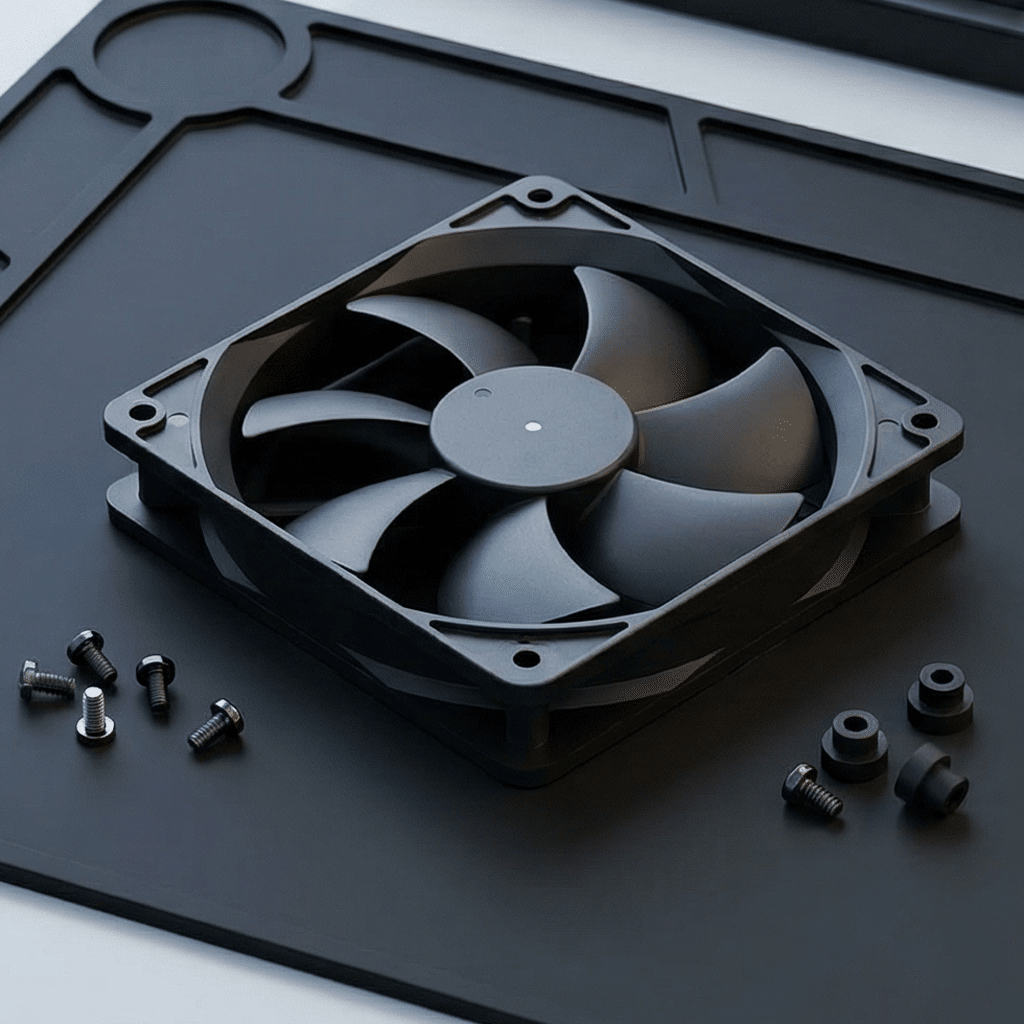
Protecting Outdoor Equipment from High Heat: IP-Rated DC Fans to the Rescue
Protecting Outdoor Equipment from High Heat: IP-Rated DC Fans to the Rescue
The sun beats down. The rain comes in sideways. Dust settles on every surface. Salt spray corrodes exposed metal. And inside your outdoor enclosure, a fan is supposed to keep spinning for years. This is what IP ratings are actually for.
1. Outdoor Equipment Has an Enemy, and It Is Not Just Heat
When an engineer specifies a cooling fan for an outdoor enclosure, the first thought is almost always about airflow: how many CFM, at what static pressure, to keep the internal temperature below the critical threshold. That is the thermal problem. But outdoor equipment faces a set of environmental threats that are just as lethal to fan longevity as heat is to electronics — and those threats are what IP ratings are designed to address.
An outdoor surveillance camera enclosure in Bangkok faces 35°C ambient, 95% relative humidity, and monsoon rain five months of the year. A digital signage kiosk in Dubai endures 50°C ambient, blowing sand, and direct solar radiation. A 5G base station on a coastal cliff in Scotland faces salt spray, driving rain, and -10°C winters. Three different environments — three different IP rating requirements for the fans that cool them.
Rain & Splash Water
Driven rain, hose-down cleaning, condensation. Water ingress shorts electronics and corrodes bearings.
Dust & Sand
Abrasive particles clog bearings, unbalance impellers, and coat PCB surfaces causing leakage currents.
Salt Spray
Coastal and marine environments corrode metal frames, bearing races, and connector pins within months.
Solar Radiation
UV degrades plastic impellers and gaskets. Direct sun pushes internal ambient beyond the fan's rated max.
Temperature Swings
-30°C to +55°C in 24 hours. Bearing lubricant must flow at both extremes. Condensation forms during cooldown.
Insects & Debris
Wasps, ants, and plant debris enter unsealed fan housings, jamming impellers and shorting open-frame motors.
"We lost twelve outdoor cabinet fans in one monsoon season because the specification said 'weather-resistant' but nobody checked what that actually meant. Now we specify IP65 minimum, with salt-spray test reports. Haven't lost a fan since."
2. IP Ratings Decoded: The Two Digits That Matter
An IP (Ingress Protection) rating is defined by IEC 60529 and consists of two digits. The first digit rates protection against solid objects and dust (0–6). The second digit rates protection against liquids (0–9K). For DC cooling fans in outdoor equipment, the most relevant ratings are IP54, IP55, IP65, IP67, and IP68.
| IP Rating | Solid Protection (1st Digit) | Liquid Protection (2nd Digit) | What It Means in Practice |
|---|---|---|---|
| IP54 | Dust-protected — limited ingress permitted; no harmful deposits | Splashing water from any direction | Protected against dust accumulation and rain splash. Not suitable for directed water jets or submersion. |
| IP55 | Dust-protected | Water jets from a 6.3mm nozzle at any angle | Withstands hose-down cleaning and heavy rain. The practical minimum for outdoor cabinets with active cooling air intake. |
| IP65 | Dust-tight — no ingress of dust | Water jets from a 6.3mm nozzle at any angle | Completely dust-tight. Withstands driven rain, pressure washing, and water jets. Standard for outdoor telecom and EV charger fans. |
| IP67 | Dust-tight | Immersion up to 1 meter for 30 minutes | Full dust and temporary submersion protection. Suitable for flood-prone installations and equipment washdown areas. |
| IP68 | Dust-tight | Continuous immersion beyond 1 meter (depth/time specified by manufacturer) | Permanent underwater operation. Used in submerged pump motors, underwater equipment, and extreme flood-risk installations. |
3. What Each IP Level Means for DC Fan Design
Achieving a given IP rating is not a matter of adding a better seal — it requires specific design choices that affect the fan's performance, cost, and serviceability.
Indoor-Outdoor Sheltered
● Parking garage equipment
● Covered walkway kiosks
General Outdoor Minimum
● Digital signage (sheltered)
● Outdoor HVAC units
Fully Exposed Outdoor
● Outdoor surveillance
● 5G base station RRU cooling
Temporary Submersion
● Marine equipment
● Washdown areas (food processing)
Continuous Submersion
● Underwater equipment
● Extreme flood defense systems
4. Beyond the IP Number: What Else Matters
An IP rating is necessary but not sufficient for outdoor fan reliability. The following factors are equally important in practice:
4.1 Salt Spray Corrosion Resistance
An IP65 fan protects against dust and water jets — but says nothing about corrosion. In coastal and marine environments, salt-laden air attacks exposed metal even when it is dry. A fan deployed on a coastal 5G tower may meet its IP65 rating perfectly while its steel frame rusts through in 18 months.
For coastal installations, look for fans that have passed ISO 9227 salt spray testing for 96+ hours. Options include: stainless steel frames and shafts, ceramic hybrid bearings (silicon nitride balls with stainless races), and marine-grade aluminum alloys with chromate conversion coating.
4.2 UV Resistance
Plastic impellers and fan frames exposed to direct or indirect sunlight degrade from UV radiation. Standard ABS or PBT becomes brittle and discolored. UV-stabilized grades (PBT+GF with UV inhibitors) or metal impeller/frame construction are required for any fan exposed to direct or strong indirect sunlight.
4.3 Wide-Temperature Bearing Lubrication
An outdoor fan may need to start at -30°C on a winter morning and run continuously at +70°C internal temperature on a summer afternoon. Standard bearing grease thickens at low temperatures (causing high starting current and potential stall) and thins or evaporates at high temperatures (causing premature bearing wear). Wide-temperature synthetic grease rated for -40°C to +150°C is essential for outdoor fans.
4.4 Condensation Management
Outdoor enclosures experience daily thermal cycling: heating during the day, cooling at night. As the internal air cools, its relative humidity rises and water vapor condenses on cold surfaces — including fan PCBs and bearing housings. IP-rated fans mitigate this with conformal coating on PCBs, sealed bearing housings, and drainage paths that direct condensate away from critical components.
Outdoor Fan Specification Checklist (Beyond IP)
- ☐ IP Rating: IP55 minimum; IP65 recommended for fully exposed outdoor.
- ☐ Salt Spray: ISO 9227, 96+ hours for coastal installations. Stainless or coated frame.
- ☐ UV Resistance: UV-stabilized plastic or metal construction for sun-exposed positions.
- ☐ Temperature Range: -30°C cold start to +70°C continuous operation.
- ☐ Bearing Grease: Wide-temperature synthetic, -40°C to +150°C rated.
- ☐ PCB Protection: Conformal coating (minimum) or potting (IP67+).
- ☐ Connector: Matching IP-rated connector with sealed mating interface.
- ☐ Drainage: Frame design includes condensation drainage paths.
5. Application-by-Application Selection Guide
| Outdoor Application | Exposure Level | Key Environmental Threats | Recommended IP | Additional Requirements |
|---|---|---|---|---|
| Outdoor Surveillance Camera | Fully exposed, elevated | Rain, dust, insects, UV, condensation | IP65 | UV-stabilized, anti-condensation, low noise |
| EV Charging Station | Fully exposed, ground level | Rain, dust, vehicle splash, vandalism risk | IP65 | Salt spray (coastal), 50k+ hr L10, dual ball bearing |
| 5G Base Station RRU | Fully exposed, tower/pole | Wind-driven rain, salt spray, wide temp, UV | IP65 | Salt spray 96h+, -40~+70°C, tachometer output |
| Outdoor Digital Signage | Partially sheltered to fully exposed | Solar heat gain, dust, rain splash | IP55–65 | Solar-aware PWM, wide-temp, UV-stabilized |
| Outdoor Telecom Cabinet | Fully exposed, pole/ground | Driven rain, dust, insects, condensation | IP55–65 | Filter-compatible, tachometer, N+1 fan array |
| Solar Inverter Enclosure | Fully exposed, ground/roof | Direct sun, dust, rain, wide temp range | IP65 | Dual ball, wide-temp grease, low-power for off-grid |
| Outdoor LED Display | Fully exposed, building-mounted | Solar radiation, dust, rain, bird debris | IP55–65 | High CFM, UV-stabilized, filter-ready |
| Marine / Coastal Cabinet | Fully exposed, near saltwater | Salt spray, wave splash, extreme corrosion | IP65–67 | Stainless steel, ceramic bearing, 200h+ salt spray |
| Flood-Prone Cabinet | Temporary submersion risk | Temporary immersion, mud, debris | IP67–68 | Potted electronics, sealed connector, SS construction |
| Food Processing Washdown | Direct water jets, chemicals | High-pressure washdown, cleaning chemicals, humidity | IP65–67 | Chemical-resistant seals, SS frame, smooth surfaces |
6. The Cost of Getting It Wrong
The premium for an IP65-rated DC fan over an unrated equivalent is typically 30–80% on unit cost — depending on size, bearing type, and frame material. That premium can feel significant on a component that itself costs $10–$40. But it must be weighed against what happens when an unrated fan fails outdoors:
| Fan Failure Scenario | Immediate Consequence | Cascading Cost |
|---|---|---|
| Fan in outdoor EV charger fails (IP44, rain ingress) | Charger power modules overheat and derate | Charge session fails; customer leaves; charger offline until service visit. $500–1,200 per incident. |
| Fan in 5G base station fails (unrated, dust ingress) | RRU internal temperature rises; equipment throttles | Cell site coverage shrinks; SLA violation; emergency maintenance dispatch. $800–2,500 per incident. |
| Fan in outdoor signage fails (no IP, insect jam) | Display overheats; LCD black spots or LED module failure | Panel replacement at $300–800; advertising revenue loss; access equipment rental for elevated sign. |
| Fan in solar inverter fails (IP54, coastal salt spray) | Inverter derates; energy production drops | Lost energy revenue over weeks before detection; inverter warranty may not cover corrosion damage. |
In every one of these scenarios, the service cost of a single fan failure exceeds the IP-rating premium for the entire fleet of fans across dozens of units. The economics of IP-rated fans are not about component cost — they are about avoided service calls.
"The $15 IP65 fan we install today will outlast three $7 unrated fans. But the real savings is not the fans — it is not having to roll a truck to a remote cell site because a fan seized up in the rain."
7. IP Rating Verification: Trust but Verify
Not all IP rating claims are equal. When evaluating a fan supplier's IP rating, ask for:
● Test Reports: IP testing certificates from ISO 17025-accredited laboratories. Self-declared IP ratings without test reports should be treated as unverified.
● Test Standard and Conditions: Was the fan tested while running or stationary? In its installed orientation or flat on a bench? These details matter — a fan that passes IP65 horizontal may fail when mounted vertically on a cabinet door.
● Aging Effect: IP ratings are tested on new samples. Gaskets age, seals compress, and lubricants migrate over years of thermal cycling. Ask the supplier whether they have aged IP test data or accelerated life test results.
● Production Consistency: A lab sample passing IP65 does not guarantee that every production unit passes. Ask about in-line production testing — some suppliers perform batch IP spot-testing as part of their quality control process.
8. The Decision Framework
Use the following logic to determine the appropriate IP rating for your outdoor cooling fan:
IP Rating Decision Flow for Outdoor DC Fans
- Is the fan inside a sealed enclosure with no direct outdoor air exchange?
→ IP54 may suffice. The enclosure provides the primary environmental barrier. - Is the fan exposed to rain, but not direct water jets or hose-down?
→ IP55 minimum. Protected against dust accumulation and splashing water. - Is the fan fully exposed to weather — rain, dust, insects, direct sun?
→ IP65. This is the standard recommendation for outdoor exposed fans. Dust-tight and water-jet resistant. - Is the installation coastal or marine, within 5 km of saltwater?
→ IP65 + salt spray certification (ISO 9227, 96h+) + stainless/corrosion-resistant materials. - Is there a risk of temporary submersion (flood zone, washdown area)?
→ IP67 minimum. Dust-tight and immersible to 1m for 30 minutes. - Is the fan operating underwater or permanently submerged?
→ IP68. Manufacturer must specify depth and duration rating.
9. The Right Protection Pays for Itself
Outdoor equipment is an investment measured in years of reliable operation. The cooling fan inside it is a small component in both size and cost — but it is one of the few components that is directly exposed to the outdoor environment, even when installed inside a ventilated enclosure. Rain, dust, salt, insects, and temperature extremes all converge on the fan first.
Choosing the right IP rating is not about overspending on protection you do not need. It is about honestly assessing the environment the fan will actually operate in, matching the IP rating to that environment, and verifying that the supplier's rating is backed by accredited test data — not just a label on the datasheet.
For the vast majority of outdoor equipment applications — surveillance, EV charging, telecom, signage, solar — IP65 is the convergence point where dust-tight construction meets water-jet resistance, at a cost premium that is immediately justified by the service calls it prevents.
Contact Our Team
We manufacture IP54, IP55, IP65, IP67, and IP68 rated DC axial fans and blowers for outdoor equipment applications — from 40mm micro-fans to 172mm high-CFM models. Dual ball bearing, wide-temperature grease, UV-stabilized or stainless steel construction, and full salt-spray certification where required. CE, RoHS, and UL recognized. Send us your environmental requirements and we will recommend the right IP-rated fan.
Visit Our Website →Medical Devices Demand Quieter Cooling, DC Fans Become Preferred Solution
Solving Cabinet Cooling Problems? Learn About DC Fan Array Solutions
Related Article