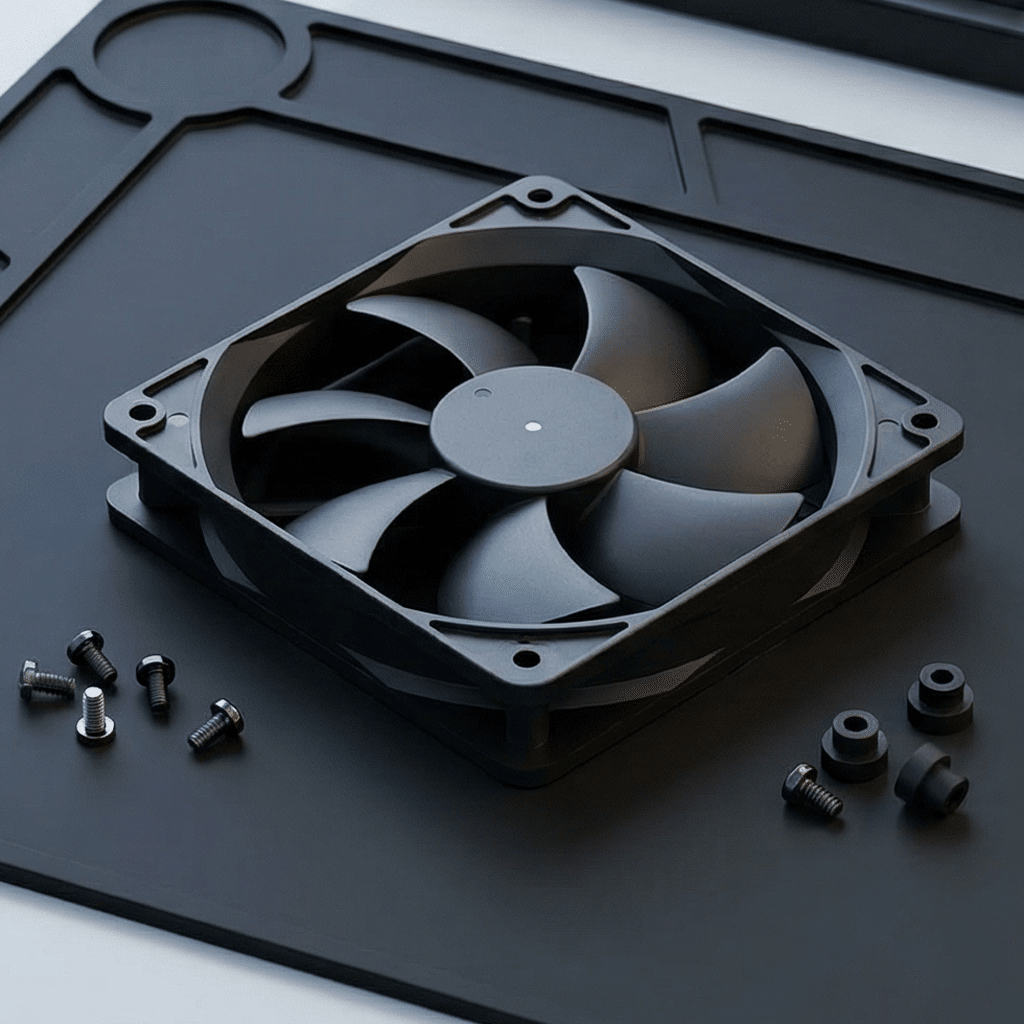
Cooling Selection Guide for Automation Equipment: Why More Engineers Are Choosing DC Fans
Cooling Selection Guide for Automation Equipment: Why More Engineers Are Choosing DC Fans
AC fans have dominated industrial control cabinets for decades. But on factory floors around the world, engineers are replacing them with DC alternatives — not because DC is newer, but because the lifecycle math, control precision, and reliability data have become impossible to ignore.
1. The Heat Inside the Cabinet
A sealed industrial control cabinet on a factory floor is an inhospitable place for electronics. Inside, PLCs, servo drives, VFDs, power supplies, and communication modules convert electrical energy into control signals — and they waste between 5% and 15% of their rated power as heat. A mid-size cabinet with 2 kW of installed electronics may need to reject 200–300 W of thermal energy continuously, every shift, for years.
Without active cooling, internal cabinet temperatures can climb to 55–70°C within hours. At these temperatures, electrolytic capacitors degrade at 2–3× their rated rate, semiconductor junction temperatures approach thermal limits, and the statistical probability of an unplanned line stoppage rises sharply. For an automotive assembly line or a food processing plant, the cost of that stoppage is measured in thousands of dollars per minute.
The cooling fan inside that cabinet is, by unit cost, one of the least expensive components in the automation system. It is also one of the few components whose failure can cascade into a system-wide shutdown. This asymmetry — low unit cost, catastrophic failure consequence — is what makes fan selection a genuinely strategic engineering decision, not a commodity procurement afterthought.
"We used to treat cabinet fans as a consumable — replace them when they fail. After one fan failure took down a packaging line for four hours, we rewrote the specification. The fan cost went from $12 to $28. We haven't had a fan-related stoppage in three years."
2. The Automation Cooling Landscape: Where Every Fan Lives
Industrial automation equipment is not a single thermal problem — it is a collection of distinct cooling environments, each with its own airflow path, temperature range, contamination risk, and reliability requirement.
| Automation Equipment | Typical Heat Load | Cooling Method | Fan Position | Key Environmental Challenge |
|---|---|---|---|---|
| PLC Control Cabinet | 100–500 W | Filtered forced air | Cabinet door / roof exhaust | Conductive dust, wide ambient range |
| Servo Drive Enclosure | 300–2,000 W | Forced air + heatsink | Direct module cooling | High heat flux density, vibration |
| Variable Frequency Drive | 200–5,000+ W | Forced air through finstack | Integrated in drive chassis | Conductive dust, 24/7 operation |
| HMI / Industrial PC Panel | 30–150 W | Natural convection or micro-fan | Rear enclosure | Sealed IP65 front, limited rear volume |
| Power Supply Module | 50–300 W | Integrated fan or convection | Internal to PSU chassis | High internal ambient, limited space |
| Motor Control Center (MCC) | 2,000–20,000+ W | Large forced-air or HVAC | Multiple cabinet-level fans | Arc-flash safety, high total airflow |
3. DC vs AC: The Architecture Difference
Before comparing specifications, it is essential to understand what is fundamentally different about the two motor architectures — because those differences drive almost every downstream comparison in cost, control, and reliability.
| Characteristic | AC Shaded-Pole / Capacitor-Run Fan | DC Brushless (BLDC) Fan |
|---|---|---|
| Motor Type | Induction — requires rotating magnetic field from AC mains | Permanent-magnet rotor, electronically commutated stator |
| Speed Determination | Fixed by line frequency (50/60 Hz) and pole count | Variable — controlled by PWM duty cycle from onboard driver IC |
| Starting | Requires shaded pole or capacitor phase shift; fixed-speed ramp | Soft-start via microcontroller; programmable ramp profile |
| Power Supply | Direct from AC mains (110/220/380 V) | Low-voltage DC (12/24/48 V) — requires DC bus or external PSU |
| Efficiency | 15–35% (shaded-pole); 30–50% (capacitor-run) | 60–85% (brushed DC); 75–93% (BLDC) |
| Speed Feedback | None natively; external sensor required | Inherent — Hall sensors provide rotor position; tachometer output standard |
| EMI | Low (passive magnetic field only) | Moderate — PWM switching noise; manageable with onboard filtering |
| Typical Lifespan | 20,000–40,000 hours (sleeve bearing dependent) | 50,000–100,000+ hours (dual ball bearing, BLDC) |
4. Dimension by Dimension: Where DC Pulls Ahead
4.1 Energy Efficiency and Operating Cost
A shaded-pole AC fan that draws 30 W continuously will consume approximately 263 kWh per year. At an industrial electricity rate of $0.10/kWh, that is $26.30 per fan per year. A BLDC fan moving the same airflow might draw 9–12 W — consuming 79–105 kWh/year, at a cost of $7.90–$10.50.
This $16–$18 annual difference per fan sounds modest until you multiply: a single factory with 50 cabinets saves $800–$900 per year in electricity alone. Over the 8-year typical refresh cycle of an automation system, energy savings alone pay for the DC fan upgrade more than twice over.
⚡ AC Shaded-Pole Fan
✅ BLDC Fan
The total cost of ownership comparison is not close: DC fans deliver 60–70% lower TCO over an 8-year automation system lifecycle, even with a higher initial purchase price. The savings multiply with cabinet count, making DC the economically dominant choice for any installation with more than a handful of cabinets.
4.2 Speed Control and Thermal Precision
AC fans in automation cabinets typically run at a fixed speed — either always on, or thermostatically switched on/off at a preset temperature. This binary control creates unnecessary thermal cycling: the cabinet heats to the trigger point, the fan turns on at full speed, the temperature drops rapidly, the fan turns off, and the cycle repeats. Each thermal cycle stresses solder joints, connectors, and semiconductor packages.
A BLDC fan with PWM speed control and tachometer feedback enables a fundamentally different approach: the fan speed is modulated continuously to maintain a stable internal temperature, rather than chasing it. The controller can ramp the fan from 20% to 100% duty cycle based on a thermistor input, creating a smooth thermal profile that eliminates the mechanical and thermal shock of on/off cycling.
What PWM Control Enables in Automation Cabinets
- Stable internal temperature: PID-based fan speed control maintains ±2°C around the target. Reduces thermal stress on all electronics.
- Filter life extension: Lower average fan speed reduces dust loading on intake filters, extending filter replacement intervals by 2–4×.
- Audible noise reduction: A fan running at 50% PWM is dramatically quieter than one cycling on/off at full speed — important for cabinets near operator workstations.
- Predictive maintenance: Tachometer feedback enables the PLC to monitor fan speed and trigger a warning before failure — turning a reactive maintenance event into a planned one.
4.3 Reliability in Harsh Industrial Environments
Factory floor environments subject fans to conditions that consumer electronics never face: conductive metal dust, oil mist, vibration from nearby machinery, and wide ambient temperature swings between summer and winter, day and night shifts.
| Reliability Factor | AC Fan Weakness | DC Fan Advantage |
|---|---|---|
| Bearing Life | Sleeve bearings dominate in budget AC fans — limited to 20,000–30,000 hours; fail rapidly when mounted non-horizontal | Dual ball bearing standard in industrial DC fans; 50,000–100,000+ hours L10; all-orientation mounting |
| Dust Ingress | Open-frame AC motors accumulate conductive dust on windings, causing insulation breakdown over time | IP54–IP56 rated DC fans with sealed bearing housings and conformally-coated driver PCBs resist dust ingress |
| Wide Temperature Range | AC motor lubricant thickens below -10°C, causing high starting current and potential stall | BLDC fans with wide-temperature grease and electronic soft-start operate reliably from -30°C to +70°C |
| Voltage Fluctuation | AC fan speed varies with mains voltage; undervoltage can cause stall; overvoltage accelerates winding aging | BLDC driver regulates motor current independent of DC bus voltage; stable speed across ±20% input variation |
| Fan-Failure Detection | None natively — requires external airflow sensor or current monitor | Tachometer output provides real-time RPM; PLC can trigger alarm on speed drop below threshold |
4.4 Space, Voltage, and System Integration
Modern automation cabinets are densely packed. DIN-rail-mounted components compete for every cubic centimeter. DC fans, particularly in the 24V standard that dominates industrial control, integrate cleanly into the existing control voltage architecture:
● No separate AC circuit required: The fan connects to the same 24V DC bus that powers sensors, relays, and PLC I/O modules. This eliminates a dedicated AC circuit, fuse, and wiring run for the fan — simplifying cabinet design and reducing potential failure points.
● Smaller form factor for equivalent airflow: BLDC motors achieve higher power density than shaded-pole AC motors. A 120mm DC fan can often replace a 150mm or 172mm AC fan with equivalent airflow — freeing cabinet space for additional I/O or drives.
● No 50/60 Hz dependency: AC fans designed for 60 Hz will run 17% slower on a 50 Hz grid, delivering less airflow. When equipment is shipped between markets with different line frequencies, DC fans eliminate this variable entirely.
5. When AC Still Makes Sense
For all of DC's advantages, there are specific scenarios where an AC fan remains the pragmatic choice — and honest engineering means acknowledging them:
● Retrofitting Legacy Cabinets: If the cabinet already has a dedicated AC power feed for the fan, and the control system has no available 24V DC capacity, an AC drop-in replacement may be faster and cheaper than adding a DC power supply.
● Very Large Airflow Requirements: For MCC rooms or large enclosure ventilation requiring 500+ CFM per fan, large AC axial fans (200–300mm+) remain widely available and cost-competitive at these sizes.
● Electrically Noisy Environments: In rare cases where PWM switching noise from a BLDC driver cannot be adequately filtered for the specific EMC environment, a passive AC fan eliminates this concern entirely — though this is increasingly uncommon with modern BLDC driver ICs that include spread-spectrum modulation.
● Extreme Budget Sensitivity: For non-critical, short-lifecycle equipment where fan failure carries low consequence, the $8 AC fan retains a unit-cost advantage. This is the exception, not the rule, in industrial automation.
6. Selection Decision Tree
Use the following framework to determine the appropriate fan type for your automation cooling application. Follow the questions in order:
Automation Cooling Fan Selection
Interpretation: If you answered "Yes" to Q1 and any two of Q2–Q5, a BLDC fan is the recommended choice. If you answered "Yes" to Q1 alone, a BLDC fan with tachometer feedback is still strongly recommended on reliability grounds. The AC fan case narrows primarily to retrofit situations with no DC bus available and low failure consequence.
7. Recommended Specifications by Application
| Application | Recommended Type | Size | Voltage | Bearing | Key Features |
|---|---|---|---|---|---|
| PLC Control Cabinet | DC Axial | 92–120mm | 24V | Dual ball | PWM, tach, IP54 filter-ready |
| Servo Drive Module | DC Blower | 60–92mm | 24V | Dual ball | High static pressure, compact form |
| VFD Integrated Fan | DC Axial | 80–172mm | 24–48V | Dual ball | 70k+ hr L10, thermistor speed control |
| HMI / Industrial PC | DC Blower / Micro-Axial | 30–60mm | 12–24V | Dual ball | Ultra-slim, ≤30 dBA |
| Power Supply Module | DC Axial | 40–80mm | 12–24V | Dual ball | Thermistor speed control, compact |
| MCC Room Ventilation | AC or Large DC Axial | 172–250mm | 48V DC (or 220V AC) | Dual ball | High CFM, redundant N+1 configuration |
| Outdoor Automation Cabinet | DC Axial | 92–120mm | 24–48V | Dual ball | IP65, -30~+70°C, salt spray optional |
8. Procurement Checklist
Before finalizing a fan specification, run through this checklist to ensure the selection addresses all relevant operational requirements:
DC Fan Procurement Checklist for Automation Applications
- ☐ Airflow (CFM or m³/h): Verified against cabinet heat load calculation with 20% margin.
- ☐ Static Pressure (mmH₂O or Pa): Sufficient for the filter + cabinet impedance at the required airflow.
- ☐ Nominal Voltage: Matches the available DC bus (12V, 24V, or 48V).
- ☐ Bearing Type: Dual ball bearing specified. Sleeve or single-ball rejected for industrial environments.
- ☐ L10 Life at Operating Temperature: ≥ 50,000 hours at the expected internal cabinet temperature.
- ☐ IP Rating: IP54 minimum for indoor cabinets; IP55+ for washdown areas or outdoor enclosures.
- ☐ PWM Control Input: 0–10V or 4–20mA input preferred for PLC integration; open-collector PWM acceptable.
- ☐ Tachometer Output: Open-collector or frequency output for fan-speed monitoring by PLC.
- ☐ Connector Type: Specified to match cabinet wiring standard (terminal block, Molex, JST, or flying leads).
- ☐ EMC Compliance: EN 55032 Class A (industrial) minimum; Class B if near residential zones.
- ☐ Certifications: CE, RoHS, REACH. UL 507 recognized if exporting to North America.
- ☐ Supplier Field Data: MTBF or field return rate data available for the specific fan model.
9. The Shift Is Already Happening
The transition from AC to DC fans in industrial automation is not a future prediction — it is an ongoing migration that can be observed in new equipment designs from every major automation manufacturer. Siemens, Rockwell, Beckhoff, Mitsubishi — their latest-generation drives and controllers ship with BLDC fans as standard, not as an upsell.
The reasons converge on a simple economic truth: in industrial automation, the cost of a fan is not the purchase price. It is the electricity it consumes over a decade, the filter changes it requires, the cabinet temperature swings it creates, and — above all — the production downtime it causes when it fails.
When engineers and procurement teams evaluate fans on total lifecycle cost rather than unit price, DC wins. When they factor in the value of speed control, thermal precision, and predictive maintenance, DC wins by an even larger margin. And when they add the cost of just one unplanned line stoppage, the comparison ceases to be a debate.
Contact Our Team
We manufacture DC axial fans and blowers engineered specifically for industrial automation applications — PLC cabinets, servo drives, VFDs, and outdoor enclosures. Dual ball bearing, IP54–IP65, PWM/tachometer, 24V/48V standard. CE, RoHS, and UL recognized. Send us your cabinet specifications and we will recommend the right fan configuration.
Visit Our Website →Solving Cabinet Cooling Problems? Learn About DC Fan Array Solutions
From Consumer Electronics to Industrial Equipment: A Roundup of DC Cooling Fan Cross-Sector Applications
Related Article