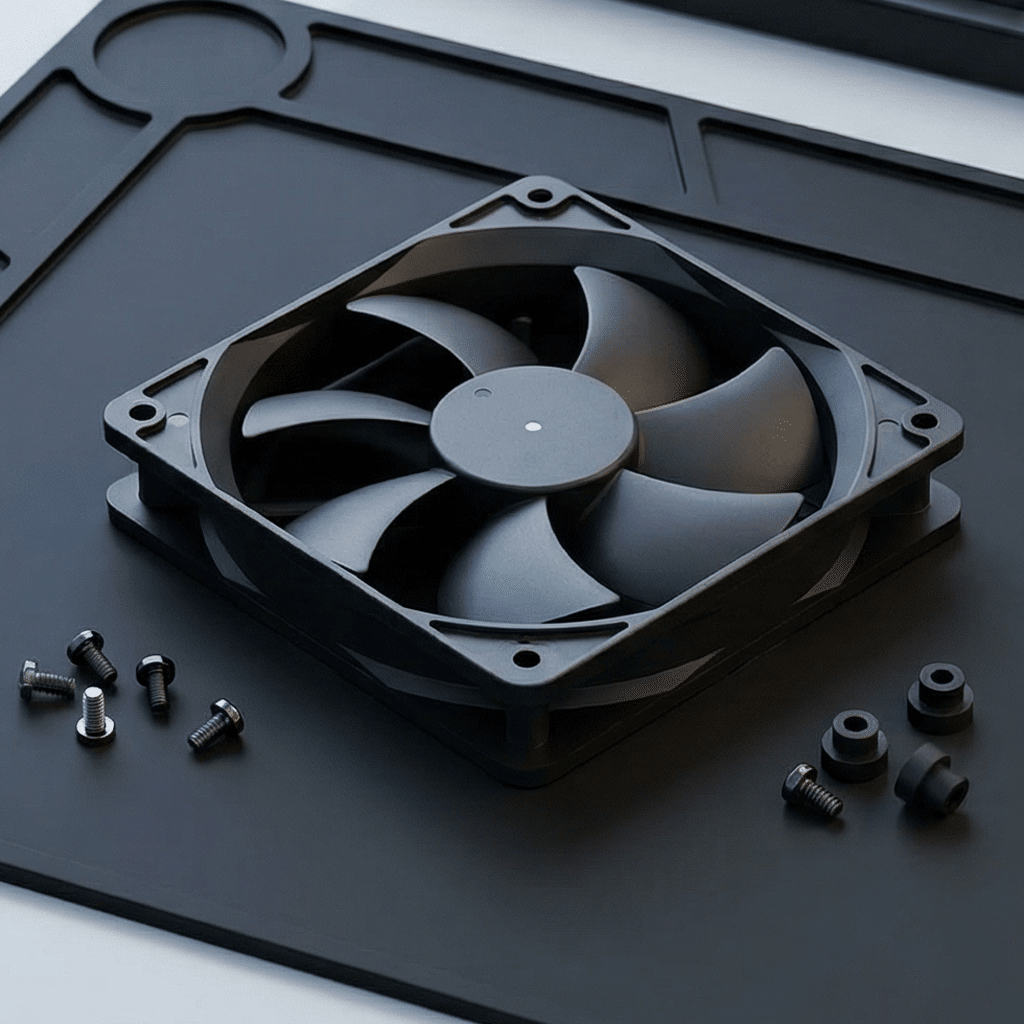
From Consumer Electronics to Industrial Equipment: A Roundup of DC Cooling Fan Cross-Sector Applications
From Consumer Electronics to Industrial Equipment: A Roundup of DC Cooling Fan Cross-Sector Applications
That small black fan inside the printer, the projector, the telecom cabinet, the air purifier — it is almost certainly a DC brushless fan. And across every sector it touches, the requirements are surprisingly different.
1. The Hidden Component
Open the case of almost any electronic device that draws more than a few watts — a laser printer, a network switch, a medical monitor, an industrial servo drive — and you will find at least one DC cooling fan. It is rarely mentioned in the product brochure. It never appears in the marketing photos. But without it, the device either throttles its performance, shortens its component life, or simply shuts down.
DC brushless fans are a $12+ billion global market precisely because they are everywhere. But the way a fan is specified for a 5G base station on a coastal tower is radically different from the way a fan is specified for an air purifier in a bedroom. Voltage, airflow, static pressure, noise, bearing type, ingress protection, PWM control, connector type — every parameter shifts depending on where the fan lives.
This article is a tour. Its goal is not to exhaustively catalog every application, but to show the range and variety of environments where DC fans operate — so that engineers, procurement managers, and product designers can recognize which category their own device falls into, and what that implies for fan selection.
2. The Three Shapes of Forced Air
Before diving into applications, it is worth clarifying the three fundamental DC fan types, because each solves a different airflow problem:
| Fan Type | Airflow Pattern | Typical Pressure | Best For |
|---|---|---|---|
| Axial Fan | Straight through, parallel to shaft | Low (2–15 mmH₂O) | High airflow, low restriction — enclosure ventilation, heatsink cooling, general exhaust |
| Blower (Centrifugal) | 90° turn, perpendicular to shaft | Medium-High (10–60 mmH₂O) | Tight spaces, ducted airflow, high-impedance heatsinks — laptops, 1U servers, automotive HVAC |
| Cross-Flow Fan | Broad, wide rectangular curtain | Low (2–8 mmH₂O) | Wide, even airflow across a surface — air curtains, projector cooling, large electronics bays |
3. The Application Landscape: Eight Verticals
Below are the eight major industry sectors where DC cooling fans are embedded — each with its own thermal profile, size constraints, reliability expectations, and cost sensitivity.
🖨 Office Equipment
Laser Printers & MFPs
Fuser units generate 180–220°C. DC fans exhaust hot air and cool power supply boards. Requires moderate static pressure and low noise for office environments.
Projectors
UHP lamps or laser light sources generate intense localized heat. Cross-flow fans provide even airflow across the entire optical engine. Lamp-off cooling cycle requires fan run-on after shutdown.
Desktop PCs & Workstations
CPU, GPU, PSU, and chassis each require dedicated cooling. Fans range from 80mm case exhaust to 140mm high-CFM models. PWM speed control is standard.
Scanners & Document Feeders
Compact spaces require ultra-slim blowers (10–15mm thickness). Primary purpose is preventing paper path heat buildup during high-volume scanning.
🏠 Home Appliances
Air Purifiers
Fans must overcome HEPA filter resistance while maintaining quiet operation for bedroom use. EC axial fans with backward-curved impellers are the premium choice.
Dehumidifiers
Two fan positions: one drawing humid air across cold evaporator coils, one cooling the compressor. Moisture-resistant fan construction is critical to prevent bearing corrosion.
Humidifiers
Ultrasonic and evaporative humidifiers use small DC fans to disperse mist or draw air through a wet wick. Water-resistant bearings and low-voltage DC are safety requirements.
Range Hoods & Kitchen Ventilation
High-temperature DC motors replace traditional AC shaded-pole motors for energy efficiency. Must tolerate grease-laden air and operate at 40–60°C ambient.
📶 Communications & Networking
5G Base Stations
Outdoor RRU (Remote Radio Unit) enclosures are sealed, fanless, or actively cooled depending on power class. Active-cooled units demand IP65+ fans rated for -40°C to +55°C ambient and 10-year service life. Salt spray certification is mandatory for coastal deployments.
Network Switches & Routers
1U rack-mount switches pack 24–48 PoE ports into a 44mm height. Side-to-side airflow with 40mm axial fans is standard. Fan failure alarms via tachometer output are required for managed switches.
Data Center Servers
High-static-pressure axial fans (counter-rotating pairs in some designs) push air through dense heatsinks. Hot-swappable fan trays are standard. Redundant N+1 configurations with automatic failover.
Outdoor Telecom Cabinets
Sealed enclosures with heat exchanger or direct air cooling. Fans must operate reliably in direct sun, rain, and dust. Filter clogging detection via pressure differential or tach feedback is increasingly specified.
🏭 Industrial Control & Automation
Variable Frequency Drives (VFDs)
IGBT modules in VFDs dissipate significant heat. Fans must tolerate conductive dust, high ambient temperatures (up to 50°C inside cabinets), and 24/7 operation. Fan failure can trip the drive offline.
Servo Drives & Motor Controllers
Compact, high-power-density servo drives need targeted airflow through finned heatsinks. Blower-style fans are often used for their higher static pressure in constrained spaces.
SCADA & Industrial PCs
Panel-mount and box-type industrial PCs use filtered fan intakes with positive-pressure enclosures to keep dust out. Wide-temperature fans (-20°C cold start) are standard.
Power Supplies & Inverters
AC-DC power supplies and solar inverters require reliable forced-air cooling for rectifiers, transistors, and magnetics. Fan speed is often thermally controlled via onboard thermistor.
🚗 Automotive & EV
EV Battery Thermal Management
Battery packs require uniform temperature distribution. DC fans circulate air or cool liquid-to-air heat exchangers. Must meet automotive vibration (ISO 16750) and EMC (CISPR 25) standards.
On-Board Chargers (OBC)
3.3–22 kW onboard chargers use sealed liquid-cooled housings with fan-cooled external radiators. Automotive-grade fan qualification (AEC-Q) is increasingly specified.
Infotainment & ADAS ECUs
High-performance processors in head units and ADAS domain controllers need compact cooling. Ultra-thin blowers (5–10mm) fit into tightly stacked dashboard assemblies.
EV Charging Stations
DC fast chargers (60–350 kW) contain 6–12 power modules, each with dedicated DC fans. Dual ball bearing, IP55+, and 50,000h L10 minimum. (See our dedicated article on EV charger cooling.)
🏥 Medical & Laboratory Equipment
Ventilators & Respiratory Devices
Blowers provide precisely controlled airflow for patient ventilation. Medical-grade reliability, ultra-low noise, and compliance with IEC 60601-1 medical electrical equipment safety standards.
Diagnostic Imaging (CT, MRI, X-ray)
High-power X-ray tubes and gradient coils need aggressive cooling. Fans must operate in strong magnetic fields (MRI) and meet stringent EMI limits to avoid image artifacts.
Laboratory Incubators & Ovens
Fans circulate heated air for uniform chamber temperature. Must operate continuously at 60–80°C ambient. High-temperature grease and metal fan construction required above 70°C.
Patient Monitors & Ultrasound
Compact, fanless designs are preferred where possible. Where forced air is necessary, ultra-quiet (≤25 dBA) blowers with tachometer feedback for fan-failure alarm are used.
☀ Renewable Energy
Solar Inverters
String and central inverters (3–1000+ kW) need robust cooling for IGBT/power modules. Outdoor-rated fans must survive desert heat, tropical humidity, and coastal salt. Fan life directly impacts inverter warranties.
Wind Turbine Converters
Nacelle-mounted power converters face vibration, temperature swings from -30°C to +60°C, and salt-laden air offshore. Fans are often part of a redundant N+2 configuration.
Energy Storage Systems (BESS)
Containerized battery storage requires forced-air or liquid cooling to maintain cell temperatures within 15–35°C. Large-diameter EC axial fans with variable speed control are typical.
LED Grow Lights & Horticulture
High-power LED arrays for indoor farming generate concentrated heat. Fans must operate in 85–95% RH environments with fertilizer-laden air. IP65 rating and corrosion-resistant materials are non-negotiable.
🏪 Commercial & Retail Equipment
Refrigerated Display Cases
Evaporator fans circulate cold air through display cases. Must operate in condensing humidity and sub-zero temperatures. EC fans now dominate for their energy efficiency (30–50% lower power than shaded-pole AC).
Vending Machines
Compressor cooling and electronics bay ventilation. Fans must resist vibration from compressor cycling. Compact form factor to fit into tight machine interiors.
Gaming & Arcade Machines
High-performance GPUs in gaming cabinets require aggressive cooling. Fans must tolerate cigarette smoke, dust, and 24/7 operation in entertainment venues. Harsh environment, commodity budget.
Digital Signage & Outdoor Kiosks
Sun-loaded LCD panels and media players need forced ventilation. IP55+ rated fans with sunshade-compatible airflow paths. Fan speed may be GPS/clock-synchronized based on time-of-day solar load.
4. At a Glance: The Full Cross-Sector Specification Matrix
The table below maps each major application to its typical fan specification profile, giving procurement and engineering teams a quick reference for where their product fits.
| Application | Fan Type | Size | Voltage | Key Requirement | Bearing |
|---|---|---|---|---|---|
| Laser Printer | Axial | 60–80mm | 24V | Low noise, moderate temp | Dual ball |
| Projector | Cross-flow + Blower | Custom | 12V | Even airflow, quiet run-on | Dual ball |
| Desktop PC | Axial | 80–140mm | 12V | High CFM, PWM, RGB optional | Rifle/Hydro |
| Air Purifier | EC Axial | 120–200mm | 24V | Ultra-quiet, high static pressure | Dual ball |
| Dehumidifier | Axial | 80–120mm | 12–24V | Moisture-resistant | Dual ball |
| 5G Base Station | Axial | 80–120mm | 48V | IP65, -40~+55°C, salt spray | Dual ball |
| Network Switch | Axial | 40mm | 12V | Tach output, hot-swap | Dual ball |
| Data Center Server | Axial (CR) | 40–80mm | 12V | High static pressure, redundant | Dual ball |
| VFD / Industrial Drive | Axial | 80–172mm | 24V | 70k+ hr L10, 50°C ambient | Dual ball |
| Servo Drive | Blower | 60–92mm | 24V | High pressure, compact footprint | Dual ball |
| EV Charging Station | Axial | 60–120mm | 24–48V | IP55+, dual ball, PWM | Dual ball |
| EV Battery Pack | Axial | 120–172mm | 12–24V | Automotive EMC, vibration | Dual ball |
| Medical Ventilator | Blower | 60–80mm | 12–24V | IEC 60601, ultra-quiet | Dual ball |
| MRI / CT Scanner | Axial | 120–172mm | 24–48V | Low EMI, high airflow | Dual ball |
| Solar Inverter | Axial | 120–172mm | 24–48V | IP65, outdoor rated | Dual ball |
| Battery Storage (BESS) | EC Axial | 172–250mm | 48V | High CFM, variable speed | Dual ball |
| Refrigerated Display | EC Axial | 120–200mm | 24V | Cold-temp, energy-efficient | Dual ball |
| Digital Signage | Axial | 80–120mm | 24V | IP55, solar-aware control | Dual ball |
| Laboratory Incubator | Axial | 80–120mm | 24V | 60–80°C continuous | High-temp ball |
| Gaming Arcade | Axial | 80–120mm | 12V | Dust-resistant, budget-sensitive | Sleeve/ball |
5. Recognizing Your Own Application
If there is a single takeaway from this tour, it is that a DC cooling fan is never just a DC cooling fan. The same 60mm 24V axial fan form factor that works perfectly in a laser printer will fail within months if installed in a solar inverter in the Gobi Desert. The requirements are defined by the environment, not by the catalog.
Quick Self-Diagnosis: Does Your Product Need a Custom Fan Specification?
- Does your device operate outdoors? → IP55 minimum. IP65 if exposed to driven rain.
- Is your device in a humid or condensing environment? → Moisture-resistant bearing and conformal-coated PCB.
- Is your device near saltwater? → Stainless steel frame, salt-spray-rated bearing, or ceramic hybrid.
- Does your device run 24/7? → L10 ≥ 50,000 hours at expected operating temperature.
- Is fan noise a market requirement? → Larger-diameter, lower-RPM fan; blower instead of axial if space-constrained.
- Does your device have constrained physical space? → Blower fan or slim axial (10–15mm thickness).
- Is your device subject to regulatory EMC? → Verify fan radiated and conducted emissions against your standard.
- Is your product B2B or B2C? → B2B tolerates higher fan cost for reliability; B2C prioritizes unit cost and noise.
For procurement and engineering teams, the value of understanding the full application landscape is not in memorizing every specification — it is in recognizing which category your product belongs to, and therefore which requirements are non-negotiable and which are flexible. The 5G base station engineer and the air purifier product manager are solving fundamentally different thermal problems, even if they both end up buying a 120mm fan.
Recognizing your category is the first step. Finding a supplier who can deliver against that category's requirements — with the certifications, test data, and field track record to back those claims — is the second.
Contact Our Team
We manufacture DC axial fans, blowers, and cross-flow fans covering the full spectrum of the applications described above — from 20mm micro-blowers to 250mm high-CFM EC axial fans. Dual ball bearing, IP55–IP68, PWM/tachometer, CE & UL certified. Custom fan curves, connectors, and mounting frames available. Tell us about your application and we will recommend the right fan configuration.
Visit Our Website →Cooling Selection Guide for Automation Equipment: Why More Engineers Are Choosing DC Fans
EV Charger Cooling Demand Surges, DC Fan Market Sees New Growth
Related Article