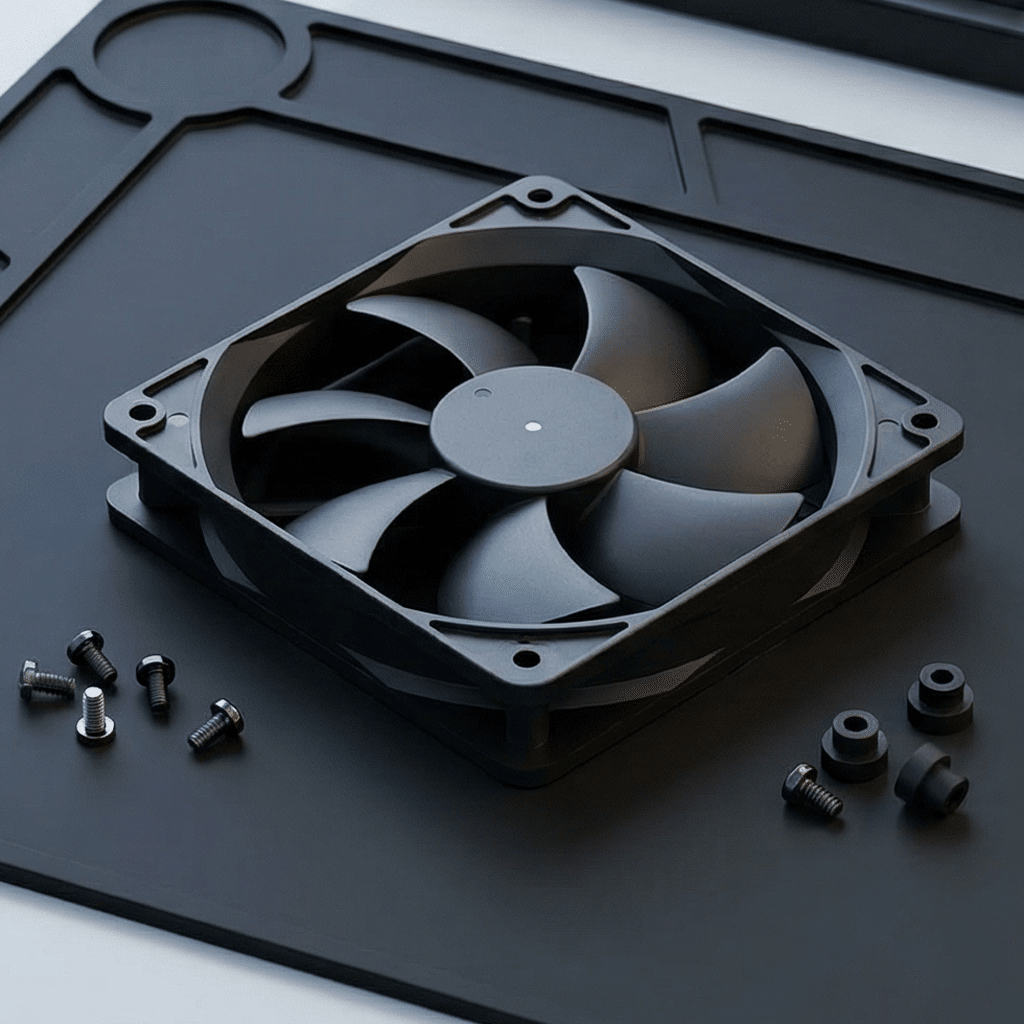
From World Factory to Global R&D Hub: The Independent Innovation Journey of Chinese Fan Companies
From World Factory to Global R&D Hub: The Independent Innovation Journey of Chinese Fan Companies
How Chinese fan manufacturers evolved from OEM producers to technology leaders – driving BLDC breakthroughs, smart fan innovation, and a new era of independent IP.
1. The Great Transformation: From OEM to OBM
Twenty years ago, Chinese fan companies were primarily known as OEM manufacturers – producing fans to foreign designs, under foreign brands, with foreign specifications. Today, the landscape has fundamentally changed. Leading Chinese fan enterprises have completed the journey from OEM (Original Equipment Manufacturer) to ODM (Original Design Manufacturer) to OBM (Original Brand Manufacturer). They now design, develop, and brand their own fan technologies – competing head-to-head with established global players.
📊 The Transformation in Numbers
In 2005, over 80% of Chinese fan exports were pure OEM. By 2026, more than 55% of exports involve independent design or proprietary brands. Over 60 Chinese fan companies now operate their own R&D centers, and more than 20 have established overseas innovation outposts in Germany, Japan, and the United States.
OEM Era (~2010)
Production according to foreign designs. Limited engineering capability. Minimal IP ownership.
ODM Era (2010-2018)
In-house design and engineering. First proprietary motor platforms. Growing patent portfolio.
OBM Era (2018-Present)
Own brands in global markets. Full-stack R&D. Industry-leading efficiency and smart features.
2. R&D Investment: Fueling Independent Innovation
The transformation didn't happen by accident. Chinese fan companies have made massive, sustained investments in research and development. According to industry data, R&D spending by leading Chinese fan manufacturers has tripled over the past five years, reaching an average of 5-8% of revenue – on par with European and Japanese competitors.
| Year | Avg. R&D Spend (% of Revenue) | Total Industry R&D (USD) | R&D Personnel |
|---|---|---|---|
| 2016 | 2.1% | $180M | ~8,000 |
| 2019 | 3.5% | $420M | ~15,000 |
| 2022 | 5.2% | $890M | ~28,000 |
| 2026 | 6.8% | $1.6B | ~45,000 |
🔬 World-Class R&D Facilities
Today, leading Chinese fan companies operate accredited laboratories for acoustic testing, wind tunnel analysis, thermal simulation, and EMC compliance – many certified by TÜV, SGS, and UL. These facilities enable rapid prototyping and in-house certification, dramatically reducing time-to-market for new products.
3. Patent Powerhouse: Building a Technology Moat
The most concrete evidence of independent innovation is intellectual property. Chinese fan companies have filed tens of thousands of patents over the past decade, covering core technologies in motor design, blade aerodynamics, driver circuits, and smart control algorithms.
| Patent Category | Active Patents (China, 2026) | Growth (2020-2026) | Global Ranking |
|---|---|---|---|
| BLDC motor structures & control | 4,800+ | +210% | #2 (after Japan) |
| Fan blade & impeller aerodynamics | 3,200+ | +185% | #3 |
| Smart fan & IoT control systems | 2,500+ | +340% | #1 |
| High-temperature & IP-rated designs | 2,100+ | +260% | #2 |
| Noise reduction technologies | 1,800+ | +195% | #3 |
🏆 Leading Patent Filers
Several Chinese fan companies now rank among the top patent filers globally in fan-related technologies. In smart fan and IoT-enabled fan control systems, Chinese entities filed more patents than any other country in 2024-2025 – signaling a clear shift in innovation leadership.
4. BLDC Breakthroughs: Efficiency Leadership
Perhaps the most significant technical achievement has been in BLDC (brushless DC) motor technology. Chinese R&D teams have independently developed motor architectures, magnetic circuit designs, and driver algorithms that achieve peak efficiencies of 90-92% – matching or exceeding many established international brands.
Advanced Magnetic Design
Proprietary rotor and stator geometries optimized through FEA simulation. Domestic high-grade NdFeB magnets with grain-boundary diffusion.
Intelligent Motor Drivers
In-house developed ASICs and firmware for sensorless sinusoidal control, reducing electromagnetic noise and improving efficiency.
High-Temperature Engineering
Class H insulation systems and high-temp bearings designed for 85°C+ ambient operation – critical for industrial and automotive applications.
📊 Efficiency Benchmark (120mm axial fan)
Chinese Tier 1 BLDC fan: 92% peak efficiency | Japanese premium brand: 93% | German premium brand: 92.5%
Result: Chinese fans now operate within 1-2 percentage points of global leaders – at 30-40% lower cost.
5. Smart Fan Development: IoT and AI Integration
In the race toward smart, connected products, Chinese fan companies have taken an early lead. Leveraging China's strength in IoT hardware and cloud platforms, domestic fan manufacturers have developed comprehensive smart fan ecosystems.
- Embedded sensors: Temperature, vibration, and current monitoring integrated into fan PCBs – enabling predictive maintenance.
- Wireless connectivity: Wi-Fi, Bluetooth, and Zigbee modules for remote monitoring and control via smartphone apps or building management systems.
- Cloud analytics: Proprietary platforms that aggregate fan performance data across thousands of installations for fleet-level optimization.
- AI-powered diagnostics: Machine learning algorithms that detect bearing wear, imbalance, and filter clogging before failures occur.
| Smart Feature | Chinese Adoption Rate (2026) | Global Average | Leadership |
|---|---|---|---|
| IoT-enabled fans (standard) | 42% | 28% | Chinese lead |
| Predictive maintenance algorithms | 35% | 22% | Chinese lead |
| Cloud monitoring platforms | 28% | 19% | Chinese lead |
| Open API / Modbus / OPC UA | 51% | 45% | Parity |
6. The Future: Chinese Fan Companies as Global R&D Partners
The transformation is complete. Chinese fan companies are no longer just cost-effective producers – they are genuine technology partners capable of co-developing next-generation cooling solutions with global clients.
🤝 Co-Development Capabilities
Leading Chinese R&D centers now offer joint development programs, sharing IP ownership with international partners under flexible terms.
🌍 Global R Footprint
Chinese fan companies have established overseas R&D outposts in Germany, Japan, and the US – recruiting local engineering talent.
📈 Continuous Investment
Planned R&D spending for 2026-2030 exceeds $3 billion, focusing on next-generation motor materials, AI-driven cooling, and ultra-low noise designs.
🏆 Final Verdict
The "World Factory" label no longer captures the reality of China's fan industry. Today, it is a global R&D hub – producing not just fans, but innovations, patents, and technologies that shape the future of thermal management. For international buyers, partnering with Chinese fan companies means access to world-class R&D, cutting-edge efficiency, and the agility of a transformed industry. The journey from OEM to OBM is complete. The next chapter is global leadership.
🔬 Do you need BLDC fans?
We provide you with the right cooling solutions and customized design services.
❓ FAQs on Chinese Fan R&D Capabilities
Q: Can Chinese fan companies develop custom designs from scratch?
A: Absolutely. Leading Chinese R&D centers offer full custom development – from aerodynamic simulation to prototype testing to mass production.
Q: Do Chinese fan companies respect intellectual property?
A: Yes. Established exporters have robust IP management systems and welcome joint development agreements with clear IP ownership terms.
Q: How do Chinese BLDC fans compare to Japanese/German brands in efficiency?
A: Within 1-2 percentage points at 30-40% lower cost. The performance gap has virtually closed.
Q: Can I audit R&D facilities before partnering?
A: Yes. We welcome technical audits of our R&D centers and manufacturing facilities. Contact our team to arrange a visit.
March 2026 China Fan Export Data Released: Monthly Exports Exceed $800 Million
China Fan Exports to Middle East Grow 30%: High-Temperature Design Wins Desert Markets
Related Article