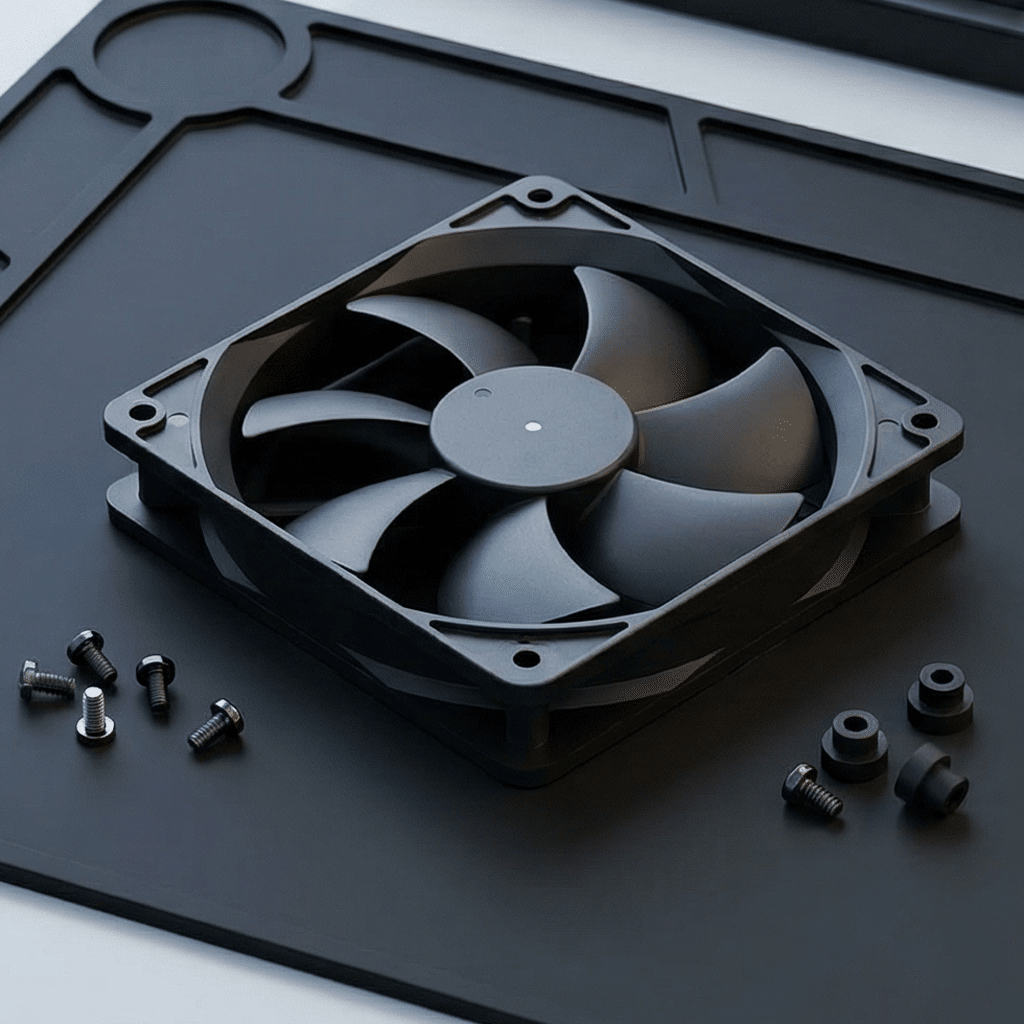
Industrial Fan Selection Guide: Matching Axial, Centrifugal & Mixed Flow Fans to Your Application
Industrial Fan Selection Guide: Matching Axial, Centrifugal & Mixed Flow Fans to Your Application
From aerodynamic principles to application matching — a systematic framework for selecting the right fan type that delivers optimal performance in your specific industrial process.
Analyzed
Scenarios
Coverage
Steps
Selecting the wrong industrial fan type costs more than energy — it creates system instability, accelerates wear, and compromises process outcomes. Yet many engineers default to familiar fan types without systematically matching aerodynamic characteristics to application demands.
This guide breaks down the fundamental pressure-flow relationships of axial, centrifugal, and mixed flow fans, then maps each type to the industrial scenarios where it performs best.
1. The Aerodynamic Foundation
Every industrial fan moves air by converting rotational mechanical energy into aerodynamic energy. The critical difference lies in how each type achieves this conversion — and that determines the pressure-flow relationship that defines its operating envelope.
Understanding the Performance Curve
A fan's performance curve plots static pressure (vertical axis) against volumetric flow rate (horizontal axis) at a given speed. This is the single most important tool in fan selection because it reveals:
- Maximum pressure the fan can develop
- Maximum flow rate it can deliver
- The stable operating region for reliable performance
- The stall region where performance becomes unpredictable
Two applications may require identical flow rates but vastly different pressures — or vice versa. The performance curve tells you whether a given fan can meet both requirements simultaneously while operating in its stable region.
2. Three Fan Types: Characteristics & Performance
Each fan type has distinct aerodynamic principles that determine its pressure-flow relationship, efficiency envelope, and application suitability. Understanding these differences is essential for proper selection.
Axial Flow Fans
High flow, moderate pressure, compact inline design
How They Work
Air enters and exits along the axis of rotation, parallel to the shaft. The rotating blades accelerate air in the axial direction, similar to an aircraft propeller. Energy transfer occurs primarily through changes in air velocity rather than pressure.
The performance curve is relatively flat — high flow rates with moderate static pressure capability. A pronounced stall region at low flow rates causes aerodynamic separation on blade surfaces, resulting in pressure fluctuations, noise, and vibration.
Key Performance Parameters
Design Variations
Strengths & Limitations
- Compact inline installation — fits directly into ductwork
- High flow-to-size ratio
- Relatively low cost for propeller and tube-axial
- Reversible airflow capability
- Lower weight vs. centrifugal at equivalent capacity
- Limited static pressure generation
- Stall region creates instability risk
- Higher noise at equivalent duty points
- Propeller types poorly suited to ducted systems
Centrifugal Fans
High pressure, stable operation, versatile blade geometries
How They Work
Air enters the impeller axially at the center (the "eye") and is redirected 90° to exit radially. The centrifugal force created by rotation, combined with blade geometry, significantly increases both air velocity and static pressure. The scroll-shaped housing further converts velocity energy into pressure through controlled deceleration.
The performance curve is steeper — maintaining pressure development across a wider flow range with a more stable operating region. Stall behavior is generally less abrupt, providing a more forgiving operating envelope.
Key Performance Parameters
Blade Geometry Options
Strengths & Limitations
- High static pressure suits complex duct systems
- Stable characteristics across wide operating range
- Multiple blade geometries for specific conditions
- Non-overloading power (BC/AF) protects drive motors
- Excellent contaminated air handling (RB blades)
- Larger footprint due to scroll housing
- 90° flow change complicates inline installation
- Higher weight and structural requirements
- Generally higher initial cost
Mixed Flow Fans
Balanced pressure and flow — the best of both worlds in a compact form
How They Work
Mixed flow fans combine axial and centrifugal principles. Air enters axially but the impeller imparts both axial and radial velocity components, typically discharging at an angle between 20° and 70° from the shaft axis. The result is a performance profile that falls between axial and centrifugal fans.
The curve occupies the middle ground — higher pressure capability than axial fans with higher flow rates than centrifugal fans of equivalent size. Generally smooth with good stability and a less pronounced stall region than pure axial designs.
Key Performance Parameters
Strengths & Limitations
- Compact cylindrical housing allows inline install
- Higher pressure than axial, smaller than centrifugal
- Good efficiency across operating conditions
- Lower noise than axial at equivalent duty
- Moderate cost relative to performance
- Cannot match centrifugal maximum pressure
- Cannot match axial maximum flow
- Fewer blade geometry optimization options
- Less widely available — fewer standard sizes
- Limited heavy industrial track record
3. Side-by-Side Performance Comparison
| Parameter | Axial (Vane-Axial) | Centrifugal (BC/AF) | Mixed Flow |
|---|---|---|---|
| Static Pressure | 50–1,500 Pa | 500–25,000+ Pa | 200–2,500 Pa |
| Flow Capacity | Highest | Moderate | High |
| Peak Efficiency | 70–85% | 75–92% | 75–88% |
| Space Required | Compact (inline) | Large (scroll) | Compact (inline) |
| Noise Level | Higher | Lower | Moderate |
| Stall Tolerance | Low | High | Moderate |
| Dirty Air Handling | Poor | Excellent (RB) | Moderate |
| Reversibility | Yes | No | Limited |
| Relative Cost | Lower | Higher | Moderate |
4. Application Matching: Where Each Fan Type Excels
Click each application below to reveal detailed analysis of requirements, recommended fan types, and critical design considerations.
General Factory Ventilation
Typical requirements: High volume air exchange at low system resistance. Pressure requirements are minimal — 50 to 300 Pa — because ductwork is short or nonexistent and the primary goal is replacing stale air with fresh air.
The defining need is moving large volumes of air economically. Wall-mounted propeller fans or roof-mounted axial exhaust fans deliver the necessary air changes per hour at minimal energy cost. Low system resistance keeps operating points well within the stable region.
Centrifugal fans are unnecessarily expensive and space-intensive. Mixed flow fans work but offer pressure capability that goes unused, representing unnecessary capital expenditure.
Exception: When ventilation air must be filtered or delivered through extensive ductwork, system resistance increases significantly. Consider tube-axial or vane-axial fans, and centrifugal fans if duct static pressure exceeds 500 Pa.
Industrial Dust Collection Systems
Typical requirements: Moderate-to-high flow rates at high static pressure (1,500–5,000 Pa). System includes hoods, branch ducts, main trunks, filters (baghouses or cartridge collectors), and exhaust stacks. Air carries abrasive particulate matter.
Centrifugal fans with radial or radial-tip blades excel here. Radial blade impellers resist erosion from abrasive particles and their self-cleaning geometry prevents material accumulation that would create imbalance.
For less abrasive dust (textile fibers, wood dust before the collector), backward-inclined fans with wear-resistant coatings offer better efficiency while maintaining acceptable durability.
Critical Design Consideration: In "clean-side" installations (fan downstream of collector), higher-efficiency airfoil or backward-inclined blades become viable. In "dirty-side" installations (fan before collector), radial blade designs are essential.
Process Cooling & Heat Dissipation
Cooling towers & air-cooled condensers → Axial fans. Maximum airflow through low-resistance heat exchange surfaces. Large-diameter axial fans (up to 12+ meters) with adjustable pitch blades provide efficient air delivery with capacity modulation.
Forced/induced-draft with ducting → Centrifugal fans. Combustion air supply for boilers, flue gas exhaust, and process air systems with extended ductwork and significant pressure drop require sustained high pressure.
Moderate-pressure inline cooling → Mixed flow fans. An effective compromise when process cooling involves moderate ductwork but inline duct constraints preclude centrifugal scroll housings.
Tunnel & Underground Ventilation
Typical requirements: High flow rates sustained over long tunnel lengths. Variable pressure from moderate (short tunnels) to very high (deep mines). Reversibility is often required for emergency smoke management.
Road and rail tunnels favor axial jet fans mounted at ceiling level, creating longitudinal airflow without ductwork. Ducted mine ventilation uses multi-stage vane-axial or mixed flow fans for compact inline performance in confined underground environments.
Centrifugal fans serve at surface stations of deep mines where maximum pressure is needed and space is less constrained. The reversibility of axial fans is a critical safety advantage for smoke management protocols.
HVAC Systems (Commercial/Industrial)
Typical requirements: Moderate flow at 500–2,500 Pa through filters, heating/cooling coils, humidifiers, attenuators, and extensive ductwork. Low noise is important.
Forward-curved centrifugal fans dominate light commercial HVAC — compact, quiet, cost-effective. Backward-curved/airfoil types for larger systems deliver superior efficiency that justifies higher cost through lifetime energy savings.
Mixed flow fans are increasingly used in HVAC where inline installation is advantageous — particularly retrofit situations. Plug fans (centrifugal impellers without scroll, operating inside a plenum) offer centrifugal performance with greater installation flexibility.
Fume Extraction & Corrosive Environments
The primary selection criterion here is material compatibility rather than aerodynamic optimization. FRP (fiberglass reinforced plastic), polypropylene, stainless steel, or special alloy construction is required depending on chemical exposure.
Centrifugal fans are preferred because scroll housings can be manufactured in specialty materials more readily than the close-tolerance blade-to-housing interfaces required for axial fan performance. Radial blade designs simplify construction in non-metallic materials.
For lower-pressure fume exhaust without scrubbers, axial fans in FRP or polypropylene construction are available and offer cost advantages.
Pneumatic Conveying Systems
Typical requirements: Very high static pressures (3,000–15,000+ Pa) to maintain transport velocity through long pipe runs carrying bulk materials.
Only centrifugal fans can generate the sustained high pressures required. Radial blade designs handle the abrasive particulate that inevitably passes through the system, particularly in vacuum (suction) conveying where the fan is downstream of the material separator.
For dense-phase conveying exceeding 15,000 Pa, positive displacement blowers (rotary lobe or screw type) replace centrifugal fans — these are technically compressors operating on different principles.
Important: Axial and mixed flow fans are not suitable for pneumatic conveying — insufficient pressure capability and inability to handle material-laden airstreams make them incompatible with these systems.
5. The Selection Decision Framework
A systematic four-step approach to matching the right fan type to your specific operating requirements. Follow these steps sequentially to narrow from all possible options to the optimal selection.
Define System Requirements
Before considering fan types, quantify three essential parameters:
- Required flow rate (Q) — Determined by air changes per hour, transport velocity, or heat transfer calculations. Express in m³/s or CFM at actual operating conditions.
- Required static pressure (Ps) — Sum all resistance elements: duct friction, fittings, filters, coils, dampers, equipment pressure drops, and exit losses.
- Air properties — Temperature, humidity, altitude, and contaminant content all affect air density, which directly impacts fan performance. Fans are rated at standard air density (1.2 kg/m³ at 20°C and sea level).
Plot the System Operating Point
The intersection of your required flow rate and static pressure defines the system operating point. This single point determines which fan types can serve the application:
Apply Application-Specific Constraints
Within aerodynamically suitable fan types, narrow the selection based on:
- Air quality — Clean air → airfoil/BC blades for max efficiency. Particulate-laden → radial blades. Corrosive → compatible materials (FRP, SS316, PP).
- Space constraints — Limited space favors inline fans (axial or mixed). Mechanical rooms with adequate floor space accommodate centrifugal scroll housings.
- Noise requirements — Sensitive environments favor centrifugal fans (particularly airfoil type) or mixed flow over axial. Attenuators add cost and resistance.
- Operational flexibility — Variable speed drives (VSDs) work with all types. Axial fans with adjustable pitch blades offer additional modulation capability.
- Redundancy & reliability — Parallel axial fan installation is straightforward; parallel centrifugal fans require careful curve matching to prevent dominance.
- Reversibility — Emergency smoke management or process flexibility requiring airflow reversal strongly favors axial fans.
Select and Verify
With the fan type identified, perform final verification:
- Obtain manufacturer performance data for candidate fans at the required operating point
- Verify the operating point falls in the stable region — not in stall and not at extreme ends of the curve
- Confirm operation near peak efficiency — a fan at 60% of peak wastes 25–40% of input energy vs. proper match
- Check motor power requirement including safety factors for non-overloading verification
- Evaluate off-design conditions — dirty filters, damper positions, and seasonal variations shift the operating point. Ensure stability across expected range.
6. Common Selection Mistakes to Avoid
Oversizing for "Safety Margin"
Adding excessive safety factors pushes fan selection to a larger size operating below its efficient range. A 20% margin on both flow and pressure results in a fan selected for 44% more air power than needed. Apply 10% on each — that's generally adequate for well-calculated systems.
Ignoring System Effect
Published performance assumes ideal inlet/outlet conditions. Poor conditions (elbows near inlet, abrupt discharge) degrade actual capacity by 15–30%. System effect losses must be accounted for in selection to avoid underperformance.
Selecting on First Cost Alone
A radial blade fan costs less than airfoil but may consume 20–30% more energy over its lifetime. For continuous operation fans, energy cost dominates total cost of ownership within 2–3 years.
Neglecting the Stall Region
Axial fans near stall exhibit violent pressure fluctuations, excessive noise, and potential structural damage. If system resistance could increase above design (filter loading, damper closure), ensure adequate stall margin.
Mismatching Fan to System Curve
Flat system curves (low resistance) pair naturally with axial fans. Steep curves (high resistance) pair with centrifugal. Wrong pairing results in unstable operation or wasted capacity — and often premature failure.
Best Practice: Always request manufacturer performance data for your specific operating point. Verify the operating point falls in the stable region, confirm the fan operates near peak efficiency, and evaluate performance at off-design conditions before finalizing selection.
7. Quick Reference Summary
Axial Fans
Maximum airflow through minimal resistance — ventilation, cooling towers, short-duct exhaust.
Prioritize: Simplicity & Low CostCentrifugal Fans
Sustained high pressure through complex systems — dust collection, conveying, extensive HVAC, process air.
Prioritize: Pressure & EfficiencyMixed Flow Fans
Moderate pressure with compact inline format — tunnel ventilation, retrofit HVAC, moderate ductwork.
Prioritize: Balance & SpaceStart with Your System — Not the Fan Catalog
The best fan selection begins with a thorough understanding of your system — its resistance characteristics, operating variability, air quality conditions, and physical constraints. Match the aerodynamics to the application, and the fan will deliver reliable, efficient performance throughout its service life. When operating conditions fall in the overlap zones between fan types, detailed engineering analysis comparing lifecycle costs of competing options is always worthwhile.
Contact Our Team
PWM Speed Control in DC Fans: Stepless Regulation & Precision
Global Fan Supply Chain 2026: China Still Dominates, but Regionalization Gains Momentum
Related Article