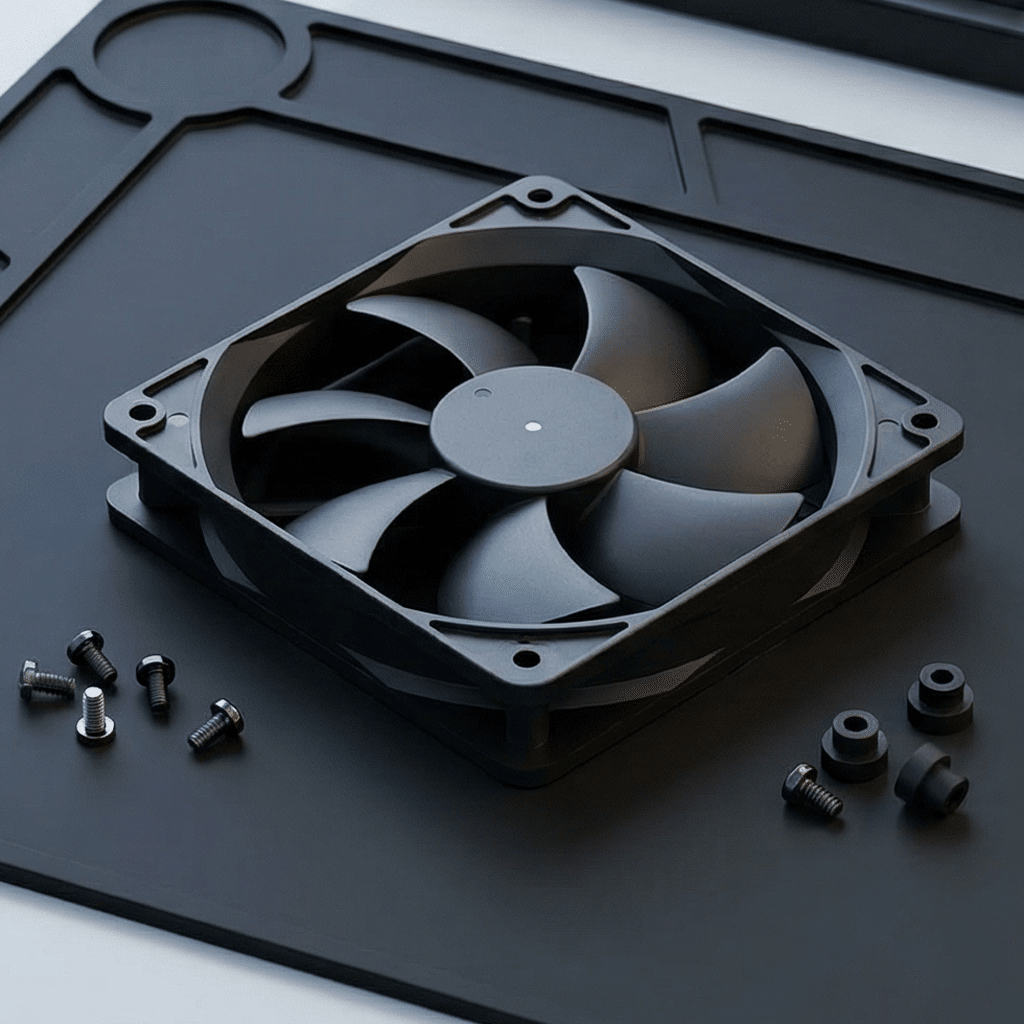
VFDs in Industrial Fans: How Variable Frequency Drives Optimize Energy & Process Control
VFDs in Industrial Fans: How Variable Frequency Drives Optimize Energy & Process Control
Table of Contents
- Introduction: The Need for Speed Control
- 1. What is a VFD and How Does It Work?
- 2. The Affinity Laws: Why Speed Reduces Energy Exponentially
- 3. Real-World Energy Savings: 30-50% Is Achievable
- 4. Soft Start: Protecting Equipment and Power Grid
- 5. Process Control with PID: Maintaining Pressure, Temperature & Flow
- 6. The DC Advantage: Why DC Fans Pair Perfectly with VFDs
- 7. Selecting VFD-Ready Fans
- Frequently Asked Questions (FAQ)
Publication Date: March 20, 2026 | Category: Industrial Fan Technology
Introduction: The Need for Speed Control
In the world of industrial ventilation, one truth is undeniable: most fans run too fast, too often. Traditional fixed-speed fans operate at 100% speed regardless of actual demand, wasting energy and subjecting equipment to unnecessary stress.
Enter the Variable Frequency Drive (VFD)—a technology that has revolutionized industrial fan control. By allowing fan speed to match real-time requirements, VFDs deliver energy savings of 30-50%, extend equipment life, and enable precise process control.
This comprehensive guide explains how VFDs work with industrial fans—particularly DC fans—and why they should be part of your next ventilation investment.
1. What is a VFD and How Does It Work?
A Variable Frequency Drive (also called adjustable speed drive, variable speed drive, or inverter) is an electronic device that controls the speed of an electric motor by varying the frequency and voltage of the power supplied to it.
1.1 Basic Operating Principle
- AC Input: The VFD receives fixed-frequency AC power (50 Hz or 60 Hz).
- Rectification: Converts AC to DC power.
- DC Bus: Smooths and stores the DC power.
- Inversion: Converts DC back to AC at the desired frequency and voltage.
- Output: Supplies variable-frequency power to the motor, controlling its speed.
For industrial fans, this means the motor can run at any speed from 0% to 100%, precisely matching the ventilation demand at any moment.
While VFDs are commonly associated with AC motors, they are equally essential for DC fans in industrial settings. DC fans with integrated electronic controls often have built-in VFD functionality, offering seamless speed adjustment without external drives.
2. The Affinity Laws: Why Speed Reduces Energy Exponentially
The relationship between fan speed, airflow, pressure, and power consumption is governed by the Fan Affinity Laws—physics principles that every engineer should know:
📐 Fan Affinity Laws
Pressure ∝ Speed²
Power ∝ Speed³
Flow = 80% of original
Pressure = 64% of original
Power = 51% of original (nearly 50% energy savings!)
This cubic relationship is the foundation of VFD energy savings. A small reduction in speed delivers a dramatic reduction in power consumption. For industrial fans that rarely need to run at full capacity, this translates directly to lower electricity bills.
3. Real-World Energy Savings: 30-50% Is Achievable
3.1 Typical Industrial Fan Operating Profiles
Most industrial fans operate under one of these scenarios:
- Constant volume systems: Designed for worst-case conditions, but actual demand is often lower.
- Demand-based systems: Ventilation needs vary with production levels, occupancy, or time of day.
- Process control systems: Require precise pressure or temperature maintenance.
3.2 Savings by Application
| Application | Typical Speed Reduction | Energy Savings |
|---|---|---|
| HVAC ventilation (variable occupancy) | 30-50% | 65-85% |
| Industrial exhaust (production-dependent) | 20-40% | 50-80% |
| Process cooling (temperature-controlled) | 15-30% | 40-65% |
| Parking garage ventilation (CO-based) | 40-60% | 75-90% |
Independent studies consistently show that VFD retrofits on industrial fans pay for themselves in 1-3 years through energy savings alone.
4. Soft Start: Protecting Equipment and Power Grid
4.1 The Problem with Across-the-Line Starting
When a large industrial fan starts directly across the line:
- Inrush current can reach 6-8 times normal running current, causing voltage dips and stressing electrical infrastructure.
- Mechanical shock stresses belts, couplings, bearings, and impellers.
- Thermal stress from rapid acceleration can damage motor windings.
4.2 How VFD Soft Start Solves These Problems
VFDs provide controlled acceleration by gradually increasing frequency and voltage. Benefits include:
- Reduced electrical stress: Starting current typically limited to 100-120% of full load current.
- Extended mechanical life: Gentle acceleration eliminates belt slippage and reduces bearing wear.
- Controlled deceleration: Prevents water hammer in duct systems and allows controlled stops.
Facilities report that VFD-controlled fans require 30-50% less maintenance than direct-on-line started fans, primarily due to reduced mechanical stress during starting.
5. Process Control with PID: Maintaining Pressure, Temperature & Flow
5.1 What Is PID Control?
PID (Proportional-Integral-Derivative) is a control loop algorithm that continuously calculates an error value as the difference between a measured process variable and a desired setpoint. The VFD then adjusts fan speed to minimize this error.
5.2 Common Industrial Applications
🌡️ Constant Pressure Systems
In ducted ventilation systems, a pressure sensor sends feedback to the VFD. If pressure drops (due to opened dampers or increased demand), the VFD increases fan speed to maintain setpoint. This ensures consistent performance while saving energy during low-demand periods.
🌡️ Temperature Control
In cooling applications, a temperature sensor in the critical zone controls fan speed. The fan runs only as fast as needed to maintain target temperature—no more, no less.
💨 Airflow Control
For processes requiring precise airflow (paint booths, fume hoods), flow sensors enable the VFD to maintain exact CFM regardless of filter loading or duct changes.
5.3 Beyond Simple On/Off
Unlike mechanical control methods (inlet vanes, outlet dampers, variable pitch blades), VFD control changes the fan's actual operating point rather than wasting energy to throttle output. This is why VFDs are the most energy-efficient control method available.
6. The DC Advantage: Why DC Fans Pair Perfectly with VFDs
While VFDs work with both AC and DC fans, DC (BLDC) technology offers unique advantages:
6.1 Built-in Intelligence
Many industrial DC fans feature integrated VFD functionality within the motor controller. This means:
- No external VFD required—saving panel space and wiring costs
- Factory-tuned motor-drive compatibility
- Built-in PID control and communication protocols (Modbus, BACnet)
6.2 Higher Efficiency Across the Speed Range
AC induction motors lose efficiency at reduced speeds, but DC motors maintain high efficiency across their entire operating range. This maximizes the energy savings predicted by the affinity laws.
6.3 Better Low-Speed Performance
DC fans can operate reliably at very low speeds (10-20%) without overheating or cogging—ideal for nighttime ventilation or standby modes.
7. Selecting VFD-Ready Fans
Not all fans are created equal for VFD duty. When sourcing industrial fans for VFD applications, consider:
7.1 Motor Insulation
VFDs produce voltage spikes that can stress motor windings. Look for:
- Inverter-duty motors with enhanced insulation (Class F or H)
- For DC fans: Ensure the integrated controller has proper filtering
7.2 Bearing Protection
VFDs can induce shaft voltages that cause bearing currents. Specify:
- Insulated bearings or ceramic hybrid bearings for larger fans
- Shaft grounding rings as an alternative
7.3 Cooling at Low Speeds
Motors rely on internal fans for cooling. At very low speeds, cooling may be inadequate. For continuous low-speed operation, consider separately powered ventilation or specially designed DC motors.
7.4 Communication Compatibility
Modern industrial systems require integration. Ensure your fan/VFD combination supports:
- 4-20 mA or 0-10 V analog control
- Digital communication (Modbus RTU, BACnet, Profibus)
- Ethernet/IP for Industry 4.0 applications
Conclusion: VFDs Are No Longer Optional
In an era of rising energy costs and increasing environmental regulation, variable frequency drives have moved from "nice to have" to "essential" for industrial fan applications. The combination of 30-50% energy savings, extended equipment life, and precise process control delivers ROI that few other technologies can match.
For new installations, specifying VFD-ready DC fans with integrated intelligence ensures you're positioned for maximum efficiency and minimum maintenance. For existing systems, VFD retrofits remain one of the highest-return investments in industrial facilities.
Frequently Asked Questions (FAQ)
What is a VFD and how does it work with industrial fans?
A Variable Frequency Drive (VFD) is an electronic device that controls the speed of an electric motor by varying the frequency and voltage of the power supplied to it. For industrial fans, this allows precise matching of fan speed to actual demand, rather than running at full speed continuously.
How much energy can a VFD save in fan applications?
According to the Affinity Laws, fan power consumption is proportional to the cube of speed. Reducing speed by just 20% reduces power consumption by nearly 50%. Typical industrial fan applications achieve 30-50% energy savings with VFD control.
What is soft start and why is it important for industrial fans?
Soft start refers to gradually ramping up motor speed rather than starting at full voltage. This eliminates high inrush currents (which can be 6-8 times normal) and reduces mechanical stress on belts, bearings, and impellers, extending equipment life.
How does PID control work with VFD-driven fans?
PID (Proportional-Integral-Derivative) control uses a sensor (pressure, temperature, or flow) to monitor the process variable. The VFD continuously adjusts fan speed to maintain the setpoint, enabling precise process control without manual intervention.
Are all industrial fans compatible with VFDs?
While many fans can be retrofitted with VFDs, best results are achieved with motors specifically designed for inverter duty, featuring enhanced insulation to withstand voltage spikes and (for DC fans) bearings protected against VFD-induced currents.
What is the payback period for VFD installation on industrial fans?
Based on energy savings alone, typical payback periods range from 1 to 3 years. When factoring in reduced maintenance and extended equipment life, the ROI is even more attractive.
VFD-Ready DC Series
Integrated VFD functionality, PID control, Modbus communication. Inverter-duty motor with insulated bearings.
View Product →External VFD Drives
Standalone VFDs for retrofitting existing fans. Available for 1-500 kW motors. IP54 enclosures.
View Product →Integrated VFD Systems
Factory-configured fan + VFD packages. Pre-programmed for your application. Plug-and-play installation.
View Product →🔧 Need Industrial Fans?
Our team provides VFD selection guidance and custom fan solutions.
Contact Our Team →Industrial Cooling Solutions: How to Choose the Right DC Fan for Your Production Line
Bearing Technology in Industrial DC Fans: Why Lifespan Depends on Bearing Selection
Related Article