
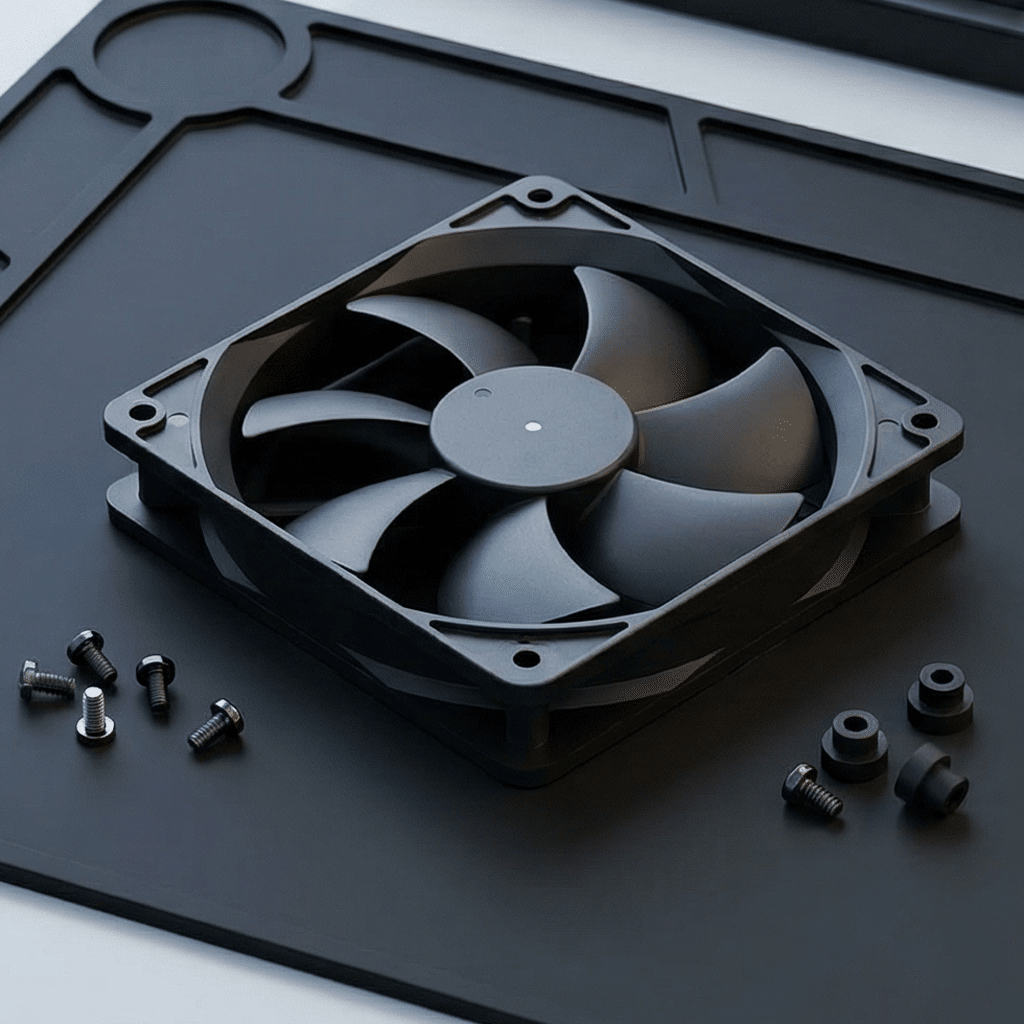
How Do Blade Angle, Count, and Shape Affect Cooling Fan Performance
How Do Blade Angle, Count, and Shape Affect Cooling Fan Performance? A Technical Deep Dive
Published on Feb 4, 2026
Abstract: Cooling fan performance isn’t just about RPM or size—blade angle, number, and geometry are the true determinants of airflow, static pressure, noise, and efficiency. This article explains the aerodynamic principles behind each parameter and provides application-specific design guidelines for servers, GPUs, telecom cabinets, and more.
1. Why Blade Design Matters More Than You Think
As power densities rise in electronics—from GPUs to 5G base stations—the cooling fan has become a critical performance bottleneck. The blade is the only component that directly interacts with air, so its design governs:
- Airflow: Volume of air moved per unit time (CFM or m³/h)
- Static Pressure: Ability to overcome resistance from heatsinks, filters, or tight enclosures (mmH₂O or Pa)
- Noise: Acoustic output (dBA), a key user experience factor
- Efficiency: Airflow per watt of input power
✅ Key Insight: There is no “best” blade design—only the optimal match for your system’s impedance curve.
2. Blade Angle (Pitch): The Lever of Air Movement
Blade angle (or pitch) is the angle between the blade chord and the plane of rotation. It determines how much air is “scooped” per revolution.
| Pitch Range | Airflow | Static Pressure | Best For |
|---|---|---|---|
| Low (<20°) | Lower | High | High-resistance systems (dense fin stacks, dust filters) |
| Medium (20°–30°) | Balanced | Balanced | General-purpose (VRMs, power supplies) |
| High (>30°) | High | Lower | Open environments (chassis intake/exhaust) |
Engineering Trade-off:
Excessive pitch causes flow separation and turbulence → increased noise and reduced efficiency.
Too little pitch fails to generate sufficient thrust → poor heat dissipation.
? Industry Practice: High-end server fans often use 25°–28° variable-pitch blades to balance pressure and acoustic performance.
3. Blade Count: Why Odd Numbers Dominate
Nearly all industrial and high-performance fans use an odd number of blades (3, 5, 7, 9, 11). Here’s why:
- Avoid resonance: Even-numbered symmetric blades can couple with motor vibration frequencies, causing structural fatigue.
- Smoother airflow: Odd counts distribute pressure pulses more evenly, reducing tonal noise.
(This principle also applies to helicopter rotors and jet engines.)
| Blade Count | Airflow | Static Pressure | Noise | Typical Use |
|---|---|---|---|---|
| Few (3–5) | High | Low | Higher | Open-air cooling (case fans) |
| Medium (7–9) | Balanced | Balanced | Lowest | CPU/GPU coolers |
| Many (11+) | Lower | High | Moderate-High | Compact PSUs, telecom cabinets |
⚠️ Myth Alert: Adding more blades doesn’t always help—it increases drag and power consumption, potentially lowering overall efficiency.
4. Blade Shape: From Flat Plates to Bio-Inspired Wings
Modern fans have evolved far beyond simple flat blades. Key geometries include:
Curved / Swept Blades
- Guide airflow tangentially
- Reduce vortex shedding
- ↑ Airflow by 10–15%, ↓ noise by 3–5 dBA
- Used by Noctua, be quiet!, and other premium brands
Twisted (Skewed) Blades
- Pitch varies from hub to tip
- Compensates for higher linear speed at the tip
- Maximizes efficiency at high RPM (>3000 RPM)
Bionic Winglets (Inspired by Nature)
- Sawtooth or winglet tips mimic humpback whale fins or eagle wings
- Suppress tip vortices
- Reduce high-frequency noise by up to 8%
- Seen in data center and outdoor-rated fans
Materials & Surface Finish
- PBT: Heat-resistant, stable up to 130°C
- LCP: Ultra-rigid, low moisture absorption
- Mirror-polished surfaces reduce turbulence
- Hydrophobic coatings enhance IP68 reliability
5. System Matching: Choosing the Right Blade for Your Application
| Application | Recommended Blade Features | Design Goal |
|---|---|---|
| Gaming GPU | 7–9 blades, 28° pitch, curved profile | High static pressure to penetrate dense heatsinks |
| Server Rack | 9–11 blades, twisted design, PBT material | Maximize pressure for hot-swap redundancy |
| Outdoor Telecom Cabinet | 5–7 blades, IP68 sealed, UV-resistant | Reliability over 10 years in -40°C to +85°C |
| Quiet Office PC | 7 blades, 22° pitch, bionic winglets | Noise <20 dBA, comfort-first |
? Golden Rule:
- High-impedance systems → prioritize static pressure → fewer, thicker, steeper blades
- Low-impedance systems → prioritize airflow → more, thinner, swept blades
6. Future Trends: Simulation + AI-Driven Design
- CFD-first development: Millions of mesh cells simulate airflow before prototyping.
- Machine learning optimization: Algorithms explore millions of blade combinations to find Pareto-optimal designs.
- Active blade control: Experimental fans adjust pitch in real-time—like aircraft flaps—for dynamic load matching.
Conclusion: The Art and Science of Moving Air
Fan blades sit at the intersection of fluid dynamics, materials science, and acoustics. Understanding how angle, count, and shape interact empowers engineers—and informed buyers—to make better thermal decisions.
The most expensive fan isn’t the one with the highest RPM—
it’s the one whose blades are perfectly tuned to your system’s airflow needs.
When selecting a cooling fan, look beyond specs like size and speed. Dive into the blade design—it’s where true performance lives.
Explore Further:
Fan Digital Twin: How Simulation Technology Optimizes Thermal Design
The Future of Cooling Fans: How Intelligence, Systemization, and Sustainability Are Reshaping the Post-2025 Landscape
Related Article