
2025 AC/DC Cooling Fan Technology Trends-Development Directions of Quietness, Energy Efficiency, and Intelligence
author: Rainie
2025-07-05


Rainie YU
Cooling Fan Expert | XQF FAN Overseas Mgr
Specialize in DC FAN/AC FAN/EC FAN/Industrial Equipment Cooling Solutions Services.
In the heat dissipation solutions of industrial equipment and electronic products, AC/DC cooling fans have always played an indispensable role. With the rapid development of technology and the increasing market demand for efficient, environmentally friendly, and intelligent products, AC/DC cooling fans will show three significant technological development directions in 2025: quietness, energy efficiency, and intelligence.
I. Innovation in Quiet Technology: Brushless Motors Become Mainstream
Traditional AC/DC cooling fans mostly use brushed motors. The friction between the brushes and the commutator not only generates noise but also shortens the motor's service life. The rise of brushless motors (Brushless Direct Current Motor, BLDC) has brought hope to solve this problem. Brushless motors replace mechanical commutation with electronic commutation, eliminating the physical contact between brushes and commutators, thus significantly reducing operating noise. According to data from market research institutions, in 2024, the market share of cooling fans using brushless motors in the mid-to-high-end market has reached 35%, and it is expected that this proportion will rise to 45% in 2025.
In terms of working principle, the stator of a brushless motor is composed of electromagnetic coils, which generate a rotating magnetic field when energized; the rotor is composed of permanent magnets, which rotate under the action of the rotating magnetic field. The position sensor monitors the rotor position in real-time and feeds the signal back to the electronic commutation circuit to precisely control the current direction of the stator windings, ensuring the motor runs continuously and stably. Taking computer cooling fans as an example, the application of brushless motors enables the fan to control noise at an extremely low level while providing efficient heat dissipation, creating a quiet working environment for users. In the industrial field, brushless motor cooling fans have gradually become the mainstream choice. For example, in medical equipment and precision instruments with strict noise requirements, their low-noise characteristics ensure a quiet and stable operating environment for the equipment.
II. Upgrade of Energy-Saving Technology: Synergistic Effect of PWM Speed Regulation and High-Efficiency Motors
1. Optimization of PWM Speed Regulation Technology
PWM (Pulse Width Modulation) speed regulation technology is increasingly widely used in AC/DC cooling fans, becoming one of the key technologies to achieve energy saving. PWM speed regulation adjusts the input voltage of the fan motor by controlling the duty cycle of the pulse signal, that is, the proportion of time the high level occupies in a cycle, thereby precisely controlling the fan speed. When the equipment is in a low-load operation state and generates less heat, the PWM speed regulation system will automatically reduce the fan speed to reduce energy consumption; when the equipment is under high load and generates a large amount of heat, the fan speed will be increased to ensure the heat dissipation effect.
Compared with the traditional voltage speed regulation method, PWM speed regulation has significant energy-saving advantages. Studies have shown that cooling fans using PWM speed regulation can reduce energy consumption by 30% - 40% under partial load conditions. In data centers, a large number of servers run 24 hours a day, and the energy consumption of cooling fans accounts for a considerable proportion of the total energy consumption. Cooling fans using PWM speed regulation technology can adjust the speed in real-time according to the internal temperature of the server, effectively reducing the overall energy consumption of the data center, which is in line with the global concept of energy conservation and emission reduction.
2. Breakthroughs in High-Efficiency Motor Technology
In addition to PWM speed regulation, improving the efficiency of the motor itself is also an important way to save energy. New high-efficiency AC/DC motors are constantly emerging. For example, the EC fan driven by an electronically commutated DC brushless motor launched by Delta can achieve energy savings of up to 70% compared with traditional AC motor fans. Such high-efficiency motors reduce copper loss, iron loss, and mechanical loss during motor operation by optimizing the magnetic circuit design of the motor, using high-performance magnetic materials, and improving manufacturing processes, thereby improving the conversion efficiency from electrical energy to mechanical energy. In the fields of heating, ventilation, air conditioning, and commercial refrigeration, cooling fans driven by high-efficiency motors can significantly reduce energy consumption while ensuring heat dissipation performance, saving operating costs for enterprises.
III. Intelligent Trend: Integration of Intelligent Temperature Control and Internet of Things
1. Upgrade of Intelligent Temperature Control System
In 2025, the intelligent temperature control technology of AC/DC cooling fans will become more mature. The intelligent temperature control system deploys high-precision temperature sensors, such as thermistors and thermocouples, in key heating parts of the equipment to monitor temperature changes in real-time. The sensor transmits the collected temperature data to the intelligent temperature control chip, which has a built-in advanced algorithm. It can quickly calculate and output control signals according to the preset temperature threshold and equipment operating status to precisely adjust the speed of the cooling fan.
Taking Juhui industrial computers as an example, their intelligent temperature control cooling system deploys temperature sensors with an accuracy of ±0.1℃ in key heating areas such as CPU and GPU. The sensors feed temperature data back to the intelligent temperature control chip at a millisecond-level speed. When the chip detects that the temperature is close to or exceeds the preset threshold, it immediately sends an instruction to the cooling fan to adjust the speed. In a high-temperature environment, the fan speed increases rapidly to form a strong air flow, quickly taking away the heat inside the equipment; in low temperatures or when the equipment is under light load, the fan speed decreases to reduce energy consumption and noise. This intelligent temperature control system not only improves the heat dissipation efficiency of the equipment but also extends the service life of the equipment.
2. Empowerment of Internet of Things Technology
The development of Internet of Things (IoT) technology has brought new opportunities for the intelligence of AC/DC cooling fans. By connecting cooling fans to the Internet of Things, users can realize remote monitoring and management. In industrial production, enterprise managers can check the operating status of cooling fans distributed on equipment in different workshops in real-time through mobile APPs or computer management platforms, including parameters such as speed, temperature, and working hours. Once an abnormality is found in a fan, such as a decrease in speed or excessive temperature, the system will immediately issue an alarm to remind maintenance personnel to deal with it in time, avoiding equipment shutdown due to heat dissipation failures and improving production efficiency.
In addition, with the help of IoT big data analysis technology, enterprises can also conduct in-depth mining of the operating data of cooling fans, understand the heat dissipation needs of equipment under different working conditions, optimize heat dissipation strategies, and further improve the overall performance and reliability of the equipment. For example, by analyzing a large amount of data, enterprises can find that the energy consumption of cooling fans is too high in certain time periods or working modes of some equipment, and then adjust the intelligent temperature control algorithm or replace more efficient cooling fans in a targeted manner to achieve the dual goals of energy conservation, emission reduction, and equipment performance optimization.
To sum up, AC/DC cooling fans will make significant progress in quietness, energy efficiency, and intelligence in 2025. The application and integration of technologies such as brushless motors, PWM speed regulation, intelligent temperature control, and the Internet of Things will promote cooling fans to develop in a more efficient, intelligent, and environmentally friendly direction, meeting the escalating market demand. Whether in the industrial field or the consumer electronics field, these technological trends will provide strong guarantees for the stable operation and performance improvement of equipment.
Axial Fan vs Centrifugal Fan:Which Has Better Cooling Effect?Different Application Scenarios
Interpretation of Energy Efficiency Standards for AC/DC Cooling Fans: How to Meet EU CE and US UL Certifications
Related Article
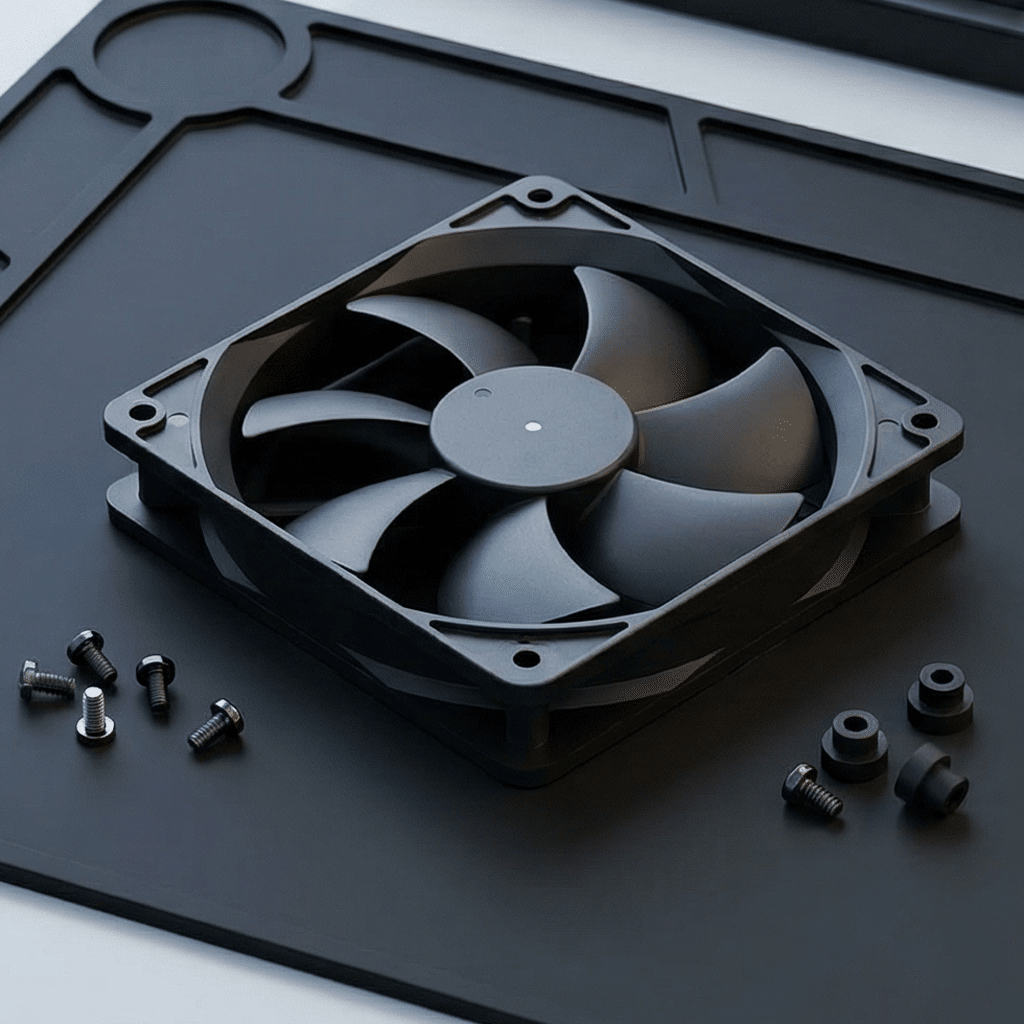
hoose a cooling fan at the operating point where its published performance curve meets the resistance of the finished equipment—not at the fan’s maximum free-air CFM.
How Do You Choose a Cooling Fan by Static Pressure and Airflow

Set cooling fan airflow so cool supply air reaches the highest-heat components first and hot air exits without returning to the intake. Verify the airflow arrow molded on the fan frame, not the visible blade shape.
How Do You Set Cooling Fan Airflow Direction in Electronic Equipment?

An axial fan is usually better for moving a large volume of air through a low-resistance enclosure, while a centrifugal blower is usually better when air must pass through dense heat sinks, filters, narrow ducts or other high-resistance components.
Axial Fan vs Centrifugal Blower- Which Is Better for Electronics Cooling