Interpretation of Energy Efficiency Standards for AC/DC Cooling Fans: How to Meet EU CE and US UL Certifications
author: Rainie
2025-06-23

Rainie YU
Cooling Fan Expert | XQF FAN Overseas Mgr
Specialize in DC FAN/AC FAN/EC FAN/Industrial Equipment Cooling Solutions Services.
AC/DC cooling fans play a crucial role in the thermal management solutions of industrial equipment and electronic products worldwide. As environmental protection and safety requirements become increasingly stringent, countries around the globe have tightened their energy efficiency standards and certification systems for cooling fans. For enterprises, purchasing AC/DC cooling fans that comply with international certification standards is not only essential for product compliance but also key to ensuring stable equipment operation and user safety. This article will provide a detailed analysis of the energy efficiency and safety requirements of EU CE certification and US UL certification for AC/DC cooling fans, along with practical advice on procuring compliant products.
I. EU CE Certification: Dual Assurance of Safety and Environmental Protection
1. Energy Efficiency Standard Requirements
The EU regulates the energy efficiency of AC/DC cooling fans mainly through the ErP (Energy-related Products) Directive and the Ecodesign Directive. These directives focus on the energy efficiency ratio during the fan's operation, aiming to reduce energy consumption throughout the product's life cycle. For instance, the fan's energy efficiency ratio (airflow/power) must reach a specific threshold to ensure sufficient heat dissipation while minimizing power waste. Additionally, strict limits are imposed on the fan's standby power consumption, in line with the EU's green energy-saving initiative.
2. Safety Performance Requirements
The safety requirements of CE certification cover multiple dimensions. In terms of electrical safety, fans must have robust insulation protection to prevent electric shock risks and withstand specified withstand voltage tests. Regarding mechanical safety, components such as fan blades and casings must have sufficient strength and stability to avoid detachment or damage due to mechanical stress during operation. In electromagnetic compatibility (EMC), fans should not generate electromagnetic radiation that interferes with other electronic devices and should be able to resist external electromagnetic interference.
3. Certification Process and Testing
To obtain CE certification, enterprises must first ensure that their products pass energy efficiency and safety performance tests conducted by third-party laboratories, such as energy efficiency ratio detection, insulation resistance testing, withstand voltage testing, and EMC testing. After passing the tests, enterprises need to compile technical documents detailing the product's design, manufacturing, testing processes, and compliance standards. Finally, affix the CE mark to the product to complete the certification process.
II. US UL Certification: A Benchmark of Stringent Safety Performance
1. Energy Efficiency Standard Requirements
In the United States, energy efficiency requirements for cooling fans are mainly reflected in the Energy Star program. Although this program is not mandatory, products with Energy Star certification are more competitive in the market. The Energy Star program sets high requirements for indicators such as the fan's energy efficiency ratio and speed regulation function, encouraging enterprises to produce energy-efficient products.
2. Safety Performance Requirements
UL certification is renowned for its rigorous safety testing. In terms of electrical safety, UL requires that the fan's electrical components comply with the National Electrical Code (NEC) and have functions such as overcurrent protection and short-circuit protection. For fire safety, the fan's casing, insulation materials, etc., must pass flame retardant tests to prevent fires caused by overheating. In terms of structural safety, fans must undergo mechanical shock and vibration tests to ensure stable operation in harsh environments.
3. Certification Process and Testing
When applying for UL certification, enterprises need to submit product samples and technical materials to the UL laboratory. The laboratory will conduct comprehensive tests on the products, including electrical safety tests, fire safety tests, and mechanical performance tests. The testing cycle usually takes 4 - 8 weeks. After passing the tests, UL will issue a certification certificate and allow the enterprise to use the UL mark on the product. Subsequently, UL will conduct regular factory inspections to ensure that the products continuously meet the certification requirements.
III. Practical Advice for Enterprises on Procuring Compliant Products
1. Pay Attention to Certification Marks and Documents
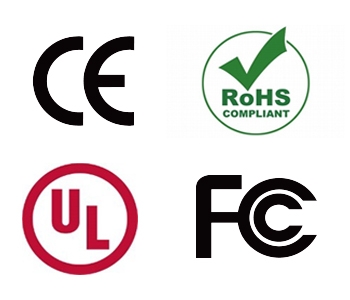
When purchasing AC/DC cooling fans, enterprises must check whether the products have clear CE or UL marks and request certification certificates and test reports from suppliers. Additionally, verify the validity of the certificates to avoid purchasing counterfeit certified products.
2. Understand Suppliers' Certification Capabilities
Give priority to suppliers with a sound certification system, such as those with their own laboratories or long-term cooperation with well-known certification institutions. These suppliers can better control product quality during the product research and development and production processes, ensuring that products continuously meet certification standards.
3. Select Products Based on Actual Requirements
Enterprises should comprehensively consider the fan's energy efficiency, safety performance, and certification standards according to the usage scenarios and performance requirements of their own products. For example, for equipment used in harsh environments such as high temperatures and high humidity, select fans with higher protection levels and mechanical stability.
4. Establish Long-Term Cooperative Relationships
Establishing long-term cooperative relationships with reliable suppliers can not only ensure the stable supply of products but also provide timely technical support and after-sales service in case of product problems. Moreover, long-term cooperation helps enterprises stay informed about the latest certification trends and product technology upgrades in the industry.
This article comprehensively analyzes the certification key points of AC/DC cooling fans. If you want to add certification information from other countries or conduct a more in-depth analysis of specific sections, feel free to let me know.
2025 AC/DC Cooling Fan Technology Trends-Development Directions of Quietness, Energy Efficiency, and Intelligence
The Unconventional Duties of Cooling Fans: A Showcase of Surprising Applications from Medical Equipment to Agricultural Greenhouses
Related Article
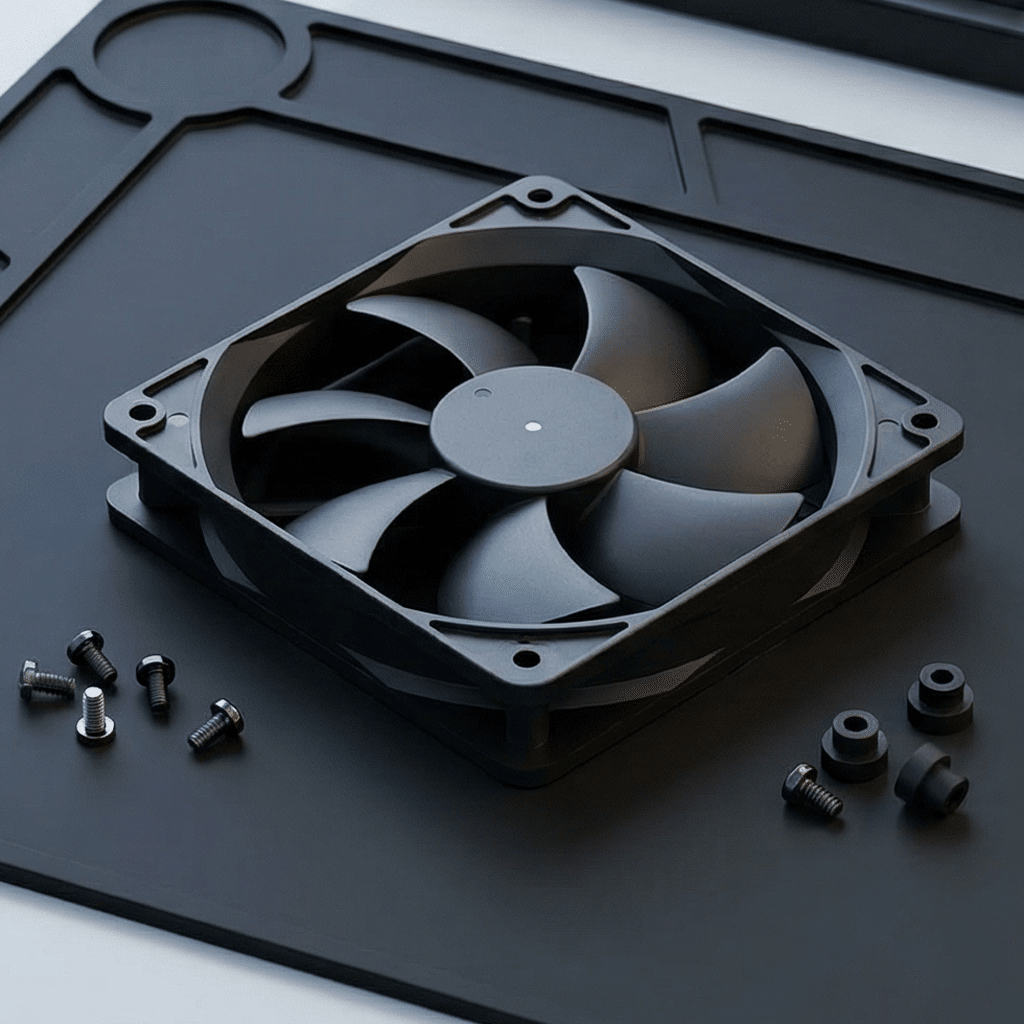
hoose a cooling fan at the operating point where its published performance curve meets the resistance of the finished equipment—not at the fan’s maximum free-air CFM.
How Do You Choose a Cooling Fan by Static Pressure and Airflow

Set cooling fan airflow so cool supply air reaches the highest-heat components first and hot air exits without returning to the intake. Verify the airflow arrow molded on the fan frame, not the visible blade shape.
How Do You Set Cooling Fan Airflow Direction in Electronic Equipment?

An axial fan is usually better for moving a large volume of air through a low-resistance enclosure, while a centrifugal blower is usually better when air must pass through dense heat sinks, filters, narrow ducts or other high-resistance components.
Axial Fan vs Centrifugal Blower- Which Is Better for Electronics Cooling