
The Unconventional Duties of Cooling Fans: A Showcase of Surprising Applications from Medical Equipment to Agricultural Greenhouses
author: Rainie
2025-06-19


Rainie YU
Cooling Fan Expert | XQF FAN Overseas Mgr
Specialize in DC FAN/AC FAN/EC FAN/Industrial Equipment Cooling Solutions Services.
I. Medical Equipment: The "Invisible Guardians" Protecting Lives
1.1 Incubators for Premature Infants: The Cradles of Precise Temperature Control
In neonatal intensive care units (NICUs), the environmental control of incubators for premature infants is crucial for their survival. Traditional incubators rely on heating elements to maintain temperature, but local overheating or uneven temperature distribution can harm these fragile infants. The high - end incubators developed by Fisher & Paykel, a German company, are equipped with miniature cooling fans. These fans ensure that the temperature fluctuation inside the incubator does not exceed ±0.5℃ through precise control of air circulation. Operating at extremely low speeds, the fans generate gentle airflow that does not disturb the infants. Combined with humidity sensors, they also maintain the humidity within the ideal range of 50% - 60%, creating a stable environment similar to that of the mother's womb for premature infants.
1.2 Air Purification in Operating Rooms: The Sterilization Combination of Fans and Filters
In operating rooms, cooling fans, when combined with high - efficiency particulate air (HEPA) filters, become the "transporters" of clean air. In Stryker's laminar flow purification system, axial fans push air through multiple layers of filters at a constant speed, filtering out 99.97% of particles larger than 0.3 microns, including bacteria and viruses. The directional airflow generated by the fans forms an "air curtain," preventing contaminated external air from entering the surgical area and reducing the postoperative infection rate by more than 30%, thus safeguarding patients' lives.
II. Agricultural Greenhouses: The "Climate Regulators" for Crop Growth
2.1 Mushroom Cultivation Greenhouses: Dual Control of Humidity and Ventilation
Mushroom growth has strict requirements for environmental humidity and ventilation. Excessive humidity can easily lead to mold growth, while insufficient ventilation can affect mycelium development. At the edible fungus cultivation base owned by FrieslandCampina, a Dutch company, an intelligent ventilation system is adopted. Axial fans are linked with humidity sensors. When the humidity inside the greenhouse exceeds 85%, the fans automatically start to exhaust the humid air and introduce fresh air, maintaining air freshness. This precise control has increased mushroom yields by 25% and reduced the proportion of deformed mushrooms by 15%, providing an efficient solution for modern agriculture.
2.2 Flower Greenhouses: The Unsung Heroes of Temperature Equalization
In the large - scale greenhouses of the Dounan Flower Market in Yunnan, cooling fans play a vital role in temperature equalization. Flowers are sensitive to day - night temperature differences, and traditional greenhouses often suffer from local temperature variations due to their large spaces. Delta Electronics has designed a mixed - flow fan system for greenhouses. Through multi - point layout, the system evenly distributes the heat accumulated at night to every corner, preventing flowers from being frost - damaged due to local overcooling. According to actual measurement data, after installing this system, the temperature uniformity in the greenhouse has increased by 40%, and the defective rate of delicate flowers such as roses and lilies has decreased by 20%.
III. Cold Chain Logistics: The "Freshness Preservers" for Ingredients
3.1 Refrigerated Trucks: The Magic of Airflow Circulation for Freshness Preservation
In cold chain transportation, uneven temperature distribution inside the truck is a major cause of cargo spoilage. Nissin, a Japanese company, has equipped its refrigerated trucks with a patented fan system. Centrifugal fans installed on the top and sides of the truck compartment create a three - dimensional airflow circulation. The airflow generated by the fans bypasses the gaps between the goods, ensuring that the temperature error in each corner does not exceed ±1℃, effectively extending the shelf life of fresh food. Statistics show that this system has reduced the loss rate of fruits and vegetables from the industry average of 8% to 3%, saving companies millions of dollars in losses each year.
3.2 Vaccine Transport Boxes: Constant Temperature Assurance in Extreme Environments
The temperature control requirements for COVID - 19 vaccine transportation are extremely strict, and the cooling fans inside ultra - low - temperature transport boxes have become crucial. Thermo Fisher Scientific's 2 - 8℃ vaccine transport boxes are equipped with a dual - redundant fan system. The main fan maintains daily airflow circulation, and the backup fan automatically activates in case of a main fan failure, ensuring that the temperature fluctuation does not exceed ±0.2℃. This design has enabled the safe transportation of hundreds of millions of vaccine doses in many countries around the world, making significant contributions to the fight against the pandemic.
From medical equipment that safeguards lives to greenhouse systems that boost agricultural harvests, and from cold chain transportation that ensures food safety, cooling fans have reshaped multiple industries in unexpected ways. These "unconventional duties" not only showcase the infinite potential of technology but also reveal a truth: seemingly ordinary devices can also unleash extraordinary value driven by innovative thinking. With the development of science and technology, cooling fans may unlock even more novel applications, and we look forward to seeing what the future holds.
Interpretation of Energy Efficiency Standards for AC/DC Cooling Fans: How to Meet EU CE and US UL Certifications
How Do Industrial Equipment Combat High Temperatures— The Hardcore Applications of Cooling Fans in Manufacturing
Related Article
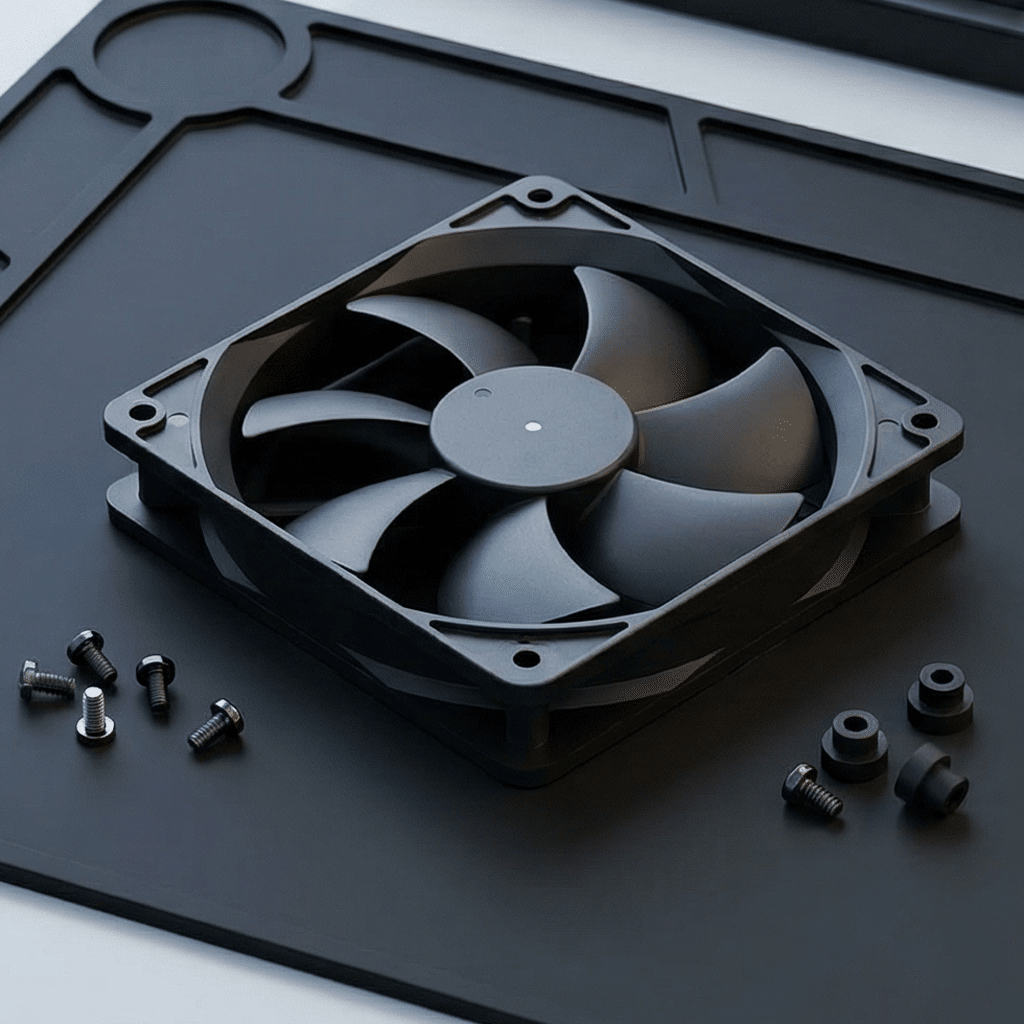
hoose a cooling fan at the operating point where its published performance curve meets the resistance of the finished equipment—not at the fan’s maximum free-air CFM.
How Do You Choose a Cooling Fan by Static Pressure and Airflow

Set cooling fan airflow so cool supply air reaches the highest-heat components first and hot air exits without returning to the intake. Verify the airflow arrow molded on the fan frame, not the visible blade shape.
How Do You Set Cooling Fan Airflow Direction in Electronic Equipment?

An axial fan is usually better for moving a large volume of air through a low-resistance enclosure, while a centrifugal blower is usually better when air must pass through dense heat sinks, filters, narrow ducts or other high-resistance components.
Axial Fan vs Centrifugal Blower- Which Is Better for Electronics Cooling