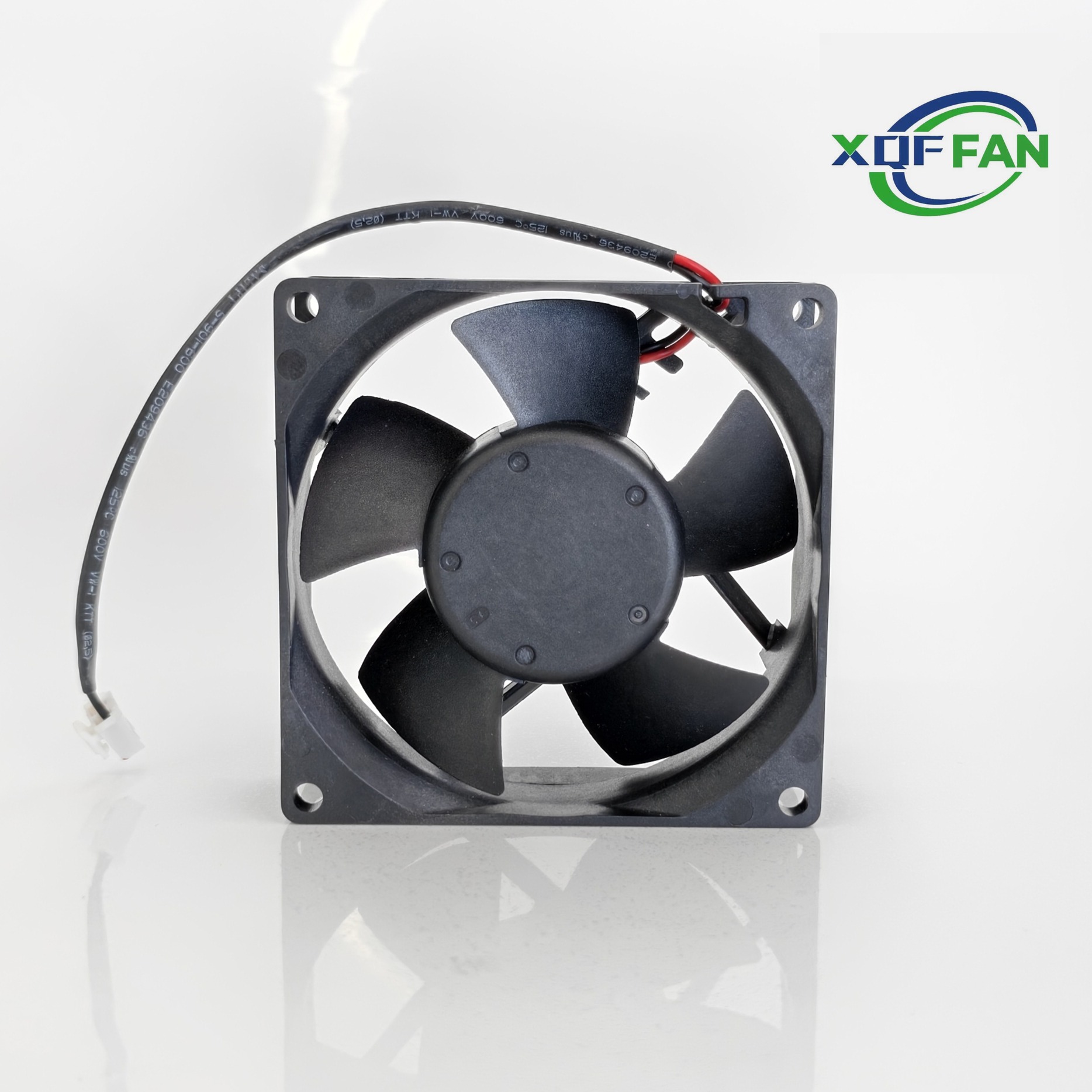
AC Axial Fan vs. DC Axial Fan-How to Choose the Right Cooling Fan
AC Axial Fan vs. DC Axial Fan: How to Choose the Right Cooling Fan
AC axial fans and DC axial fans are both widely used to cool electronics, electrical cabinets, industrial machinery, power equipment, and ventilation systems. They share the same basic purpose—moving air parallel to the motor shaft—but their power source, control options, integration requirements, and ideal applications can be very different.
AC axial fan vs. DC axial fan: the quick comparison
An AC axial fan is powered by alternating current, commonly mains voltage. It is often selected for fixed-speed ventilation in equipment that already has an AC supply. A DC axial fan is powered by direct current, commonly 5 VDC, 12 VDC, 24 VDC, or 48 VDC. Most modern DC fans use brushless motor technology and can support speed feedback and PWM control.
| Factor | AC axial fan | DC axial fan |
|---|---|---|
| Power source | AC mains or equipment AC supply. | Low-voltage DC rail, such as 12 V, 24 V, or 48 V. |
| Speed control | Often fixed speed; variable-speed control may require additional hardware. | Commonly supports voltage control, PWM input, or dedicated fan control. |
| Monitoring | Model dependent; basic models may have no speed feedback. | Tachometer, alarm, and locked-rotor signals are widely available. |
| Typical applications | Electrical cabinets, appliances, HVAC equipment, mains-powered machinery. | Servers, telecom, power supplies, battery systems, medical devices, electronics. |
| Integration | Simple where suitable AC power already exists. | Simple where a regulated DC rail and electronic controller already exist. |
What is an AC axial fan?
An AC axial fan is designed to operate from alternating-current power. It is commonly used in industrial control cabinets, appliances, ventilation equipment, and other products that already use AC mains power. AC fans can be a straightforward, durable solution when the cooling requirement is relatively constant and a fixed fan speed is acceptable.
Before specifying an AC fan, verify its rated voltage, frequency, current, insulation system, grounding requirements, connector or terminal arrangement, and applicable safety approvals. Voltage and frequency can affect speed and performance, so the exact regional power supply matters.
What is a DC axial fan?
A DC axial fan runs from a direct-current supply. Brushless DC fans are common in electronic equipment because they are compact, efficient, and easy to connect to a microcontroller or thermal-management circuit. A two-wire version usually runs at a fixed speed; three-wire versions typically add RPM feedback; four-wire PWM versions allow precise speed command and tachometer monitoring.
DC fans are available in a broad range of sizes and pressure capabilities, from compact board-level fans to high-speed units for servers, telecom, energy storage, and power-conversion equipment.
How to choose based on power architecture
The available power source is usually the first decision point. An AC fan may be the natural fit for a simple mains-powered cabinet that needs constant ventilation. A DC fan may be the better choice when the system has an established 12 VDC, 24 VDC, or 48 VDC rail and an embedded controller that can regulate fan speed.
Do not add a DC fan to an AC-only product without accounting for a correctly rated AC-to-DC power supply, electrical protection, EMC implications, and the additional integration work. Similarly, do not connect a DC fan directly to AC mains power.
Speed control: a major advantage of DC fans
Cooling demand changes with ambient temperature and equipment load. DC fans, especially four-wire PWM models, make it easier to match speed to demand. The host supplies stable DC power while a PWM control signal requests the desired speed. The tachometer output can confirm that the fan is operating correctly.
Variable-speed control can reduce acoustic output and power consumption during low load. It can also enable a fault response: if a critical temperature rises or one fan fails, the controller can command other fans to a higher speed.
AC fan speed control is possible in some designs, but the suitable method depends on motor technology and the specific product. It may require a compatible external controller. Never assume that a generic dimmer, voltage reduction, or frequency control is suitable for an AC fan.
Airflow and static pressure: compare the installed operating point
Both AC and DC axial fans must be selected according to the real air path. Airflow is usually stated in CFM or m³/h. Static pressure indicates how well the fan can overcome resistance from filters, grilles, heat sinks, ducts, and dense internal components.
A fan's maximum airflow is usually measured in free air. Once mounted in an enclosure, the delivered airflow decreases as resistance increases. Review the pressure–airflow curve and select the fan at the point where its curve intersects the system-resistance curve. This is especially important for filtered cabinets and compact electronics.
Reliability and environmental requirements
Fan lifetime is influenced by operating temperature, bearing system, orientation, supply quality, dust, moisture, vibration, and daily operating hours. AC or DC is only one part of the reliability decision. For industrial equipment, check the full data sheet and qualification information.
- Temperature: Specify for the actual air temperature at the fan inlet, not only room temperature.
- Bearings: Choose a bearing system suited to continuous duty, orientation, and temperature.
- Ingress protection: Consider dust, water, humidity, and cable/connector sealing for field equipment.
- Corrosion: Review materials and protective options for coastal, agricultural, or chemical environments.
- Fault monitoring: DC fan feedback can support predictive maintenance and safety logic in critical equipment.
Cost and total cost of ownership
AC fans can be cost-effective in fixed-speed, mains-powered products because they may require little additional control hardware. DC fans may have a higher component cost in some sizes, but the available speed control, monitoring, and part-load efficiency can improve total system performance.
Evaluate more than the unit price: include power-supply requirements, controller hardware, installation, energy use, expected service life, replacement access, noise, and the cost of downtime. For a critical cabinet or server, a fan that enables feedback and fault handling can be worth far more than its initial price difference.
When to choose an AC axial fan
- The equipment has a suitable AC supply and needs simple fixed-speed ventilation.
- The thermal load is consistent and does not require frequent speed adjustment.
- The installation is an electrical cabinet, appliance, or industrial machine with appropriate mains safety design.
- The application favors straightforward wiring and does not need detailed fan-health feedback.
When to choose a DC axial fan
- The product has an existing low-voltage DC power rail.
- Fan speed must respond to temperature, workload, or ambient conditions.
- The host system needs tachometer feedback, locked-rotor detection, or alarm output.
- The equipment is compact electronics, telecom, server, battery, medical, or power-conversion hardware.
- Energy consumption and acoustics at partial load are important design targets.
AC vs. DC axial fan selection checklist
- Identify the available power source and allowable voltage range.
- Calculate heat load and define maximum ambient and component temperatures.
- Estimate system pressure drop from filters, grilles, heat sinks, ducts, and obstructions.
- Select the fan curve that delivers required airflow at the real operating point.
- Decide whether speed control, RPM feedback, alarms, or redundancy are needed.
- Verify frame size, depth, mounting holes, connector, cable length, and airflow direction.
- Review operating temperature, bearing life, ingress protection, and corrosion resistance.
- Test temperature, noise, and fan-fault behavior in the finished equipment.
Frequently asked questions
Which is quieter, an AC fan or a DC fan?
Neither type is always quieter. Noise depends on fan size, speed, blade design, motor, mounting, and air-path turbulence. DC fans can often be run more slowly during low thermal demand using PWM control, which can reduce noise in suitable systems.
Can a DC axial fan run continuously?
Yes, if it is specified for the duty cycle and environmental conditions. Confirm the operating-temperature range, bearing system, rated life, power quality, and any requirements for maintenance or fault monitoring.
What information should I send a fan supplier?
Provide supply voltage, space constraints, required airflow, expected static pressure, operating temperature, environmental exposure, target noise, control interface, annual operating hours, and any required certifications. This helps the supplier recommend a fan for the actual system rather than a generic replacement.
Conclusion
AC and DC axial fans are both reliable cooling options when they are matched to the application. AC fans are often a practical choice for simple mains-powered ventilation. DC fans are especially valuable when compact electronics, PWM speed control, fan monitoring, and variable thermal load are part of the design. Start with your power architecture and real airflow resistance, then verify the final choice through system-level testing.
24V DC Cooling Fan Selection Guide
Battery Energy Storage System Cooling- Fan Selection and Design Guide
Related Article