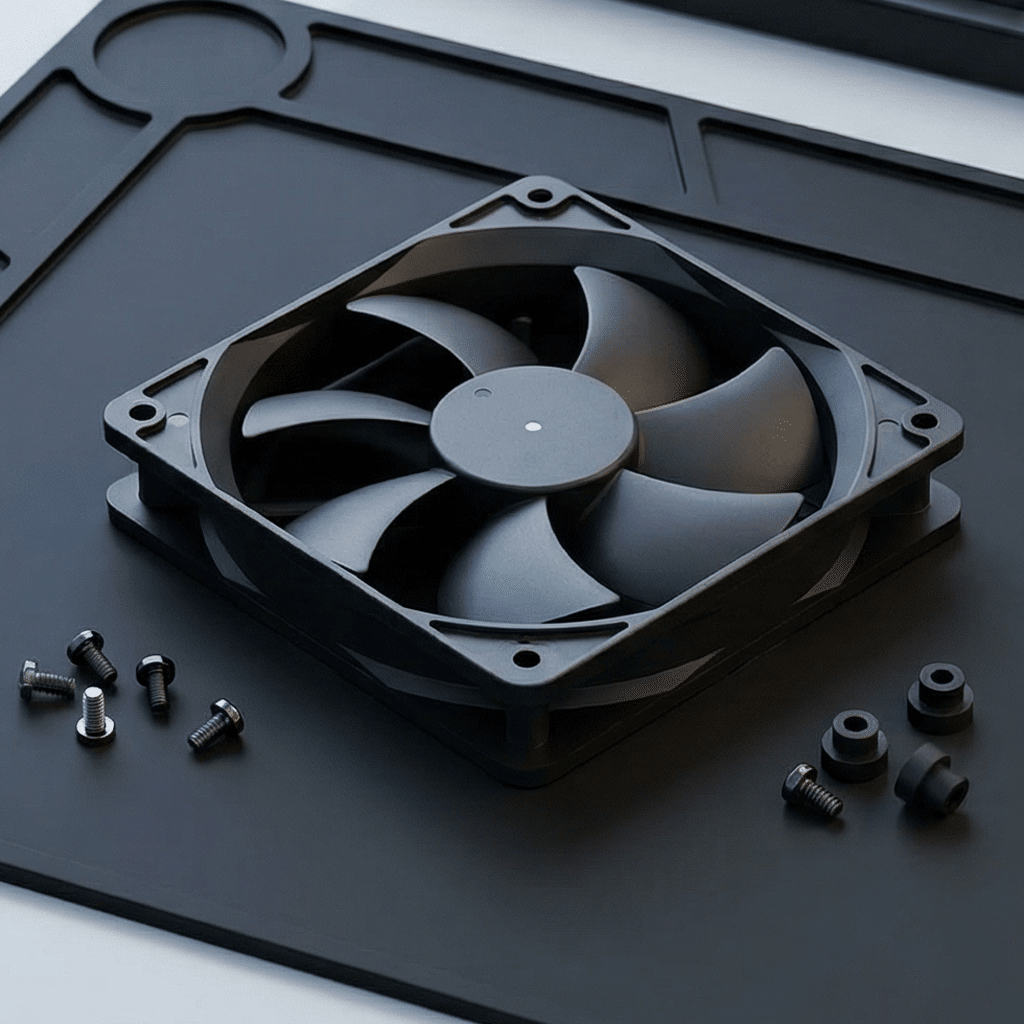
2026 Cooling Fan Procurement Decision Guide: Complete Framework from Specification Comparison to Supplier Evaluation
2025 Cooling Fan Procurement Decision Guide: Complete Framework from Specification Comparison to Supplier Evaluation
Transforming cooling fan procurement from a purchasing activity to a system reliability engineering decision
A batch fan failure at a medium-sized data center resulted in 72 hours of service interruption and over $1 million in direct losses. Post-analysis revealed the root cause wasn't the fans themselves, but a procurement oversight: ignoring the "matching degree between vibration frequency and chassis natural frequency"—a hidden parameter.
Modern cooling fan procurement for electronic devices has evolved from simple component purchasing to complex system reliability engineering decisions. Poor choices not only increase costs but can trigger cascading system failures. Industry data indicates over 60% of field failures related to thermal management can be traced back to insufficient technical matching during procurement.
The Procurement Risk Reality
With accelerating thermal technology iteration and supply chain diversification, procurement decision-makers face unprecedented information overload and selection dilemmas. This article constructs a complete decision framework from technical decoding to supplier auditing, aiming to transform procurement risks into systemic competitive advantages.
01 Market Overview: 2025 Technology Divergence and Price Stratification in Cooling Fans
The current cooling fan market displays a clear three-dimensional differentiation pattern of "technology-application-price." Products following different technological paths can vary in price by 300%-500%, while differences in lifespan and reliability can exceed 10 times.
Technology Path Differentiation Matrix
Brushless DC (BLDC) Mainstream Zone
Holds over 70% market share, ranging from basic models to intelligent programmable versions. Key differentiators include bearings (sleeve vs. dual ball), control chips, and impeller aerodynamic design.
AC Fan Cost-Performance Zone
Maintains 15% share in industrial fixed equipment. Advantages: simple, reliable, no drive circuit needed. Disadvantage: lower energy efficiency.
Special Application Frontier Zone
Includes magnetic levitation fans (no contact wear, 100,000+ hour lifespan for critical medical/aviation), piezoelectric fans (ultra-thin, no EMI), and liquid-cooling auxiliary fans (for high-density servers).
Price Sensitivity and Decision Fallacies
- Initial Cost Trap: Low-price fans (<$2) can have field failure rates 3-5 times higher than mid-range fans ($5-8), resulting in higher Total Cost of Ownership (TCO).
- Overspecification Waste: Purchasing IP68 waterproof fans for ordinary office equipment increases costs 30%-50% with no real benefit.
- Single-Source Supply Chain Risk: Over-reliance on suppliers from a single region creates vulnerability to geopolitical or pandemic disruptions.
02 Technical Specification Deep Decoding: Hidden Indicators Beyond the Datasheet
Procurement decisions must look past "best values" on datasheets to focus on "guaranteed values" and "boundary behavior" under actual working conditions.
Key Explicit Parameter Operational Interpretation
| Parameter | Typical Datasheet Wording | Practical Meaning for Procurement | Test Validation Method |
|---|---|---|---|
| Airflow (CFM) | "Max Airflow 80 CFM" | What is the airflow under actual system resistance (e.g., 0.2 inch-H₂O)? | Request complete P-Q curve from supplier; mark actual operating point |
| Noise (dBA) | "Noise 30 dBA" | Specific noise spectrum at target speed (e.g., 2000 RPM)? Any abnormal sounds? | Request noise spectrum chart; check for peak frequencies |
| Lifespan (Hours) | "MTBF 70,000 hours" | What are the test conditions? Is it L10 life (10% failure) or mean life? | Request lifespan test report; note test temperature and speed |
| Protection Rating (IP) | "IP67" | Third-party certified? To what standard? | Request certification number; verify authenticity |
Five Critical Hidden Metrics (Often Overlooked But Vital)
- Starting Voltage vs. Operating Voltage Range: Many fans are rated for 12V operation, but 15% may fail to start at 9V (especially in low temperatures).
- Vibration Frequency Distribution: Whether the fan's peak vibration frequency coincides with equipment's natural frequency can cause resonance leading to structural fatigue.
- Actual EMC Performance: Not just pass/fail, but the margin size and stability in complex electromagnetic environments.
- Long-Term Speed Stability: Speed drop after 1000 hours of operation, relating to long-term thermal performance degradation.
- Chemical Compatibility: Whether fan materials (especially seals and coatings) resist chemicals in the operating environment (e.g., oil, cleaning agents).
03 Application Scenario-Technology Path Matching Matrix: Logic for Targeted Selection
Different applications have drastically different priority weights for fan requirements. The following matrix provides priority guidance for eight common scenarios:
| Application Scenario | Core Need Priority (1=Highest) | Recommended Technology Path | Cost Sensitivity | Typical Budget ($/unit) |
|---|---|---|---|---|
| Consumer Electronics | 1. Thinness 2. Noise 3. Reliability | Ultra-thin BLDC or Piezoelectric | High | 1.5-4.0 |
| Office/Home PC | 1. Cost-Performance 2. Noise 3. Lifespan | Standard BLDC (Sleeve Bearing) | Medium-High | 2.0-5.0 |
| Gaming PC/Workstation | 1. Cooling Performance 2. Noise Control 3. Aesthetics | High-Performance BLDC (PWM) | Medium | 5.0-15.0 |
| Data Center Server | 1. Reliability 2. Lifespan 3. Energy Efficiency | Server-Grade BLDC (Dual Ball) | Medium-Low | 8.0-20.0 |
| Industrial Control | 1. Wide Temp Range 2. Vibration Resistance 3. IP Rating | Industrial BLDC (IP54+) | Medium | 10.0-25.0 |
| Telecom Outdoor | 1. IP Rating 2. Temperature Range 3. Lightning Protection | Ruggedized BLDC (IP67) | Low | 15.0-40.0 |
| New Energy Vehicles | 1. Automotive Certification 2. Temp Range 3. EMC | Automotive-Grade BLDC (AEC-Q) | Medium | 12.0-30.0 |
| Medical Equipment | 1. Reliability 2. Low Noise 3. Biocompatibility | Medical-Grade BLDC or Magnetic Levitation | Low | 20.0-60.0 |
Special Consideration Dimensions
- Regulations & Certifications: Medical, automotive, and aviation have mandatory certifications (ISO 13485, IATF 16949, DO-160), adding 20%-40% to product cost.
- Supply Chain Continuity: Evaluate supplier's raw material diversification and production flexibility. Ideal suppliers have at least two geographically dispersed production sites.
04 Six-Dimensional Radar Chart for Supplier Evaluation: Comprehensive Audit Beyond Price
The difference between excellent and average suppliers extends far beyond product catalogs and price lists. We recommend systematic assessment using the following six-dimensional radar:
1. Technical Depth Dimension
- Independent R&D team and laboratory?
- Patent quantity/quality, especially in aerodynamics and motor control?
- Participation level in industry standard development?
2. Quality System Dimension
- Certification completeness (ISO 9001 baseline, industry-specific as plus)?
- Production process quality control points (e.g., 100% inspection ratio, burn-in time)?
- Defective product tracking and root cause analysis capability?
3. Supply Chain Resilience Dimension
- Key raw material (magnets, chips, bearings) supplier diversification?
- Production flexibility (rapid ramp-up/down capability)?
- Geographical diversity (production, warehousing, distribution)?
4. Cost Structure Transparency
- Willingness to share approximate cost breakdown?
- Price adjustment mechanism (linkage to commodity prices)?
- Price protection terms in long-term agreements?
5. Technical Support Capability
- Application engineer response speed and expertise?
- Simulation support, testing assistance offered?
- Failure analysis capability and improvement suggestion quality?
6. Sustainability Performance
- Environmental compliance (RoHS, REACH, etc.)?
- Energy efficiency improvement roadmap?
- Carbon footprint tracking and reduction commitments?
Supplier Classification Example
- Grade A (Strategic Partner): Excellent across all 6 dimensions; suitable for long-term cooperation in critical applications.
- Grade B (Main Supplier): Good in 4-5 dimensions; suitable for most regular requirements.
- Grade C (Alternate Supplier): Meets 2-3 dimensions; only for non-critical, price-sensitive applications.
05 Four-Step Procurement Decision Process: From Requirement Definition to Contract Management
Establishing a standardized procurement decision process can reduce selection errors by 70%. We recommend the following four-step approach:
Step 1: Requirement Definition & Specification Development
- Convene cross-functional team (R&D, Quality, Procurement, Production) to clarify true needs.
- Differentiate between "must meet" and "nice to have" technical requirements.
- Develop comprehensive specification covering performance, environment, lifespan, certifications.
Step 2: Preliminary Screening & Sample Testing
- Screen 3-5 potential suppliers using six-dimensional radar.
- Obtain samples for actual working condition simulation testing, not standard lab tests.
- Focus on performance under boundary conditions (temperature extremes, vibration, voltage fluctuation).
Step 3: Site Audit & Capability Verification
- Conduct site audits for suppliers passing sample testing.
- Verify actual production capability, quality control, and R&D facilities.
- Interview key customers to understand actual cooperation experience.
Step 4: Commercial Negotiation & Contract Design
- Negotiate based on Total Cost of Ownership (TCO), not just unit price.
- Include clear quality metrics, liability, and continuous improvement requirements in contract.
- Design tiered pricing and long-term cooperation framework.
Risk Management Essentials
- Dual-Source Strategy: Maintain at least two qualified suppliers for critical applications.
- Inventory Buffer: Set different safety stock levels based on supply risk rating.
- Periodic Reassessment: Re-evaluate supplier performance and market changes every 12-18 months.
Conclusion: Procurement as a Competitive Advantage
With global electronic device cooling demand growing at 7.2% annually, cooling fan procurement decisions are evolving from a logistical support function to a core element of product competitiveness. Excellent fan selection not only reduces failure rates but can unlock device performance potential through optimized thermal solutions.
Companies that view fan procurement as a technical decision rather than a simple commercial purchase gain hidden competitive advantages: their products run more stably, last longer, and achieve higher customer satisfaction. In this era of increasingly important thermal design, the wisdom of cooling fan selection is quietly becoming the thermometer of a company's product capability.
Key Procurement Principles for 2025
- Focus on Total Cost of Ownership (TCO) over initial purchase price
- Implement technical validation under actual operating conditions
- Develop strategic partnerships with suppliers showing excellence across all six dimensions
- Maintain supply chain resilience through diversification and risk management
- Continuously reevaluate and optimize procurement strategies as technology and markets evolve
The Key to Safe Operation of Energy Storage Cabinets: How to Choose High-Temperature Resistant, Long-Life Cooling Fans?
Mastering Extreme Challenges Industrial-Grade Cooling Fan Applications & Selection Strategies
Related Article