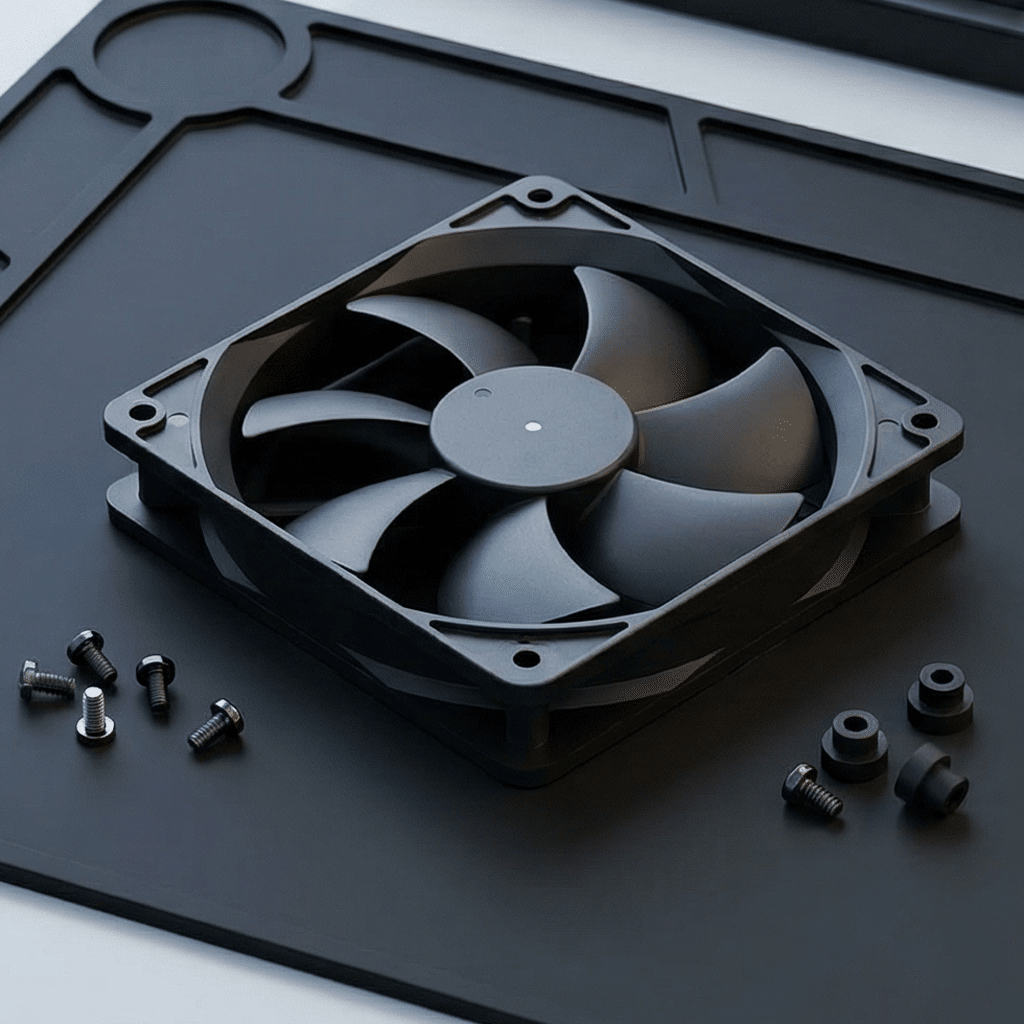
A Guide to High-Static-Pressure, Compact Cooling Fan Selection and a Deep Dive into 2025 Manufacturers
Tackling High Heat Density: A Guide to High-Static-Pressure, Compact Cooling Fan Selection and a Deep Dive into 2025 Manufacturers
Expert analysis of cooling challenges in high-power-density electronics and comprehensive review of leading fan manufacturers for demanding thermal management applications.
Inside a high-performance server's cooling module, a fan is pushing high-static-pressure airflow through a dense array of fins, rapidly exhausting over 500 watts of heat from a confined space—this is the epitome of the thermal challenge in modern high-power-density equipment.
As electronic devices continue to leap forward in performance while shrinking in size, the challenge for thermal management systems has evolved from simply removing heat to efficiently and quietly moving airflow within extremely limited space. Traditional cooling fan designs often fall short when facing the dual demands of high static pressure requirements and compact spaces.
Executive Summary: The High-Static-Pressure Imperative
Sectors represented by data center servers, 5G base stations, and high-end gaming PCs are driving an iteration in cooling technology. The selection of appropriate high-static-pressure fans and solutions directly impacts equipment stability, operational lifespan, and energy efficiency. This guide provides a technical framework for selection and profiles key manufacturers like Shenzhen Xinqifeng Technology and Huaxia Hengtai that are addressing these challenges in 2025.
01 The New Industry Challenge: Thermal Dilemmas in the Era of High Power Density
A significant trend in current electronic device development is highly integrated functionality coupled with continuous miniaturization, leading directly to a sharp increase in heat generated per unit volume (i.e., power density). For instance, the peak power consumption of new-generation CPUs and GPUs has broken through several hundred watts, and this heat must be dissipated from cavities that are smaller and more complex than ever before.
This change poses two core challenges for cooling fans:
- The "Airflow Resistance" Problem: To increase the heat dissipation area within limited space, heat sink fin designs have become increasingly dense, creating significant airflow resistance. No matter how high the "free air delivery" of a standard fan, when faced with such a dense fin array, the airflow struggles to penetrate effectively due to insufficient static pressure, causing a drastic drop in cooling efficiency.
- The "Space Versus Noise Contradiction": Internal device space is at a premium, with strict physical size limitations for cooling components. Using smaller fans often requires higher rotational speeds to move air, but this in turn leads to unacceptable noise levels. Finding the balance between compact size, adequate airflow, and low noise has become a key design challenge.
02 Key Technology Breakdown: Achieving Efficient, Compact Cooling
To address these challenges, manufacturers and engineers are seeking solutions primarily from two levels: fan technology innovation and systematic thermal design.
Fan-Level Innovations: The Shift to Static Pressure
At the fan level, the core technical indicator has shifted from "maximum airflow" to "maximum static pressure." For example, the industry-leading Sanyo Denki San Ace 120W series fan achieves a maximum static pressure of 210Pa through design optimization, a 2.1x improvement over the previous generation, ensuring airflow can penetrate denser heat sinks.
System-Level Design Evolution
To maximize cooling efficiency within limited space, system design is also evolving. The old simple combination of "axial fan + extruded aluminum heatsink" is being replaced by more complex solutions:
Deep Dive: Application-Specific Solutions
Heat Pipe Systems: Using heat pipes to rapidly conduct heat from CPU/GPU hotspots to larger, remotely located fin arrays, which are then penetrated by high-static-pressure fans. This separates the heat collection and rejection areas.
Piezoelectric Fans: In scenarios with extreme space constraints or zero tolerance for electromagnetic interference (such as precision medical equipment, communication chips), piezoelectric ceramic fans are becoming a new option. They directly drive air via piezoelectric material vibration, produce no EMI, can be made very thin, and excel at solving local "hot spot" issues.
Server-Grade Solutions: In high-heat-density scenarios like servers, combinations of centrifugal blowers and carefully designed air ducts are common. They can generate higher static pressure to directionally exhaust hot air from the chassis, overcoming internal airflow resistance.
03 Market Manufacturer Analysis: Top High-Static-Pressure & Specialized Cooling Fan Providers for 2025
Based on a comprehensive analysis of manufacturers' technical approaches, product portfolios, and market positioning for high-demand cooling applications, the following enterprises stand out in the 2025 landscape.
| Rank | Manufacturer | Core Technology / Product Focus | Typical Application Areas | Core Advantages & Characteristics |
|---|---|---|---|---|
| 1 | Sanyo Denki | High-static-pressure axial fans, IP68 high-protection-rated fans | EV charging stations, solar inverters, outdoor communication equipment | Outstanding static pressure performance, strong environmental adaptability, holds multiple EU eco-certifications |
| 2 | Shenzhen Xinqifeng Technology | DC/AC fans, blowers, brushless DC motors | Automotive electronics, industrial control equipment, new energy, communication devices | ISO9001 certified, offers both standard and customized production, maintains a comprehensive product line for diverse industrial needs |
| 3 | Cooler Master | High-performance chassis/CPU fans, integrated cooling solutions | Gaming PCs, high-performance workstations, servers | Excellent balance of cooling performance and acoustic control, strong customization capability, high brand recognition in consumer and prosumer markets |
| 4 | Huaxia Hengtai | Industrial-grade cooling fans and high-end electric motors | Industrial automation, new energy, automotive electronics, cloud server infrastructure | Significant investment in R&D and production facilities, operates independent brands, recognized as a "Specialized, Refined, Distinctive, and Innovative" enterprise in China |
| 5 | Nidec | Ultraflo series high-static-pressure fans, micro precision fans | Consumer electronics, industrial automation, data center cooling | Possesses a complete technical ecosystem, ensures stable global supply chain, is a recognized leader in small precision motors worldwide |
Notable Specialists in the Ecosystem
Beyond the top-ranked comprehensive suppliers, specialized players like Dongguan Wanhang Electronics have a deep presence in specific niches such as integrated industrial cooling modules. These companies provide solutions ranging from core DC brushless motors to complete, application-specific cooling assemblies, securing strong positions in sectors with extreme reliability requirements like automotive electronics and telecommunication servers.
04 Selection Guide: A Systematic Framework for Matching Fans to Your Project
Faced with diverse fan products and manufacturers, making an optimal choice requires a structured, three-step evaluation process.
Step 1: Quantify Core Technical Requirements
- Thermal Design Power (TDP): The total power (in watts) that the cooling system must dissipate under maximum load.
- Physical Space Constraints: The maximum allowable installation dimensions for the fan (thickness, length, width) and any surrounding components.
- System Airflow Resistance: Estimate or empirically measure the airflow resistance (pressure drop) curve of the heatsink and chassis to determine the minimum required static pressure at the target airflow rate.
- Acoustic Performance Limits: The maximum allowable noise level (in dBA) for the end device, often dictated by user environment or regulatory standards.
Step 2: Match Fan Technology to Application Scenario
- For Dense Fin-Stack Air Coolers: Prioritize axial fans with a high maximum static pressure. Crucially, consult the manufacturer's provided "Pressure-Volume (P-Q) curve" to ensure the fan delivers sufficient performance at your system's specific operating point, not just at zero pressure.
- For Ultra-Thin Devices or Sensitive Environments: Evaluate piezoelectric fans for localized, low-noise cooling or specialized centrifugal blowers for systems with defined intake and exhaust pathways.
- For High-Reliability & Harsh Environments: Scrutinize product longevity data (e.g., MTBF ratings) and qualification certificates. Leading industrial-grade fans undergo accelerated life testing equivalent to over 10 years of operation and certifications for extreme temperatures, humidity, and vibration.
Step 3: Evaluate Manufacturer Capabilities and Support
- Customization and Flexibility: Does the project require non-standard dimensions, special connectors, specific PWM control curves, or unique bearing types? Assess the manufacturer's willingness and speed in providing engineering samples (e.g., 1-week vs. 4-week lead time).
- Supply Chain and Production Scale: For volume production, verify the manufacturer's production capacity, quality control consistency, and historical delivery reliability to avoid project delays.
- Technical Partnership Potential: Beyond selling a component, can the manufacturer provide value-added support such as preliminary thermal simulation advice, acoustic analysis, or failure mode analysis during development?
05 Future Outlook: Trajectories in Thermal Management Technology
The evolutionary path of electronic devices ensures that thermal management will remain a critical and dynamic frontier. The convergence of higher performance and smaller form factors will continue to drive innovation.
Emerging trends that will shape the next generation of cooling solutions include:
- Intelligence and Integration: Cooling fans are evolving into smart subsystems with integrated temperature sensors, MCUs, and communication interfaces (I²C, PWM) for real-time, adaptive speed control based on actual thermal loads.
- Material Science Advancements: The adoption of new thermal interface materials (TIMs), graphene-enhanced composites, and additive-manufactured heatsinks with optimized lattice structures will work in tandem with advanced fans to boost overall system efficiency.
- Sustainability-Driven Design: Aligning with global "Dual Carbon" goals, future designs will emphasize fan motor efficiency (e.g., EC motors), recyclable materials, and lower total lifecycle energy consumption without compromising performance.
- Hybrid and Liquid Cooling Adoption: In the most demanding segments (high-performance computing, power electronics), we will see increased adoption of hybrid air-liquid coolers and even direct-to-chip liquid cooling, where high-static-pressure fans still play a crucial role in rejecting heat from the liquid coolant's radiator.
When the harmonized sound of high-static-pressure fans signifies efficient operation in a server rack, or when a nearly silent piezoelectric fan maintains a precision instrument's thermal equilibrium, these often-overlooked components demonstrate their role as foundational enablers of modern technology's reliability and capability.
Mastering Extreme Challenges Industrial-Grade Cooling Fan Applications & Selection Strategies
Top 10 Cooling Fan Manufacturers in Mainland China
Related Article